
Most marketers use AI. Few run agents. In 2026, Salesforce’s State of Marketing survey put the two numbers at 76% and 13% (Salesforce, Feb 2026). I run a handful of AI marketing agents on my own site and personal brand, and the first one I tried to build did not work.
It was a fully autonomous LinkedIn agent, built on OpenClaw. It refused to work properly, so I shelved it. On the Marketing Expert Series I gave the advice that came out of it: “I would say do not start by building agents. Start by finding a problem that you want to solve.” (Marketing Expert Series EP 1, 2026, at 20:25).
This article is the working list that came after. It covers which agents I run, what each costs a month, where each stops to ask me, and what broke. I read the headings of 17 pages from the top 20 results for this topic. Most are vendors listing their own product. None has a section on what went wrong.
TL;DR: Three of the five AI systems on my list pass my test for an agent. One is still a workflow and one is too new to judge. The whole stack costs US$529 to 579 a month, and most of that is shared model plans. Nothing makes a paid call on its own. I shelved one agent, and I have not measured results beyond my own review time.
Key Takeaways
- An agent picks its own next step toward a goal. A workflow follows fixed steps. A skill waits for a person to start it.
- My biggest agent now takes 15 to 20 minutes of review a week. It took 45 to 60 minutes at the start.
- The tools cost US$5 to 200 a month per system. The model plans cost US$367 a month and are shared with all my other work.
- I remove a gate only after the output has proved consistent. Gates on spending money go last.
- My agency, 2Stallions, mostly runs skills. The agents run on my own site and brand.
What Counts as an AI Marketing Agent?
An AI marketing agent picks its own next step toward a goal, using real tools. Nobody types each step for it. Most things sold as AI marketing agents do not meet that bar. They are workflows with a better name. Agentic AI marketing is the same idea applied to campaigns: software that works through the whole job instead of answering one prompt.
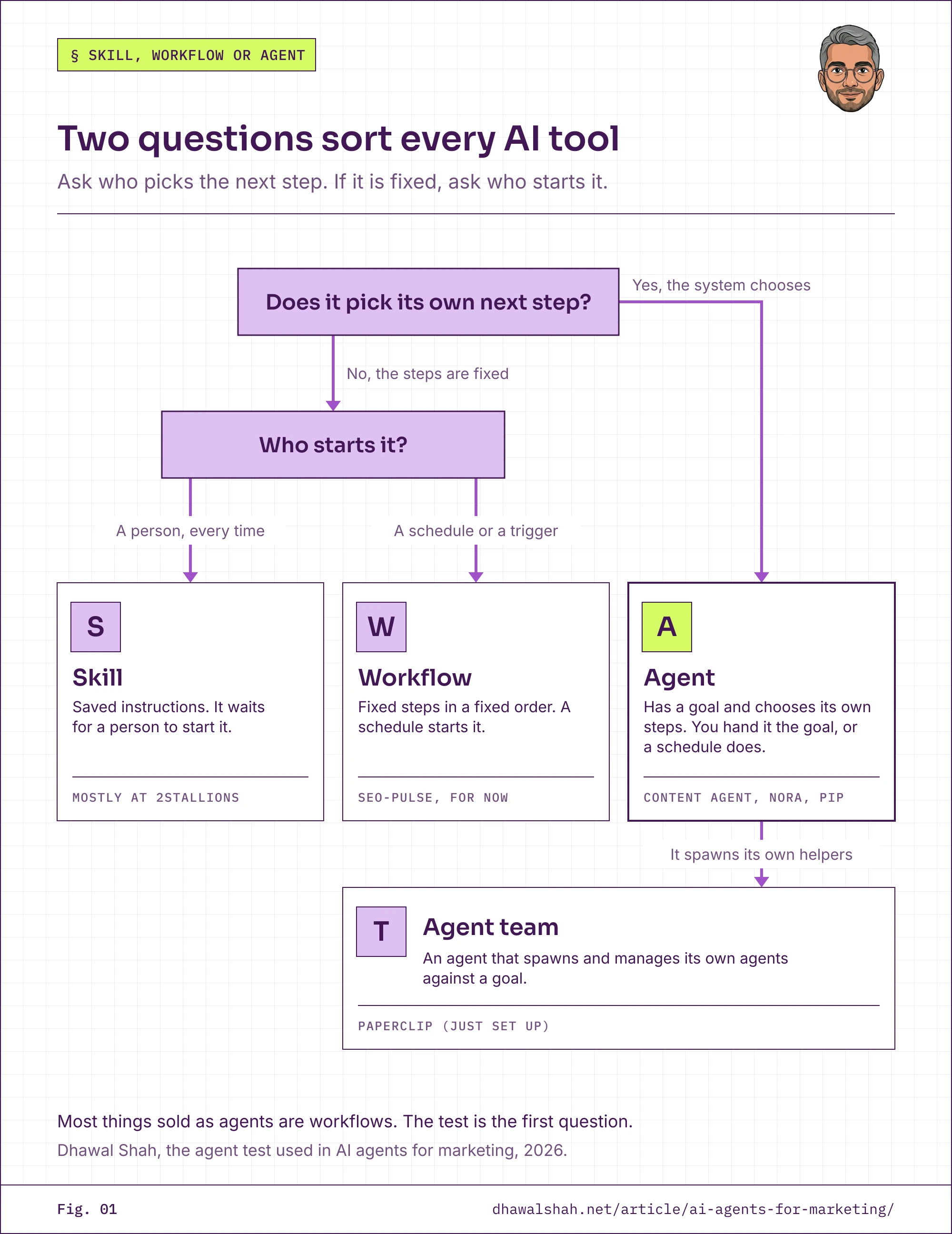
I use one test. Ask who picks the next step.
- If the steps are fixed and a person starts every run, it is a skill: saved instructions that wait to be used.
- If the steps are fixed and a schedule or a trigger starts them, it is a workflow.
- If the system chooses its own next step, it is an agent. You can hand it a goal and let it go off and do the work, as you would with Hermes or OpenClaw. Or a schedule can start it, as with my content agent.
One step further is an agent team: an agent that spawns and manages its own agents against a goal. Paperclip, which I set up recently, works this way.
In 2025, Gartner called the relabelling “agent washing”. It estimated that only about 130 of the thousands of vendors selling agentic AI offer real agentic capability. It also expected over 40% of agentic AI projects to be cancelled by the end of 2027 (Gartner, 2025). I covered the wider definition in AI agents for business, so I will not repeat it here.
Many pages define an agent as software that works with minimal human intervention. I disagree with making that the aim. Less human involvement is something an agent earns over weeks, as its output proves consistent. The section on gates below shows how that played out for me.
Citation capsule
An AI marketing agent has a goal, acts on real tools and chooses its own next step, while a workflow follows fixed steps and a skill waits for a person to start it. Gartner estimates that only about 130 of the thousands of vendors selling agentic AI offer real agentic capability, and expects over 40% of agentic AI projects to be cancelled by the end of 2027. (Gartner, 2025)
Which AI Marketing Agents Do I Actually Run?
I run five systems on my own site and personal brand. Three are agents by the test above. The table gives my verdict on each.
| System | What it does | What starts it | My verdict |
|---|---|---|---|
| Weekly content agent | Researches, plans, makes and schedules videos for a separate brand, then reads the analytics | A schedule, Wednesday night into early Thursday | Agent |
| Nora | Finds forums where I can take part, and writes her own log on this site | Her own schedule | Agent |
| Pip | Suggests and generates my weekly cartoons, and flags urgent email | Itself | Agent |
| seo-pulse | Finds content ideas and checks my rankings each week | A weekly schedule | Workflow, for now |
| Paperclip | Manages a team of agents against goals | Goals I set | Too new to judge |
Mapped to the jobs most pages on this topic list: content and social posts (the weekly content agent and Pip), SEO and reporting (seo-pulse), community and reputation (Nora), inbox triage (Pip) and coordination (Paperclip).
The weekly content agent
Every Wednesday night, into early Thursday morning, an agent runs a separate content brand that is not tied to my name. It researches ideas, plans the week and writes the scripts. It makes the videos with voice, avatar and B-roll tools (ElevenLabs, HeyGen, Higgsfield and fal.ai). It schedules the posts, then pulls the analytics so the next week can learn from what worked.
Under the hood it is a chain of skills, one per stage. The schedule is what makes the whole run an agent, because nobody types the commands. I picked Wednesday because my weekly model usage is nearing its end by then, so the run uses capacity that would otherwise go to waste.
Setup took me two to three hours. It is also the most expensive system I run, because the video tools bill on top of the model plans.
Nora
Nora runs on Hermes, an open-source agent, on a small server. She suggests forums where I can take part and build trust for my personal brand. She also writes her own work log on this site, one entry every two weeks. I read her brief before each log goes up, and that takes two to five minutes. Hermes vs OpenClaw explains how I chose between the two.
Pip
Pip is a ChatGPT agent. It helps me come up with ideas for my weekly cartoons and generates them. It also watches my email. If it thinks something is urgent, it sends me a prompt without being asked. Reviewing one task takes me five to twenty minutes, depending on the task.
seo-pulse
seo-pulse is a scheduled task that runs every week. It surfaces ideas for new content and checks how I am ranking. It pulls data from DataForSEO, Google Search Console and Bing Webmaster Tools. The steps are fixed, so it is a workflow today. I expect it to become more agentic as I trust it more. The method behind it is in agentic SEO with Claude.
Paperclip
Paperclip is a free, open-source app that organises agents like a company, with goals, a ticket system, audit logs and a monthly budget per agent (Paperclip on GitHub). I set it up recently. I still check in on its tasks often. Its goals finish before I have spent much time reviewing them, so my job is shifting from managing agents to reviewing outcomes.
Citation capsule
A solo marketer and founder runs five AI systems on a personal site and brand: a weekly content agent, a forum-finding agent called Nora, a ChatGPT agent called Pip, a weekly SEO workflow called seo-pulse, and the agent manager Paperclip. By a goal, tools and own-next-step test, three are agents, one is a workflow and one is too new to judge. (Dhawal Shah, 2026)
What Does Each AI Marketing Agent Cost to Run?
The tools cost US$5 to 200 a month per system. Model plans add US$367 more, so the whole stack comes to US$529 to 579 a month.
The first table shows the tool spend and my review time for each system. Review time is the cost most vendor pages leave out.
| System | Tool cost per month | My review time |
|---|---|---|
| Weekly content agent | US$150 to 200 (voice, avatar, video, B-roll, scheduling and hosting tools) | 15 to 20 minutes a week, down from 45 to 60 |
| Nora | US$7 (server) | 2 to 5 minutes per log |
| Pip | Nothing extra, it sits inside my ChatGPT plan | 5 to 20 minutes per task |
| seo-pulse | US$5 (data API) | About 40 minutes a week, because it is new and I am fixing issues |
| Paperclip | Not costed yet | Still a lot of check-ins |
The model plans are the second table. I pay for these once, and every system above shares them with the rest of my work.
| Model plan | Per month |
|---|---|
| Claude Max | US$200 |
| ChatGPT | US$100 |
| Kimi | About US$50 |
| DeepSeek | About US$17 (around US$50 a quarter) |
Add the two tables and the whole stack I pay for comes to US$529 to 579 a month. I cannot split the model plans between agents, so the cost of the agents alone is lower than that. I would rather show you the whole bill than guess a split.
For context, my own APAC AI adoption survey in 2026 found that 74% of the 198 businesses that answered spend US$500 a month or less on AI, free tiers included. My stack sits just above that line, with one agent making videos.
I have not measured results in views, rankings or replies for any of these systems. The only number I track is my own review time.
Citation capsule
A solo operator running several AI marketing agents pays US$150 to 200 a month in video and publishing tools for the most expensive one, US$5 for a weekly SEO workflow and US$7 for a small agent server. Shared model plans (Claude Max US$200, ChatGPT US$100, Kimi about US$50, DeepSeek about US$17) bring the whole stack to US$529 to 579 a month. Weekly review time on the largest agent fell from 45 to 60 minutes to 15 to 20 minutes. (Dhawal Shah, 2026)
Where Does Each AI Agent Stop and Ask Me?
One rule covers every system I run: nothing makes a paid call on its own. Past that, each agent has its own gate, and some have loosened.
| System | Where it stops |
|---|---|
| Weekly content agent | Paid steps need evidence first. I spot-check one in seven voiceovers. I accept the art direction as it comes |
| Nora | I read her brief before each log goes up |
| seo-pulse | It reads data from Search Console, Bing and DataForSEO, then reports |
| Pip | Nothing limits its email. It can draft and send replies as me |
| Paperclip | Still being set up |
Pip is the one place where I rely on an agent’s judgement instead of a gate. It is in the table so you can weigh it yourself.
Do the gates stay in place?
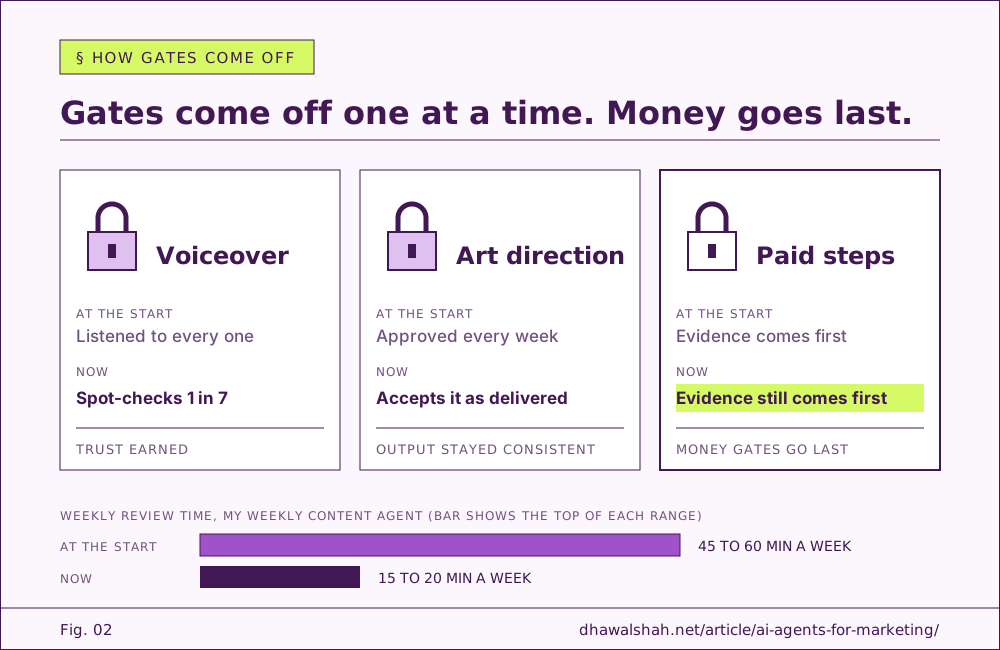
No, and this is the part vendor pages never show. At the start I listened to every voiceover the content agent made. Now I spot-check one in seven. I used to approve the art direction each week. Now I accept it, because the output has stayed consistent. My review time fell from 45 to 60 minutes a week to 15 to 20.
The rule I follow is simple. A gate comes off only after the output has proved consistent over many runs. Gates on spending money come off last, and the paid steps still need evidence before they run. That will stay true for some time.
I keep any gate at all because of what I learned on the LinkedIn agent. On the Marketing Expert Series I said that at every stage “there’s a human judgment that is required, and therefore I still need the agent to stop and ask me for permission… because otherwise the quality of content will degrade” (Marketing Expert Series EP 1, 2026, at 22:00).
Singapore’s PDPC made the same point in September 2026. Its advisory on unauthorised AI tools (PDPC, 30 September 2026) describes an AI-made email script that went live with no testing or human review and listed every customer in the “To:” field. Pip can send replies as me, which is the loosest gate in my stack, so I read that example as a warning about my own setup. The advisory asks for a list of the AI tools in use and a human check before their output goes live. The register table above is my list, and the gates are my check.
Citation capsule
Human review gates on AI marketing agents can loosen once output proves consistent. One operator moved from listening to every AI-made voiceover to spot-checking one in seven, and from approving art direction weekly to accepting it as delivered. Weekly review time fell from 45 to 60 minutes to 15 to 20 minutes. Gates on spending money stay in place and need evidence before any paid step runs. (Dhawal Shah, 2026)
What Broke, and What Did I Switch Off?
One agent is switched off, and another archived most of its own skills by mistake.
The LinkedIn agent
I set out to build a fully autonomous LinkedIn agent on OpenClaw. It refused to work properly, so I shelved it. I then asked what problem I was solving. I built the same job as a Claude Project, and moved it to Claude Code once the steps were stable. The result is the setup in my LinkedIn content engine write-up. The lesson is the quote at the top: start with the problem, not the agent.
Nora’s skill clean-up
Nora ran a maintenance pass on her own skills and archived 57 of her 82 without asking. Twenty-one of those were in active use. A daily backup to git let me see exactly what happened and restore every file. My rules afterwards were that maintenance may propose but not decide, that archiving or deleting needs my approval, and that her setup files change only after I say yes. Nora wrote up the full incident in her own log. The five controls I run now, and a monthly review to keep them honest, are in my guide to AI agent governance.
seo-pulse
It is new, and I am still ironing out its issues. It takes the most review time of any system I run, about 40 minutes a week.
My switched-off list has one agent on it. I would be wary of anyone whose list is empty.
What Do I Still Not Hand to an Agent?
I do not hand over spending money, and I do not hand over positioning. An agent can find ideas, draft scripts and read data. It cannot decide what a brand stands for.
On the same recording I said that brands keep spending on messaging that does not work, and that “you can’t really outspend your positioning” (Marketing Expert Series EP 1, 2026, at 03:00). The same holds for agents. A faster agent running on weak positioning produces more of the wrong thing. Fix the message first, then automate.
Why Does My Agency Run Skills, Not Agents?
At 2Stallions, my Singapore agency, we mostly run skills. A team member starts a skill each time, and a named person owns the result. When a client asks who is accountable for an output, the answer is whoever pressed the button.
The one part of my agent stack that reaches the agency is ad-platform reporting. It connects to the platforms through MCP, a standard way for an AI tool to read another system’s data. I wrote that up in ad platform MCPs with Claude. The wider walkthrough, channel by channel, is in Claude Code for marketing.
Should You Buy a Platform Agent or Build Your Own?
Buy when your data already lives in one marketing platform. Build when the work crosses several tools. I have built, so my view leans that way, and you should discount it.
| Option | Cost shape | Control | Suits |
|---|---|---|---|
| Agent inside a marketing platform | Per seat, per conversation or per credit. Salesforce Agentforce charges US$2 per customer conversation, or US$125 per user per month for internal use (Salesforce, 2026) | Limited to that platform’s data | Teams whose data already sits in that platform |
| Build on Claude or ChatGPT with your own connections | A model plan plus small tool bills, as in the tables above | You set the rules | Work that crosses several tools |
| Self-hosted agent such as Hermes or OpenClaw | A small server, around US$7 a month for Nora, plus model costs | The most control and the most set-up | People happy to maintain a server |
I have not run the platform agents myself. The table uses Salesforce’s published pricing for that row. For the three tiers in more depth, see AI agents for business. For what a private assistant costs to run, see the private AI assistant guide.
How Should You Start With AI Agents for Marketing?
Pick one painful, repeatable job, and do it by hand until the steps stop changing. Then write the steps down as a skill. Run the skill on a schedule as a workflow. Let the system choose its own steps only after that. Add a gate at the end and track the minutes you spend reviewing.
Start read-only. A system that reads your data and reports cannot break anything. For a team of one to five people, the weekly SEO and analytics check is a good first job. Digital marketing analytics shows the method. For a team of twenty or more, start with ad-platform reporting, which is read-only by design.
In 2026, Salesforce reported that high-performing marketers who deploy AI agents reclaim about eight hours a week (Salesforce, Feb 2026). My own number is smaller and easier to check: review time on my biggest agent fell by roughly two thirds.
Frequently Asked Questions
Which AI agent is best for marketing?
It depends on the job and on where your data lives. If your data sits in one platform, that platform’s own agent is the easy start. If your work crosses several tools, a Claude or ChatGPT agent with your own connections gives more control. I run a Claude-based content agent, a Hermes agent called Nora and a ChatGPT agent called Pip, each for a different job.
What can AI agents do for marketing?
They can research ideas, draft scripts and posts, generate images and video, schedule content, read analytics and flag urgent email. Salesforce reports that high-performing marketers who use AI agents reclaim about eight hours a week. They are weakest at deciding what a brand should stand for.
How much does an AI marketing agent cost?
The tools for one agent cost me between US$5 and US$200 a month. The most expensive one makes videos. The model plans cost a further US$367 a month and are shared with other work, so the whole stack I pay for comes to US$529 to 579 a month. Platform agents price differently: Salesforce Agentforce charges US$2 per customer conversation.
Can AI agents replace a marketing team?
Not in my stack. Every system I run has a person reviewing its output, and I have never run one without review. What changed is the review time, which fell from 45 to 60 minutes a week to 15 to 20 minutes on my biggest agent. The judgement about positioning and spending stays with a person.
How do I build an AI agent for marketing?
Start with a problem, not an agent. Do the job by hand until the steps are stable, write them down as a skill, run it on a schedule, and only then let it choose its own steps. Keep it read-only at first, and keep a gate on anything that spends money or goes out under your name.
What Should You Do This Week?
Choose one job you repeat every week, and write down the steps you take. Do not buy an agent yet. Once the steps stop changing, you have a skill, and a skill is the first honest step toward an agent.
I share what I learn from running these agents in my newsletter. Get the next update.