
Why Do Most Claude SEO Setups Fail?
Most Claude SEO setups fail before the agent writes a word, because nobody gave it proper context. It cannot see the business, the customers or the numbers, so it guesses, and it guesses with confidence. A folder of clever prompts stays a folder of prompts. Agentic SEO, the subject of this article, means an AI agent does that work on your own data every week. A person approves what goes live.
The search results for this topic are full of big claims. One Reddit post reports 1.5 million impressions in three months with Claude as “my entire SEO team”. A YouTube video shows a plugin left alone on a website for three months. Neither gives a business owner the thing they need: a way of running SEO that their own team can keep doing.
TL;DR: Agentic SEO means an AI agent does the routine SEO work on your own data, every week, and a person on your team approves what goes live. I run it with the CRAFT framework: Context, Rules, Act, Final say, and Track and learn. Context matters most. The agent widened what my site shows up for over six months. It did not lift rankings, because a new site’s limit is authority, and no agent can earn that for you.
I run a 40-person digital agency in Singapore, and I have run SEO on this site with Claude since it launched in early 2026. This article sets out the framework and the two loops behind it, then what it costs. It ends with a six-month snapshot of my own numbers, flat ones left in.
Key Takeaways
- Agentic SEO is an agent doing SEO work on your data in a loop, with a person approving what ships.
- CRAFT: Context, Rules, Act, Final say, Track and learn. Context does the most work.
- Run two loops: weekly to find and fix, monthly to judge what last month’s changes did.
- Google says to wait “a few weeks” before judging an SEO change, so never judge a change in the week you made it.
- In six months my site’s pages earning impressions rose 120%. Impressions overall fell 6%, and the reasons are below.
What Is Agentic SEO?
Agentic SEO means an AI agent does your SEO work in a loop and a person approves what ships. The agent reads your Search Console numbers, Google’s free report of the searches you appear in, then spots problems, drafts fixes and reports back. All of this runs on your own data, and nothing goes live until someone on your team says so.
The software that does this is often called an SEO agent, or an AI SEO agent. The term is muddled, because “SEO agent” also means a person or agency you hire. Search for it in the US or Singapore and Google shows a map of local SEO agencies next to the software vendors.
So can AI do SEO at all? The routine parts, yes. How much depends on which kind of AI help you have, and three kinds get lumped together:
| Chatbot | SEO tool | SEO agent | |
|---|---|---|---|
| What it does | Answers when you ask | Shows data and scores | Reads data, decides, drafts and acts |
| Who starts it | You, each time | You, each time | A schedule or a trigger |
| Sees your own numbers | Only if you paste them in | Its own data | Your Search Console, analytics and more |
| Can change your site | No | Rarely | Yes, if you let it |
One more thing to clear up. Some writers use “agentic SEO” for a different idea: making your site easy for AI assistants to read and cite. That is generative engine optimisation, and I cover it in the four checks for GEO. Here, the agent is the one doing the SEO.
Citation capsule
Agentic SEO is the use of an AI agent to carry out SEO work on a website’s own data in a repeating loop. The agent reads Search Console and analytics, finds problems, drafts fixes and measures results, and a person approves anything that goes live. It is distinct from generative engine optimisation, which makes pages easy for AI assistants to cite. (Dhawal Shah, 2026)
What Is Claude SEO, and Can Claude Do SEO?
Claude can do SEO work, and Claude Code with your data connected can do it as an agent. Claude Code is the version of Claude that runs on your computer and can use your files and tools. A chat window gives advice. Claude Code can read your Search Console and edit your site files, every week if you schedule it.
“Claude SEO” usually refers to a popular open-source plugin for Claude Code, a set of ready-made SEO skills. A skill is a saved set of instructions Claude follows for one kind of job, such as an audit. That plugin is where I started too. I connected it to DataForSEO, a pay-as-you-go keyword and search results service, and ran its audits on this site.
I did not like the SEO work it produced. It was generic, because it knew nothing about my business and market, or what I had already published. So I wrote my own skills. Then I got tired of opening each platform to make a change. So I built connectors, which Claude calls MCPs, for Search Console, Bing Webmaster Tools, GA4 and Google Tag Manager. Claude now reads and changes those platforms directly.
That path taught me the main lesson of this article. The plugin was never the problem. Skills on their own, however clever, are only prompts. They become something a business can rely on once they have context and written rules behind them, and a person at the approval step. If you want to use Claude Code for SEO yourself, start with the data connections and the rules file. The loop comes after.
I wrote up the wider setup, across every marketing channel, in running marketing from Claude Code. This piece goes deep on SEO only.
Citation capsule
“Claude SEO” most often refers to an open-source plugin of SEO skills for Claude Code. Skills alone produce generic output, because the model knows nothing about the business it is working for. To run SEO as an agent, Claude Code needs the business’s context, live access to Search Console and analytics, written rules, and a person who approves changes before they go live. (Dhawal Shah, 2026)
What Is the CRAFT Framework for Agentic SEO?
CRAFT is a five-part way to run SEO with an agent: Context, Rules, Act, Final say, and Track and learn. You set up each part once, and the parts then run as two loops, one weekly and one monthly. The agent does the acting. The other four parts make the acting safe.
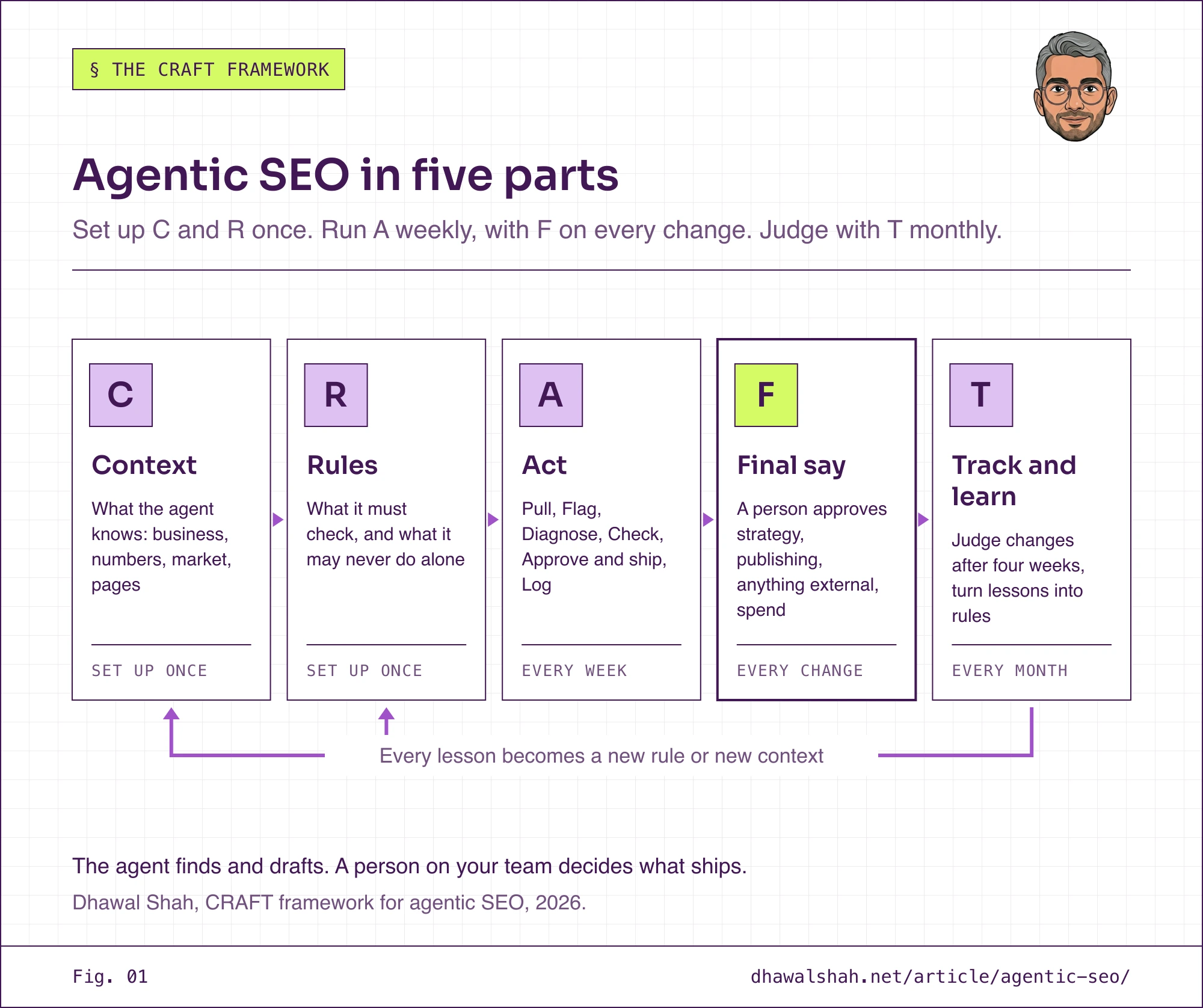
| Letter | Part | What it is |
|---|---|---|
| C | Context | Everything the agent must know about your business and your site before it acts |
| R | Rules | Written instructions it must follow, including what it may never do alone |
| A | Act | The work itself, run as a weekly loop |
| F | Final say | The points where a person on your team must approve |
| T | Track and learn | A log of every change and why, judged monthly, with lessons turned into new rules |
Most agentic SEO tools sell you the “A”. They audit and draft, and some publish. The rest is yours to supply: the context the agent works from, the rules it works under, the person who signs off and the log it learns from. Those parts decide whether the output is any use.
The last part closes the loop. Every lesson from Track and learn becomes a new rule or new context, so the system improves each month instead of repeating its mistakes.
CRAFT sits on top of two ideas I have written about before. The weekly work checks pages against the four checks for AI search: findable, clear, credible and quotable. The monthly review uses the same measure, decide, act, measure again loop I use for AI visibility tracking.
Citation capsule
The CRAFT framework for agentic SEO has five parts. Context is what the agent knows about the business and site. Rules are written limits and checks. Act is the weekly loop of work. Final say is the set of human approval points. Track and learn is a log of changes, judged monthly, with lessons turned into new rules. It runs as a weekly loop and a monthly loop. (Dhawal Shah, 2026)
C Is for Context: What Does an SEO Agent Need to Know?
An SEO agent needs four kinds of context: your business, your performance, your market and your own site. Most setups give it the third and skip the rest, so the output reads as if it could be about anyone. All four live in one file the agent reads at the start of every session, plus live connections for the numbers.

Business context. What you sell, to whom, in which countries, how you want to sound, who your competitors are, and what is off-limits. My file says the site serves founders and directors in Southeast Asia and uses British English. It also says never to publish a claim it cannot source. Without this, an agent will happily recommend keywords for a market you do not sell in.
Performance data. Search Console shows which searches you appear for and where you rank. GA4, Google’s analytics tool, shows what visitors do once they arrive. Bing Webmaster Tools adds a report of how often Bing’s AI answers cite your pages. Connect your own numbers before anyone else’s.
Market data. Search volumes and trends, plus the live search results for a term and a keyword difficulty score (how hard a term is to rank for). I use DataForSEO for this. The trend line matters as much as the volume, as the next section shows.
Site inventory. A list of every page, the search term it targets and its status. It stops the agent, and you, writing a new page that competes with one you already have. The inventory has saved me from doing that once already on this site.
Claude Code reads a file called CLAUDE.md automatically, and that is where the business context sits. Anthropic’s own guidance is to keep it short, because “bloated CLAUDE.md files cause Claude to ignore your actual instructions” (Anthropic).
Citation capsule
An SEO agent needs four layers of context before it acts. Business context covers the offer, customers, markets, voice, competitors and no-go areas. Performance data comes from Search Console, GA4 and Bing Webmaster Tools. Market data covers search volumes, difficulty, trends and live results. A site inventory lists every page and its target term. Without the business layer, agent output is generic. (Dhawal Shah, 2026)
The business context file, the data connection checklist, a site inventory sheet and five starter rules, with my own site as the worked example.
Get the TemplateR Is for Rules: What Should an SEO Agent Never Do Alone?
An SEO agent should never publish or change site-wide settings on its own, and never trust one number unchecked. Rules are written instructions the agent follows every time. Most of mine started as a mistake.

The clearest example concerns a keyword this article targets. In September my agent reported “seo agent” as the largest opening on my board: 27,100 searches a month in the US and “+124% month on month”. A re-check told a different story. The monthly figure swings between about 15,000 and 50,000 with no direction, and the yearly trend is down 33%. The live results also showed that half the searchers want to hire an agency. The agent had read one month’s jump as a trend. That mistake is now a rule: read the full monthly series and the quarterly trend before calling anything rising.
A few more of the rules my agent runs under:
- Check the live search results before trusting a keyword difficulty score. A low score on a search dominated by government or official pages is misleading.
- Never state a percentage without saying what it is a percentage of.
- Never publish anything without a person approving it.
- Never generate pages in bulk.
Write the hard limits as permissions as well as text. Claude Code’s documentation explains that its instruction file is “advisory”, while hooks “are deterministic and guarantee the action happens” (Anthropic). A hook is a small script that runs on its own at a set moment, such as before anything is published. The agent cannot skip it.
The best SEO skill for Claude is your own rules file, sitting on top of whichever skills you start with. A skill written by someone else knows SEO, and only your rules know your business.
A Is for Act: What Does the Agent Do Every Week and Every Month?
The agent runs a six-step loop every week and a two-step review every month. Keeping the two apart matters, because Google says SEO changes take weeks to show.
Google’s own guide says some changes take effect “in a few hours, others could take several months”. It adds that “you likely want to wait a few weeks to assess whether your work had beneficial effects” (Google Search Central). Many published agent loops check results days after a change. That is too soon.
The weekly loop
- Pull. Fetch Search Console, GA4 and Bing data, ending three days before today, because Search Console data “is typically available after 2-3 days” (Google).
- Flag. Fixed rules mark candidates: pages ranking 8 to 20, pages losing impressions over 28 days, two pages competing for one search.
- Diagnose. The agent looks only at flagged pages and drafts one change for each.
- Check. A second pass scores each draft and checks every fact before a person sees it.
- Approve and ship. A person approves or rejects it, editing first if needed. The agent notifies Bing, and a person asks Google to recrawl the page (called requesting indexing) in Search Console.
- Log. Record what changed, why, what should happen, and the date to judge it.
The monthly review
- Judge. For each change at least four weeks old, compare 28 days before and after. Keep it, undo it or try again.
- Learn. Turn each lesson into a new rule or new context.
Once a quarter, compare three months against the three before, which matches Google’s own advice for reading traffic changes: compare “last 3 months to previous period” (Google Search Central).
The structure follows Anthropic’s advice on building agents: fixed steps where you can (the model is free only inside a step) and a second call to evaluate the first (Anthropic). A skill I call seo-pulse runs my weekly loop, and a deeper seo-audit skill feeds the monthly review.
Citation capsule
An agentic SEO loop runs at two speeds. Weekly, the agent pulls data ending three days back, flags candidates by fixed rules, drafts one change per page and checks it. The change ships after human approval and is logged with a judge date. Monthly, changes at least four weeks old are judged on 28-day windows. Google advises waiting “a few weeks to assess” any SEO change. (Google Search Central, 2025)
F Is for Final Say: Where Must a Person Approve?
A person must approve four things: the strategy, anything published, anything outside the site, and any spending. The agent finds problems and drafts fixes. Your team decides what ships.
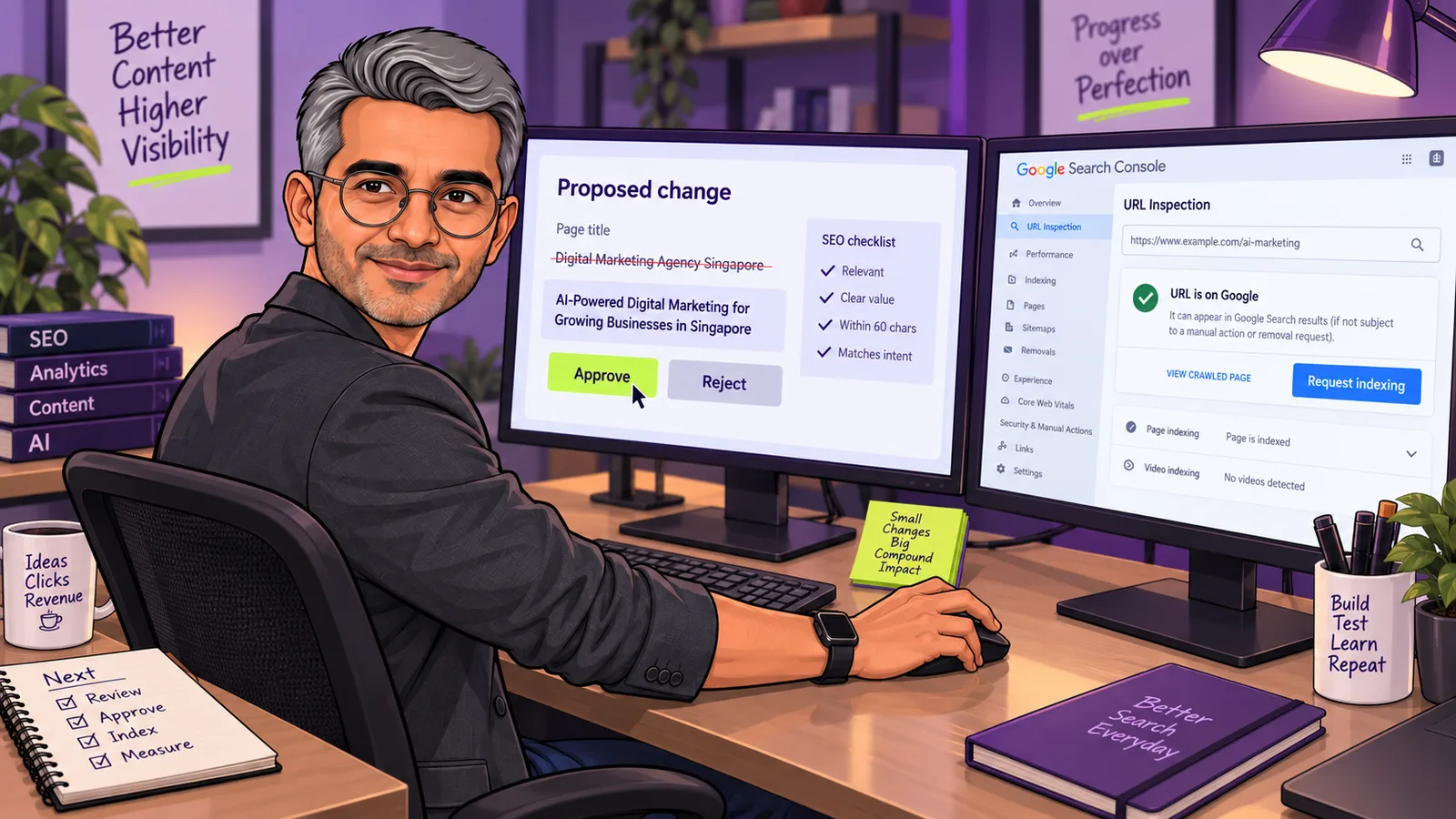
Google is explicit about the publishing step: “It is critical to manually factcheck and review all AI-generated content for accuracy and trustworthiness before publishing” (Google Search Central). Its spam policy goes further. The first example it gives of scaled content abuse is “using generative AI tools or other similar tools to generate many pages without adding value for users” (Google Search Central). An agent left alone to produce pages is heading straight for that policy.
There is one step only a person can do. After a change goes live, request indexing for that page in Search Console’s URL Inspection tool. Google’s API can check a page’s index status but cannot request a recrawl, so this stays manual. Do it once per page. Google says “requesting a recrawl multiple times for the same URL won’t get it crawled any faster” (Google Search Central).
This is also why I disagree with the “left it alone for three months” approach. A business is better served by an agent that does the legwork and leaves the judgement calls to the people accountable for them. On my site, nothing goes live without my approval, and I post and send everything external myself.
Change one thing per page per review window, too. A new title can take “a few days to a few weeks” to show, because Google has to recrawl the page first (Google Search Central). Stack two changes and you cannot tell which one worked.
T Is for Track and Learn: How Does the System Get Better?
It gets better by logging every decision with its reason, then turning every mistake into a rule. Without the log, an agent repeats the same error next month with the same confidence.

My log records four things for each change: what changed, why, what I expect to happen, and when to judge it. Mine is a plain text file with a dated entry each week. The monthly review reads that log rather than my memory. Anthropic recommends exactly this for long-running agents. A model’s “ability to accurately recall information” falls as its working memory fills, so notes should be kept “outside of the context window” (Anthropic).
The rules in the section above all came out of the log:
- The trend rule came from the “seo agent” mistake, where one month’s jump was read as a rise.
- The search results rule came from chasing a keyword with a low difficulty score that turned out to be a search for a government document. Nobody but the government ranks for it.
- The denominator rule came from a survey report on this site that once divided by all respondents when only some had been asked the question. The published figures were wrong until a check caught it.
Each of those cost time once, and the log is what stops them costing it again. Your agent will keep making mistakes. The point of the T is that they should be new ones.
Does Agentic SEO Work? A Six-Month Snapshot
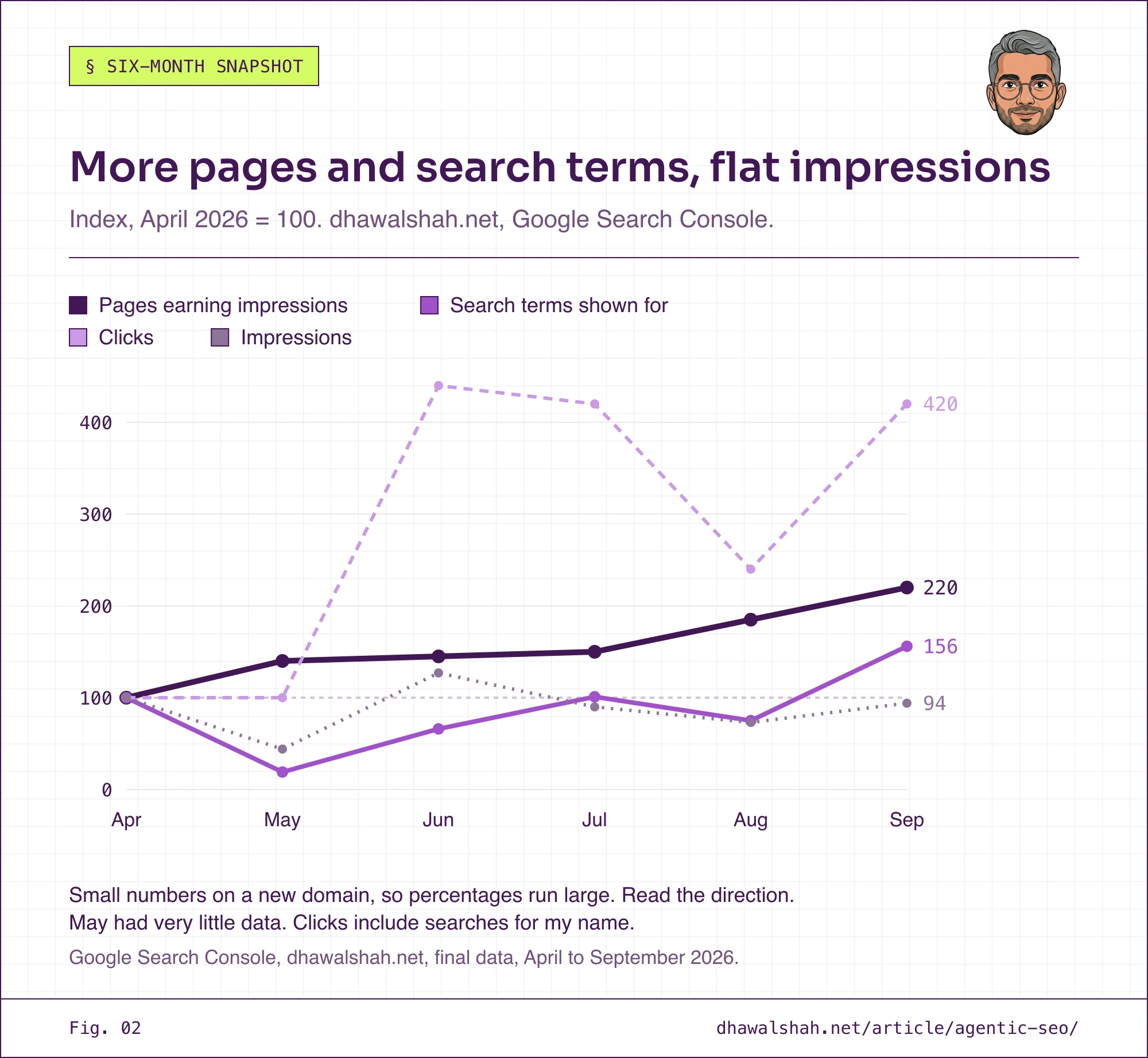
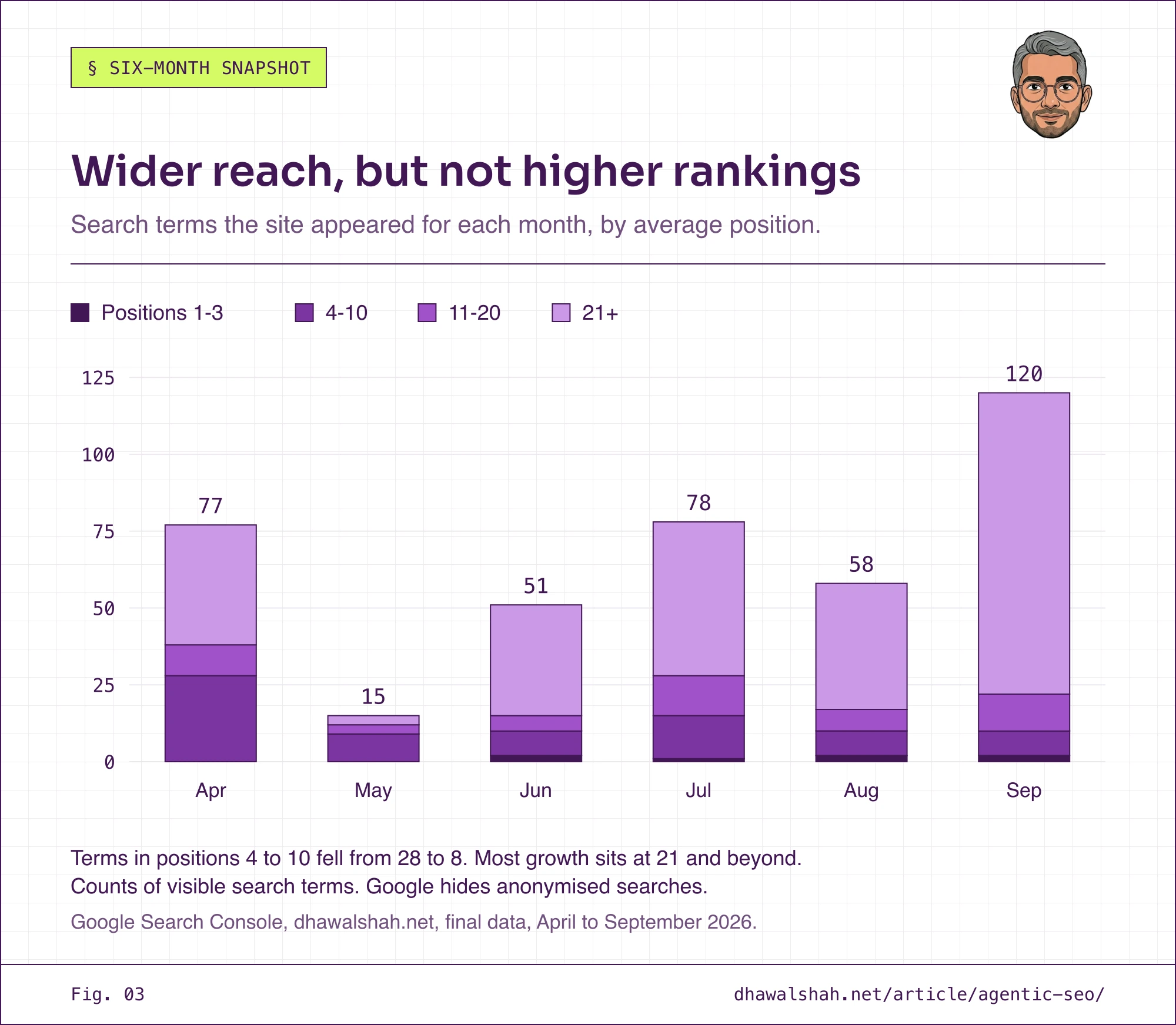
Partly, because the agent widened what my site shows up for without lifting rankings onto page one. Here is the snapshot for April to September 2026, from Search Console.
| Measure | April to September 2026 |
|---|---|
| Pages earning impressions | +120% (rose every month) |
| Search terms the site appears for | +56% |
| Clicks | +320% |
| Impressions | -6% |
| Search terms ranking 4 to 10 | down from 28 to 8 |
These are percentages on a small base. This is a new domain, so a few extra clicks make a big percentage. Much of the click growth is people searching for my name. Treat the direction as the signal and the size as noise.
Two things pulled impressions down, and neither was the agent. First, demand vanished. Searches for “openclaw install” fell 89% from April to August, and “openclaw security” fell 92%. My OpenClaw guides held their rankings but had far fewer people to show to. Second, I lost a ranking I could not hold. My ad platform MCP article slipped from about position 10 to 14 while searches for its topic rose. The results for “google ads mcp” now open with an AI Overview built on Google’s own official server. An AI Overview is the AI-written summary at the top of Google results. Vendors selling connectors come next.
The wins that are not clicks matter too. In a Bing Webmaster Tools export in August, one plain explainer, AI fluency for directors, took 52% of the page-level AI citations Bing reported for the site.
The missing page-one gains come down to authority. This site has about one relevant referring domain, meaning one other relevant site linking to it. An agent can do the work. It cannot make other sites link to you.
A note on proof. A small site cannot run a real SEO experiment. SearchPilot, which runs SEO split tests, sets 1,000 organic visits a day to the tested pages as its minimum (SearchPilot). What I have is a pattern. Proof would need far more traffic than this site has.
Citation capsule
In a six-month snapshot (April to September 2026) of a new domain run with an agentic SEO loop, pages earning Google impressions rose 120% and visible search terms rose 56%. Total impressions fell 6%, and terms ranking in positions 4 to 10 fell from 28 to 8. The causes were collapsing demand for one topic and official vendor pages outranking another. The agent widened coverage but could not build authority. (Dhawal Shah, 2026)
Should You Build It In-House, Buy a Tool, or Have It Built?
Build it in-house if someone on your team will own the weekly loop. Buy a tool if you want speed and accept its limits. Have it built if you want your own system without the setup work.
| DIY with CRAFT | SEO agent product | SEO agency | CRAFT built for you | |
|---|---|---|---|---|
| Typical cost | Your time and tools | Often around US$99 a month | Often S$1,500 to S$10,000 a month in Singapore | S$3,490 flat, then optional support |
| Who owns the system | You | The vendor | The agency | You |
| Who acts on findings | Your team | Your team | The agency | Your team |
| Knows your business | As much as you tell it | Only what its settings allow | Yes | Yes, from the build |
| Main weakness | Needs time and SEO skill | Generic, and you cannot see inside it | You rent the work and the know-how | Your team still has to do the work |
On agency fees, Singapore agencies’ own 2026 pricing guides put typical retainers for small and mid-sized businesses at roughly S$1,500 to S$10,000 a month (Hashmeta, 2026; MediaOne, 2026). Both are agencies, so read the range with that in mind. Ahrefs’ survey of SEO providers worldwide found an average of US$2,917 a month (Ahrefs, 2024).
The running cost of doing it yourself is smaller than most people expect. My keyword data and the servers for my connectors cost under US$2 a month. The real cost is the Claude plan. I use the Max 20x plan. It covers all my work, SEO included, so SEO uses a small share of it.
From running an agency, I know where an agency still earns its fee: on links and PR, and by being the one accountable for results. An agent takes the routine analysis off their plate and leaves those where they were.
If you want the system without the setup, I build CRAFT for your business in about two weeks, for a flat S$3,490. It runs on your own Claude and DataForSEO accounts, and I help you create them, so you own everything. Support after that costs S$490 or S$990 a month, billed quarterly. Your team acts on what it finds. If you want someone to run it for you, that is agency work, through my digital marketing agency.
Frequently Asked Questions
What is agentic SEO?
Agentic SEO is the use of an AI agent to do SEO work on your own website data in a repeating loop. The agent reads Search Console and analytics, finds problems, drafts fixes and measures results. A person approves anything before it goes live. It differs from generative engine optimisation, which is about making your pages easy for AI assistants to cite.
Can Claude do SEO?
Yes. Claude Code can do SEO work as an agent when it has your business context and written rules, plus live access to Search Console and analytics. The chat version of Claude can give SEO advice but cannot see your data or change your site. In both cases a person should approve changes before they go live, as Google advises for all AI-generated content.
What is the best SEO skill for Claude?
The best SEO skill for Claude is your own rules file, written for your business and placed on top of whichever skills you start with. Ready-made skills know general SEO practice but nothing about your market or the pages you already have. I started with a popular open-source plugin and replaced it with my own skills once the output proved too generic.
What is an SEO agent?
An SEO agent is software, usually built on a large language model, that reads your search data, decides what to work on, drafts changes and reports back on a schedule. The same phrase also means a person or agency you hire for SEO, so a search for it shows local agencies next to software vendors.
How much does it cost to run an SEO agent?
Running one yourself can cost very little beyond your AI plan. My keyword data and connector servers cost under US$2 a month, plus a Claude plan that covers all my work, SEO included. Packaged SEO agent products often charge around US$99 a month. A done-for-you build of the CRAFT framework is a flat S$3,490, with optional support from S$490 a month.
What is the 80/20 rule in SEO?
The 80/20 rule in SEO says a small share of the work drives most of the results. With an agent, the split is easy to see. The agent can take over most of the routine work, such as audits, reports, drafts and fact checks. The small share that moves rankings most, earning links and making judgement calls, still needs people.
What Should You Do First?
Write the business context file this week. One page: what you sell, to whom, in which markets, how you want to sound, and what the agent may never do. Then connect your own Search Console before you pay for any other data. An agent with that much context already does better work than most plugins straight out of the box. Every other part of CRAFT builds on it.
Start with the context file. Get the agentic SEO context template, or have me build CRAFT for your business.