§ Cartoon 28 October 2026

The Future of Shopping

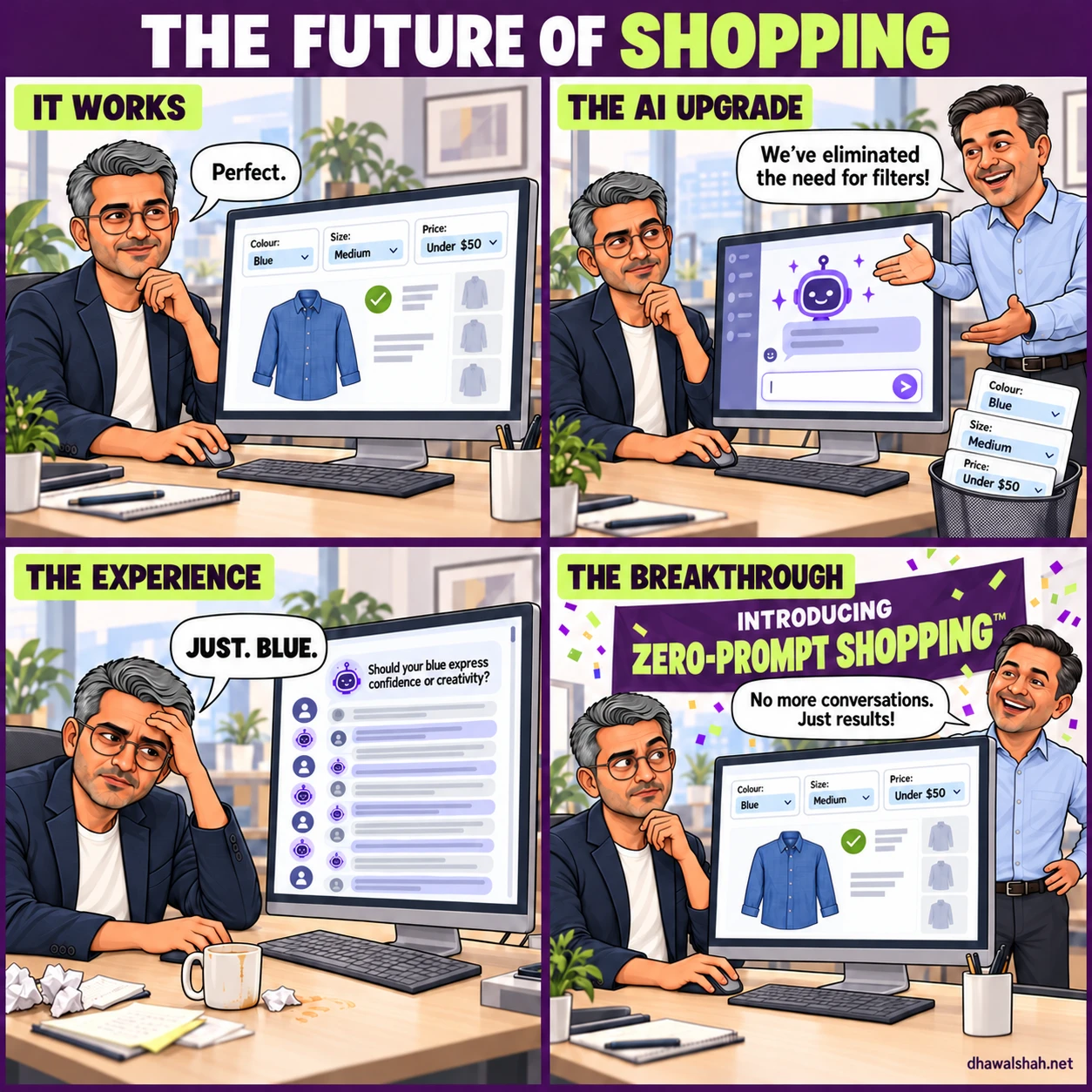
Four-panel cartoon titled The Future of Shopping. Panel one, it works: Dhawal Shah sits at his desk looking at a shopping site with three filters set to colour blue, size medium and price under 50 dollars, a blue shirt with a green tick on screen, and says perfect. Panel two, the AI upgrade: a smiling colleague in a light blue shirt gestures at the screen, now an AI chat window with a robot icon, and says we've eliminated the need for filters, while the three filter boxes sit in a wastepaper bin. Panel three, the experience: Dhawal holds his head among crumpled paper and a spilt coffee mug, facing a long chat thread in which the robot asks should your blue express confidence or creativity, and he says just. blue. Panel four, the breakthrough: under a purple banner reading introducing zero-prompt shopping, with confetti, the colleague announces no more conversations, just results, while Dhawal looks sideways at a screen showing the same three filters and the same blue shirt from panel one.
Fig. 01The strip

First, we had three filters that found exactly what we wanted. Then we replaced them with an AI assistant that needed fifteen questions to understand "blue shirt". Finally, we proudly reinvented the filters and called it Zero-Prompt Shopping™. Not everything needs AI. Sometimes we're adding complexity to problems we've already solved.

Link copied successfully
AI chatAI hypeAI adoptionmarketing
§ TranscriptPanel by panel

Title bar. "THE FUTURE OF SHOPPING", with SHOPPING picked out in lime.

Panel 1 - "IT WORKS". A bright office with plants. Dhawal, in a navy blazer over a white T-shirt, sits at his desk with his hand on his chin. On the monitor, a shopping page has three dropdown filters: "Colour: Blue", "Size: Medium", "Price: Under $50". A blue shirt sits beside a green tick. He says "Perfect."

Panel 2 - "THE AI UPGRADE". A colleague in a light blue shirt stands beside the desk, smiling and gesturing at the screen. The monitor now shows a chat window with a purple robot icon and an empty message box. He says "We've eliminated the need for filters!" In a wastepaper bin beside him sit the three filter boxes: "Colour: Blue", "Size: Medium", "Price: Under $50". Dhawal looks at the screen, unconvinced.

Panel 3 - "THE EXPERIENCE". Dhawal slumps with one hand pressed to his forehead. The desk is covered in crumpled paper, notes and a coffee mug with a spill. On the screen, a long chat thread runs down the page, alternating between his messages and the robot's. At the top, the robot asks "Should your blue express confidence or creativity?" He says "JUST. BLUE."

Panel 4 - "THE BREAKTHROUGH". Confetti falls around a purple banner reading "INTRODUCING ZERO-PROMPT SHOPPING™". The colleague beams, hand on hip, and says "No more conversations. Just results!" Dhawal glances sideways at his monitor, which shows the same three filters, "Colour: Blue", "Size: Medium", "Price: Under $50", and the same blue shirt with a green tick from the first panel.

§ 01Behind the strip

The idea behind the cartoon

We’re so eager to add AI to everything that we’re sometimes making perfectly good experiences worse.

Imagine shopping online for a blue shirt.

You know exactly what you want. Blue. Medium. Under $50.

Three filters later, you’ve found it.

Simple, effective and requiring almost no thought.

Now imagine the retailer decides its shopping experience needs an AI upgrade.

The filters disappear. In their place is a conversational shopping assistant.

Instead of selecting your preferences, you’re answering questions about your personal style, the occasion you’re shopping for and whether your choice of blue should communicate confidence or creativity.

You just wanted a shirt.

AI doesn’t automatically mean better

There’s a growing temptation to insert AI into every customer journey and business process.

Sometimes that’s justified. AI can help customers discover products when they don’t know what they want, compare complicated options or navigate large catalogues.

But when the customer’s intent is already clear, a conversation can become an unnecessary obstacle.

We’ve taken something that required three clicks and turned it into a multi-step interaction.

That’s not necessarily innovation. It may simply be added friction.

Are we solving problems or demonstrating AI adoption?

This goes beyond online shopping.

Businesses are under pressure to demonstrate that they’re adopting AI. New assistants, agents and conversational interfaces are increasingly visible signs of innovation.

But visibility isn’t the same as value.

A chatbot that replaces a perfectly functional form isn’t automatically an improvement. Neither is an AI agent that requires more supervision than the original task.

The question shouldn’t be, “Where can we add AI?”

It should be, “What problem are we trying to solve, and is AI the best way to solve it?”

Sometimes the answer will be a sophisticated AI agent.

Sometimes it’ll be a simple automation.

And sometimes it’ll be the dropdown menu we already had.

The best AI might be the AI you don’t notice

I’m not arguing against conversational shopping or AI-powered interfaces.

They have genuine applications, particularly when users need guidance, personalisation or help making complex decisions.

But they should complement effective experiences rather than replace them unnecessarily.

If AI can make finding the right product faster, easier or more accurate, use it.

If it turns a three-click task into a fifteen-message conversation, reconsider.

Successful AI adoption isn’t measured by how much AI we deploy. It’s measured by how much better we make the experience.

And sometimes, the smartest AI decision is not to use AI at all.
Dhawal Shah
Dhawal Shah

14 years building businesses across Asia. Co-founded 2Stallions (40+ person agency), launched ChutneyAds (AI-powered ad network), and has worked with 30+ startups as advisor and investor. He draws these between building things.

§ The vault Free · twice a month

The prompts, templates and checklists I actually use.

Twice a month I send what I built, what it cost and what broke. Subscribers get the whole vault, free.

  • 01Prompts and agent rules
  • 02Templates and checklists
  • 03Real numbers from my builds

No spam. Unsubscribe in one click.