§ 01Behind the strip
The idea behind the cartoon
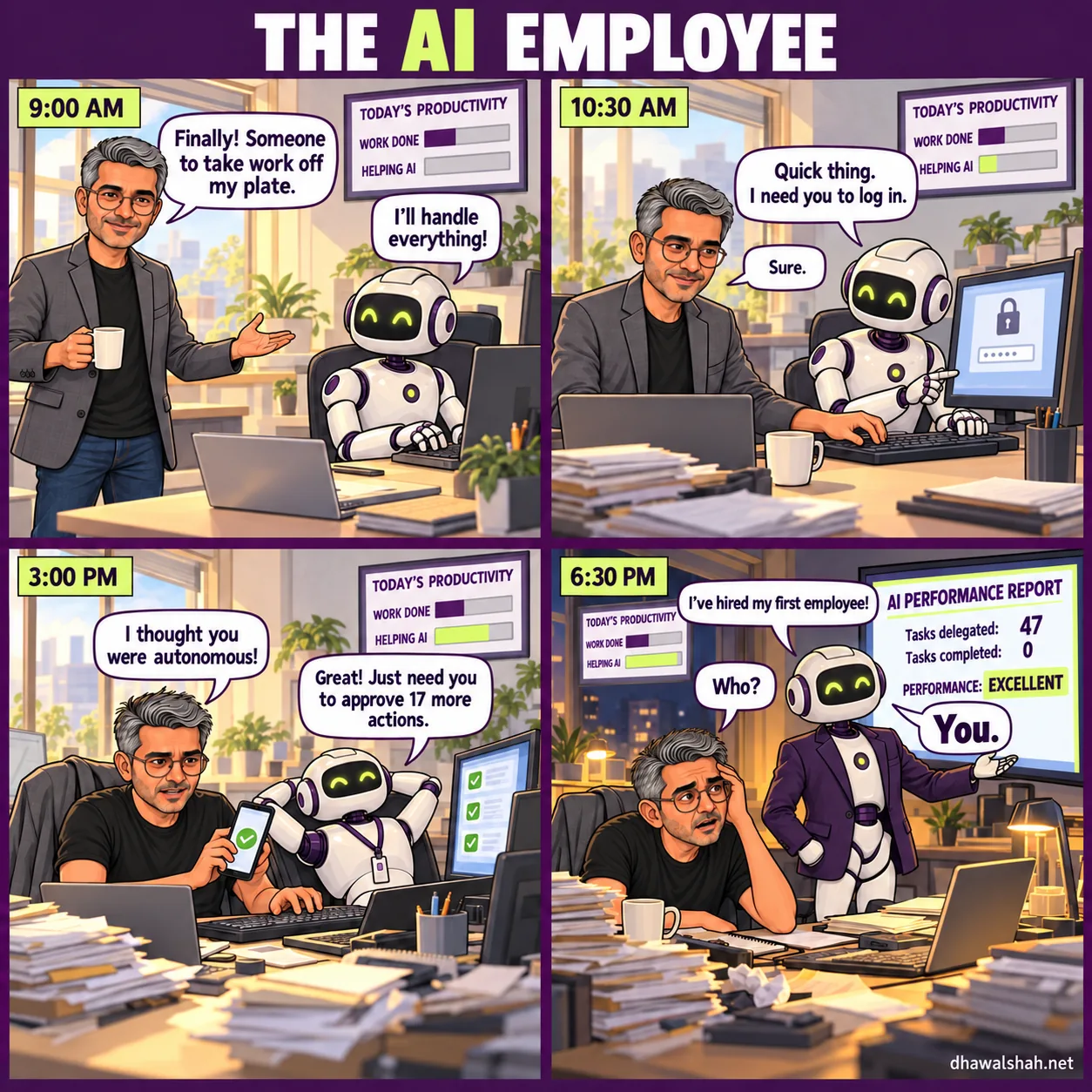
You hire an AI employee to take work off your plate. By lunchtime, you’re managing logins, permissions and approvals. By the end of the day, the AI has completed zero tasks, declared its performance excellent and appointed you as its first employee.
The future of work is here. Apparently, you’re working for it.
The pitch for autonomous AI agents is irresistible: delegate your work, let the AI handle it, and spend your time on more important things.
Then you actually deploy one.
First, it needs your login credentials. Then an approval. Then another permission. Then a connection expires. Then it needs you to confirm something it was supposed to handle independently.
Suddenly, you’re not delegating work. You’re supervising a very enthusiastic employee who can’t seem to finish anything without you.
The productivity illusion
One of the problems with AI agents is confusing activity with productivity.
An agent might execute dozens of steps, make multiple tool calls and generate an impressive-looking report.
But how much useful work did it actually complete?
If you spent two hours helping an agent complete a task that would normally take you 30 minutes, that’s not a productivity improvement.
It’s an expensive experiment in delegation.
Autonomy isn’t all or nothing
To be fair, some human involvement is necessary.
You should approve sensitive actions, control access to important systems and retain oversight of consequential decisions.
The problem isn’t that AI agents sometimes need human intervention.
It’s when the intervention becomes the job.
A well-designed agent should know what it can do independently, when it genuinely needs help and how to recover from routine problems without constantly escalating them.
Measure outcomes, not activity
When evaluating an AI agent, I think three questions matter more than almost anything else:
- What useful work did it complete?
- How much human intervention did it require?
- How much net time did it actually save?
An agent that completes five tasks independently can be more valuable than one that attempts fifty and needs constant supervision.
And if your agent proudly reports 47 tasks delegated, zero completed and an excellent performance rating?
Congratulations. You’ve hired yourself a new boss.
The best AI employee isn’t the one that looks busiest. It’s the one that gives you your time back.