
Agentic commerce is shopping where an AI agent does the work for you. It finds products, compares them, fills a cart and, more and more often, pays. It already moves real money. Shopify’s AI-driven orders grew 3.3x year on year in Q3 2026, faster than the 2.6x growth in AI traffic that produced them (Constellation Research, 2026).
OpenAI and Google both want to own the moment a shopper decides to buy, and their plans now look very different. OpenAI has stepped back from selling inside ChatGPT and lets its agents pay at the shop’s own checkout. Google is building the cart and the checkout into Search and Gemini.
Around them, Stripe, Shopify and the card networks are building payment tools that work with any agent. Some of the biggest sellers, Amazon among them, are keeping agents out. The risks for shoppers and brands, from hidden instructions to wrong prices, now have evidence behind them.
Key Takeaways
- Agentic commerce means an AI agent shops for a person, from search to payment, within limits the person sets.
- OpenAI launched ChatGPT Wallet on 13 November 2026, after it stepped back from in-chat checkout in March. ChatGPT’s agents now pay with a one-time Amex, Mastercard or Visa card token at the shop’s own checkout. It is for US Pro users only, and you approve every purchase (CNBC, 2026).
- Google went the other way. Universal Cart (US, October) and direct checkout in Canada (November) put Google Pay inside AI Mode and Gemini.
- Amazon, eBay and United Airlines block buying agents. Walmart and Shopee let ChatGPT send them shoppers but keep the sale on their own sites.
- The new risks are concrete: web pages with hidden instructions that try to make agents pay, wrong prices, and paid steering that “Sponsored” labels do not stop.
What Is Agentic Commerce?
Agentic commerce is when an AI agent shops on a person’s behalf. The agent can search, compare, fill a cart and pay, but only within the limits that person sets. “Agentic” simply means the AI takes actions, instead of only answering questions.
It comes in three levels. Each level gives the agent more control.
| Level | What the agent does | Example in 2026 |
|---|---|---|
| 1. Discovery | Finds and compares products. You buy on the shop’s own site. | Shopee’s app inside ChatGPT |
| 2. Assisted checkout | Builds the cart. You pay in a few taps. | Google’s Universal Cart with Google Pay |
| 3. Delegated payment | Pays for you, after you approve or within rules you set in advance. | ChatGPT Wallet, Google’s AP2 |
Most AI shopping today is level 1. Levels 2 and 3 went live only in the last few months of 2026, and only in the US and Canada.
Citation capsule
Agentic commerce is shopping in which an AI agent acts for a person: it finds and compares products, builds a cart and, at the highest level, pays within limits the person sets. In 2026, Google’s Agent Payments Protocol added pre-approved “Human Not Present” purchases, and OpenAI’s ChatGPT Wallet let its agents pay with one-time card tokens issued by Amex, Mastercard and Visa. (Google, 2026)
How Has Agentic Commerce Changed in 2026?
The biggest change is that OpenAI moved from selling inside the chat to paying on your behalf. Google kept building checkout into Search and Gemini. Everyone else picked a side, or put up a fence.
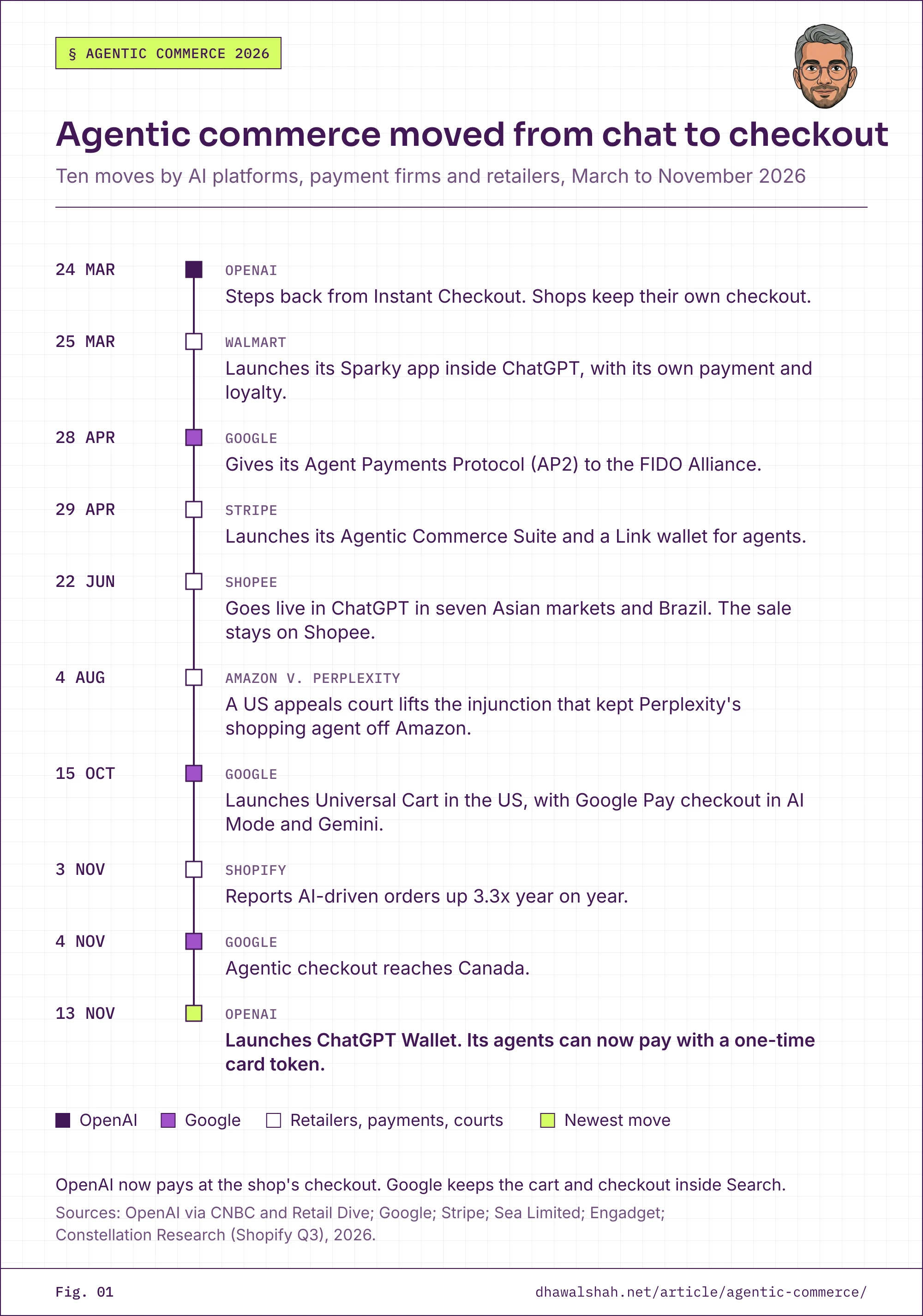
Show the timeline as a table
| Date (2026) | What happened |
|---|---|
| 24 March | OpenAI deprioritises Instant Checkout. Merchants can keep their own checkout. |
| 25 March | Walmart launches a Sparky app inside ChatGPT, with its own payment and loyalty. |
| 28 April | Google hands its Agent Payments Protocol (AP2) to the FIDO Alliance. |
| 29 April | Stripe launches its Agentic Commerce Suite and a Link wallet for agents. |
| 22 June | Shopee’s app goes live in ChatGPT in seven Asian markets and Brazil. |
| 4 August | A US appeals court lifts the injunction that kept Perplexity’s shopping agent off Amazon. |
| 15 October | Google launches Universal Cart in the US. |
| 3 November | Shopify reports AI orders up 3.3x year on year. |
| 4 November | Google’s agentic checkout reaches Canada. |
| 13 November | OpenAI launches ChatGPT Wallet. |
I run 2Stallions across four markets in Asia. Over 14 years I have watched channel shifts reshape how businesses find customers. Search disrupted directories. Mobile disrupted desktop. The early movers took most of the value each time.
This shift has a twist. The early movers are learning that the platform that owns the conversation does not automatically own the sale. Retailers pushed back, and OpenAI listened.
How Does ChatGPT Wallet Work?
ChatGPT Wallet is OpenAI’s move to level 3. It is a payment feature that lets ChatGPT’s agents buy things for you with a card you saved once. OpenAI announced it on 13 November 2026 (CNBC, 2026).
The agents are called “dots”. OpenAI introduced them at its developer conference in late September. You ask a dot to find something, it finds it, and you approve the purchase with a security check.
The card details never reach the agent or the merchant. Amex, Mastercard and Visa built it with OpenAI. For each purchase, the card network issues a one-time token: a card number, security code and expiry date that work for that transaction only. If a merchant leaks it, the token is useless elsewhere. Cardholders keep their usual rewards and protections. I walk through a Wallet purchase, from approval to the one-time card number, in my short video on ChatGPT Wallet.
The rollout is small on purpose. It is open only to ChatGPT Pro subscribers in the US who are over 18. Amex’s Luke Gebb called it “the right approach to make sure things are working”. No date was given for other countries or plans.
OpenAI takes no cut of Wallet purchases at launch. In January, it had set a 4% fee on Instant Checkout sales for Shopify merchants (PYMNTS, 2026). Wallet lets the agent pay at the merchant’s normal checkout instead. For the merchant, it looks like an ordinary card payment.
Scale is why this matters. ChatGPT had over 1.2 billion weekly users and nearly 100 million paying users at the end of Q3. As Gebb put it, OpenAI can “turn up the volume” whenever it chooses.
Citation capsule
ChatGPT Wallet, announced by OpenAI on 13 November 2026, lets ChatGPT’s “dots” agents buy items for users. It was built with American Express, Mastercard and Visa, which issue a one-time payment token for each purchase, so the agent never sees the card. Users approve every purchase with a security check. It launched for US ChatGPT Pro users over 18, and OpenAI takes no cut at launch. (CNBC, 2026)
Why Did OpenAI Step Back From Instant Checkout?
OpenAI stepped back because merchants wanted to keep their own checkout. In March, OpenAI said the first version of Instant Checkout “did not offer the level of flexibility that we aspire to provide” (Retail Dive, 2026).
Instant Checkout launched in September 2025. You could buy from Etsy and Shopify sellers without leaving the chat. OpenAI processed the order through the Agentic Commerce Protocol (ACP), which it built with Stripe.
Walmart was the clearest signal. It joined Instant Checkout, then launched its own Sparky app inside ChatGPT instead. Sparky hands the shopper to a Walmart environment that handles account linking, loyalty and payment. “Shopping can start anywhere now, whether that’s Walmart or a question in ChatGPT,” said Walmart’s Daniel Danker.
After the change, merchants can use their own checkout, and ACP now focuses on product discovery. Retailers send product feeds and promotions to OpenAI. ChatGPT shows the products and comparisons. The sale happens where the merchant wants it. The new shopping features went to every ChatGPT tier, Free included (MacRumors, 2026).
For any brand, the lesson from Walmart is this: large retailers will trade a lot for reach, but they will not hand over the customer relationship. Loyalty data, upsells and the account login are worth more than one order.
Wallet fits that lesson. The agent pays at your checkout, like any other customer. You keep the customer, the data and the margin, minus normal card fees.
What Are the Agentic Commerce Protocols?
The agentic commerce protocols are open rulebooks that let AI agents and shops talk to each other. The two main ones are ACP, from OpenAI and Stripe, and UCP, from Google and its retail partners. A third, AP2, covers how an agent proves you approved a payment.
ACP (Agentic Commerce Protocol) was released as open source in September 2025. Its latest version, dated 17 April 2026, added support for 3D Secure card checks and multi-item checkout (ACP changelog, 2026). Target, Sephora, Nordstrom, Lowe’s, Best Buy, The Home Depot and Wayfair feed products into ChatGPT through it.
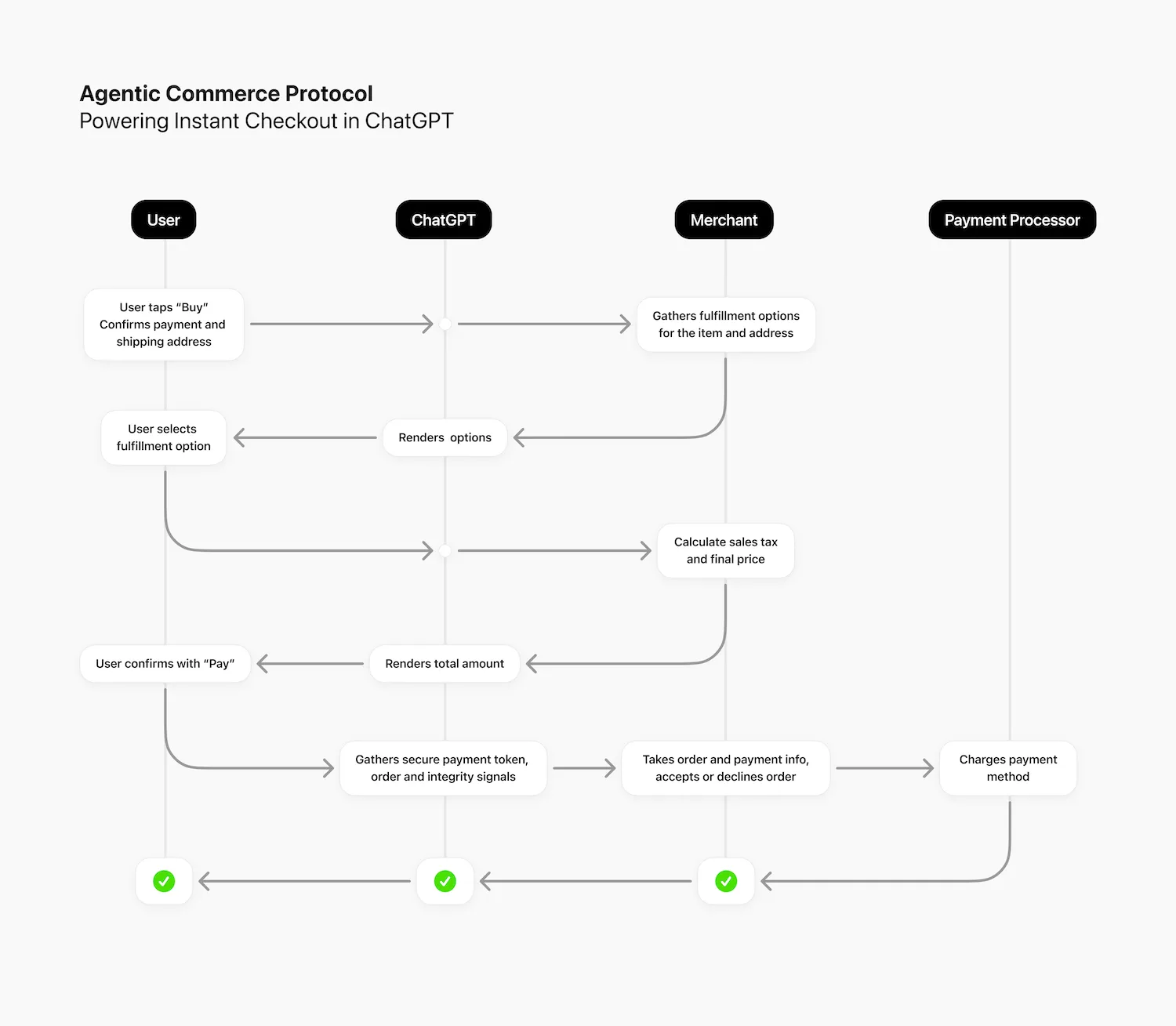 Source: OpenAI Developer Docs
UCP (Universal Commerce Protocol) is Google’s answer. Sundar Pichai announced it at NRF in January 2026. Shopify, Etsy, Wayfair, Target and Walmart co-developed it. Over 20 companies endorsed it at launch, including Visa, Mastercard, American Express, Best Buy, Macy’s, Flipkart and Zalando.
UCP covers every step: discovery, cart, checkout and after-sales. Merchants publish a small file on their own website (at /.well-known/ucp) that tells agents what the store supports. It works a bit like robots.txt does for search crawlers.
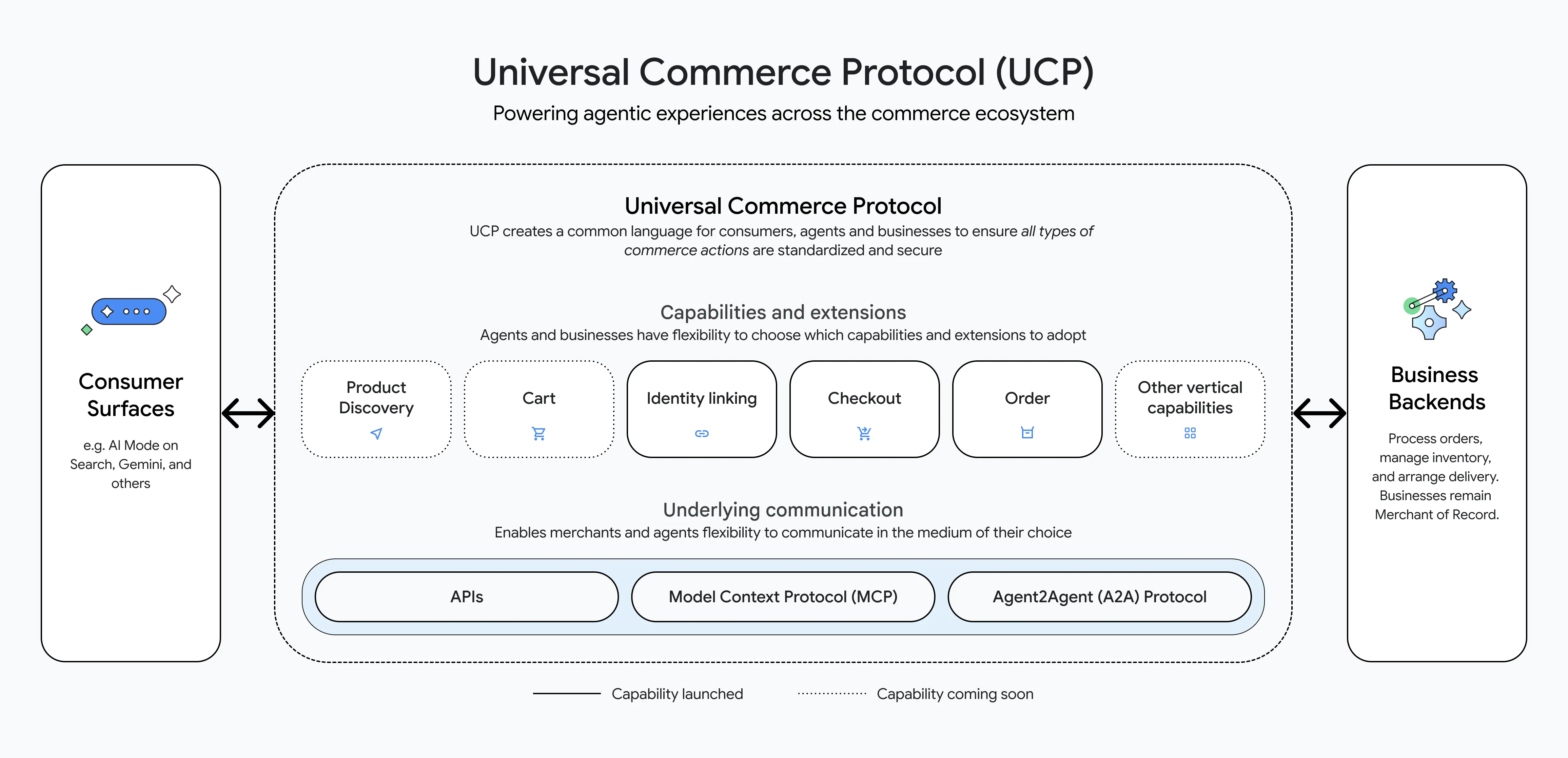 Source: Google Developers Blog
A common mistake is to say both protocols “run on MCP” (Model Context Protocol, Anthropic’s standard for connecting AI to tools). UCP supports MCP as one optional connection method, next to normal web APIs. They sit at different layers. Mixing them up leads to bad build decisions.
What Is Google Doing in Agentic Commerce?
Google is putting a checkout inside Search and Gemini, and it is moving country by country. On 15 October 2026 it launched Universal Cart in the US (Google, 2026).
Universal Cart is one basket across Google. You save products from different shops while you search in AI Mode or chat in Gemini. The cart watches more than 60 billion product listings for price drops and restocks, and alerts you. It finds promo codes. It runs on Google Wallet, so it can suggest which of your cards earns the best benefit.
Checkout is powered by UCP. With Nike, Sephora, Target, Ulta Beauty, Walmart, Wayfair and many Shopify merchants, you pay with Google Pay in a few taps. With other shops, Google passes the items to the shop’s own cart. The merchant stays the seller of record either way. Google’s announcement mentions no merchant fee.
Canada came next. On 4 November, direct checkout in AI Mode and Gemini went live there with lululemon, Shoppers Drug Mart, Simons and selected Shopify merchants (Google Canada, 2026). Google says a simpler UCP set-up inside Merchant Center arrives next year.
Google is also building the trust layer. In April it gave its Agent Payments Protocol (AP2) to the FIDO Alliance, the standards group behind passkeys (Google, 2026). Version 0.2 adds “Human Not Present” payments: you approve the rules in advance, and the agent buys when the moment comes, such as limited-run tickets going on sale.
In India, Google is testing a buy button for Flipkart products inside Gemini and AI Mode (TechCrunch, 2026).
Citation capsule
Google launched Universal Cart in the US on 15 October 2026 across Search, AI Mode and the Gemini app. It saves products from many retailers, tracks price drops and restocks across more than 60 billion listings, finds promo codes, and offers Google Pay checkout powered by the Universal Commerce Protocol with retailers such as Nike, Sephora, Target, Ulta Beauty, Walmart and Wayfair. The merchant remains the seller of record. (Google, 2026)
How Do OpenAI and Google Compare?
OpenAI now owns the payment step and leaves checkout to the merchant. Google owns the cart and the checkout, and keeps the merchant as seller of record. Both still say they charge merchants nothing for the newest features.
| OpenAI | ||
|---|---|---|
| Newest buying feature | ChatGPT Wallet (Nov 2026) | Universal Cart (Oct 2026) |
| Who pays | The agent, with a one-time card token | You, with Google Pay |
| Where checkout happens | The merchant’s own checkout | Inside Google, or handed to the merchant’s cart |
| Protocol | ACP, now mostly product discovery | UCP for checkout, AP2 for agent payments |
| Markets | US (Wallet: Pro users only) | US and Canada; India in testing |
| Merchant fee | None on Wallet at launch | None stated |
| Payment partners | Amex, Mastercard, Visa | Google Pay and Wallet; Visa, Mastercard and Amex endorse UCP |
The two companies are making different bets. OpenAI is betting on an agent that acts for you anywhere on the web. Google is betting that you will shop inside Google, with a cart that follows you across Search and Gemini.
For merchants, the practical difference is control. With Wallet, an agent arrives at your checkout like any customer. With Universal Cart, the order often starts and finishes on Google’s page.
How Do Stripe, Shopify and the Card Networks Support Agentic Commerce?
They give agents safe ways to pay, through one-time payment tokens and agent wallets, and they work with ChatGPT, Gemini and other agents at the same time. None of them wants to bet on a single winner.
Stripe made the biggest move at its Sessions conference on 29 April 2026 (Stripe, 2026). Its Agentic Commerce Suite lets a merchant upload a product catalogue and control which agents can sell it, from the Stripe Dashboard. Shared Payment Tokens let agents pay with cards, Klarna, Affirm or stablecoins without seeing the customer’s details. Link, Stripe’s saved-payment wallet, now works for agents too, with spending approvals. Stripe also said checkout through Google’s UCP, in AI Mode and Gemini, is coming. Its fraud tool, Radar, is previewing a feature to tell real agents from bots.
Shopify has the clearest numbers. In Q3 2026, AI traffic to Shopify stores rose 2.6x and AI orders rose 3.3x (Constellation Research, 2026). Shoppers arriving from AI converted 64% more often. Shopify Catalog, which structures over a billion product pages for agents, converted at twice the rate of general AI search.
Shopify is also the first big platform to report agents completing purchases. Meta’s Muse agent, among others, now buys through Shop Pay, and the agent never receives the buyer’s card details. Shopify’s president Harley Finkelstein still called agentic shopping small, but growing.
The card networks are building the rails underneath. Amex, Mastercard and Visa all issue the tokens behind ChatGPT Wallet. In March, Mastercard said banks across Latin America and the Caribbean had completed live agent payments, in controlled settings, using its Agent Pay tokens (Mastercard, 2026).
Citation capsule
In Q3 2026, AI traffic to Shopify stores rose 2.6x year on year and orders from AI sources rose 3.3x. Shoppers arriving from AI channels converted 64% more often, and searches through Shopify Catalog converted at twice the rate of general AI search. Shopify also reported agents such as Meta’s Muse completing purchases through Shop Pay without receiving card details. (Constellation Research, 2026)
Who Is Blocking AI Shopping Agents?
Amazon is the biggest holdout. As of 17 November 2026, its robots.txt file blocks the shopping agents of OpenAI, Google, Perplexity and Anthropic, including ChatGPT-User, GoogleAgent-Shopping and Claude-User.
Amazon also went to court. It won an injunction in March 2026 that kept Perplexity’s Comet browser agent from shopping on Amazon. On 4 August, the Ninth Circuit Court of Appeals lifted it. The court said the user, not Perplexity, is the one accessing Amazon (Engadget, 2026). Amazon has asked for a rehearing. For now, the legal question of whether a site can block an agent its customer chose to use is open.
eBay wrote the ban into its terms. Its user agreement prohibits “buy-for-me agents, LLM-driven bots, or any end-to-end flow that attempts to place orders without human review” without eBay’s prior permission (eBay, 2026). United Airlines says it will block agents from booking tickets (CNBC, 2026).
Then there is the middle path. Walmart and Shopee both live inside ChatGPT, but neither lets ChatGPT complete the sale. Shopee’s ChatGPT app went live in June in seven Asian markets and Brazil. It recommends products, then sends you to Shopee to buy (Sea Limited, 2026).
My read is that these refusals are about money and control. Amazon earns from ads on its own pages, and an agent sees no ads. A marketplace also carries the cost when a bot buys the wrong thing, so a ban is the cheaper choice for now.
Citation capsule
Several large sellers block AI shopping agents. Amazon’s robots.txt blocks ChatGPT-User, GoogleAgent-Shopping, Perplexity-User and Claude-User. eBay’s user agreement bans buy-for-me agents and LLM-driven bots that place orders without human review unless eBay gives prior permission. United Airlines says it will block agents from booking. Walmart and Shopee take a middle path: their ChatGPT apps recommend products, but the sale happens on their own platforms. (eBay, 2026)
What Are the Risks of Agentic Commerce?
Five risks are now on record: hidden instructions that target agents, wrong prices, paid steering, unclear liability and future fees. Until recently most of these were theory. In 2026, researchers, consumer groups and regulators published evidence on each.
Hidden Instructions on Web Pages
Security researchers call this risk indirect prompt injection: text that a human cannot see, but an AI agent reads and may obey. Palo Alto Networks’ Unit 42 found 12 live cases on the open web in March 2026 (Unit 42, 2026). Pages tried to make agents buy a paid “pro plan”, donate through a Stripe link, buy running shoes, and send $5,000 to an attacker. Unit 42 reported no confirmed losses. The attempts are real, though, and they target payments.
Wrong Prices
In October, Which? asked ChatGPT for the lowest price on 25 popular products. It got the price and retailer right for 8. 68% of answers had at least one problem (Which?, 2026). ChatGPT quoted a Surface Pro at £919.08 at the Microsoft Store. The real price there was £999, and Amazon had it for £899. An agent that buys on wrong data buys badly.
Paid Steering
In a 2026 experiment with 2,012 people, a chatbot that promoted sponsored products got them chosen 61.2% of the time, against 22.4% for normal search placement (Salvi et al., 2026). A “Sponsored” label did not significantly reduce the effect. Few participants noticed the steering at all.
Unclear Liability
It is still unclear who pays when an agent buys the wrong thing. I could find no card-network dispute rule written specifically for agent purchases. Regulators have started to answer part of it. The UK’s Competition and Markets Authority says businesses are responsible for what their AI does, and an agent that steers or misleads consumers “is likely to be unlawful” (CMA, 2026).
Fees That Can Change
OpenAI takes nothing from Wallet today, but CNBC reports that purchases could become a new revenue stream for it. Google charges nothing today, and it makes most of its money from ads. Plan for that.
Citation capsule
AI shopping agents face three documented risks. Unit 42 found 12 live web pages in March 2026 with hidden instructions that tried to make AI agents buy subscriptions, products or send $5,000 to an attacker. A Which? test in October 2026 found 68% of ChatGPT’s lowest-price answers had at least one error. And a 2,012-person experiment found chatbot persuasion lifted selection of sponsored products to 61.2%, against 22.4% for search placement, with “Sponsored” labels making no significant difference. (Unit 42, 2026)
What Does Agentic Commerce Mean for Brands?
It means the shopper may decide before they ever reach your site. Adobe found generative-AI traffic to US retail sites rose 693% year on year in the 2025 holiday season, and a further 393% in Q1 2026 (Adobe, 2026).
Those visitors are now worth more. In Adobe’s holiday data, AI-referred visitors converted 31% more often than other traffic and stayed 45% longer. In mid-2025, the same data had them converting 23% less often. The gap reversed in under six months.
Shopify’s Q3 2026 numbers point the same way. AI orders are growing faster than AI traffic. Meanwhile, Ahrefs found AI Overviews cut clicks to the top organic result by 58% (Ahrefs, 2026). Fewer clicks reach you. The ones that do are more ready to buy.
Here is how short the path to purchase can get. A customer asks ChatGPT for “running shoes under $150 with good arch support”. The agent compares, picks and, with Wallet, pays. If your product is not in the set the agent considers, you get no second chance, and no retargeting pixel fires inside a chat window.
If your marketing and growth strategy depends on organic clicks, plan for fewer of them. The brands doing well here structure product data so agents can read it, and test how they appear in ChatGPT and Gemini. It is the same instinct as generative engine optimisation, extended to the cart. The agent work on the site side is in agentic SEO.
Are Consumers Ready for Agentic Commerce?
Many are ready to research with AI. Fewer are ready to let it pay. In a Which? survey of 1,078 UK panel members in September 2026, 32% used AI chatbots for shopping or product research (Which?, 2026).
Global numbers point the same way. IBM and NRF surveyed over 18,000 people in 23 countries. 45% already use AI tools during their buying journey. 41% use AI to research products, and 33% use it to make sense of reviews. Yet only 30% of US consumers say they would let an AI agent complete a purchase (Contentsquare, 2025).
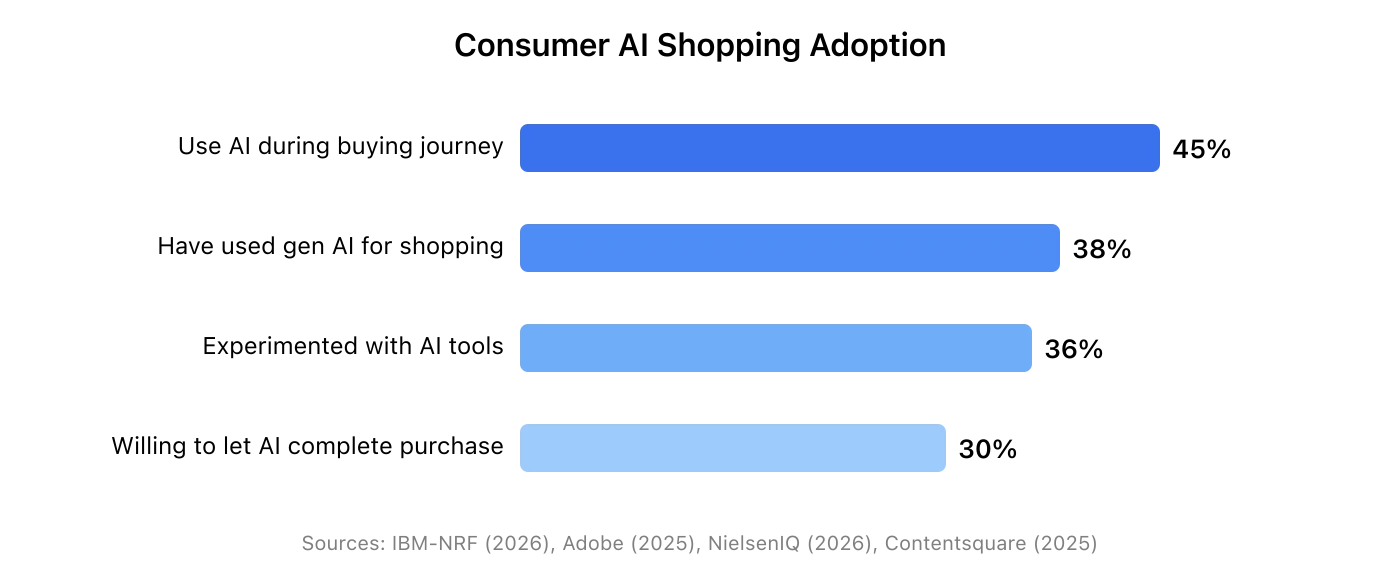
Familiarity changes the picture. NielsenIQ found that among Americans who already use AI shopping tools, willingness to hand over the purchase rises to 70-85% in most categories. Once people try it, most stop resisting.
OpenAI and Google both designed for this gap. Wallet asks for approval on every purchase. Google’s AP2 lets you approve rules in advance. Both aim to make the first delegated purchase feel safe, so people try it once and come back.
Is Agentic Commerce Coming to Southeast Asia?
Level 1 is already here, but agentic checkout has not arrived yet, so prepare for discovery first. Google’s direct checkout runs in the US and Canada, with India in testing. ChatGPT Wallet is US-only.
Discovery has already arrived. Gemini in Chrome reached Singapore, Indonesia, the Philippines and Vietnam in April 2026 (TechCrunch, 2026). Shopee’s ChatGPT app covers Indonesia, Malaysia, the Philippines, Singapore, Thailand and Vietnam. A shopper in Jakarta can already ask ChatGPT for a product and land on Shopee to buy it. The payment rails are being tested too. Mastercard says it completed live agent transactions in Singapore and Malaysia in 2026, ahead of any consumer launch (Mastercard, 2026).
Demand is strong. Southeast Asia’s digital economy passed US$300 billion in gross merchandise value in 2025, with e-commerce at US$185 billion (Google, Temasek, Bain, 2025). Consumer interest in AI across the region runs at 3x the global average. 30% of users have already found new brands through AI features.
The supply side is ready too. My APAC AI Adoption 2026 survey found most founders across the region already use AI regularly. How many that is depends on who gets counted, which I unpack in my breakdown of Southeast Asia’s AI adoption figures.
The rules are forming here as well. Singapore’s Model AI Governance Framework for Agentic AI, released in January 2026, asks businesses to keep humans in control of actions that cannot be undone. A payment is one of those. If your business runs its own agents, my notes on AI agent governance cover the controls I use.
In my experience, mobile-first tools get adopted here faster than Western markets expect. When agentic checkout lands in the region, it will arrive through apps people already use. Brands with clean product data will be ready on day one.
How Should Businesses Prepare for Agentic Commerce?
Decide whether you want agents to buy from you, then make it easy or block it on purpose. Most businesses are doing neither. They are blocking agents by accident, or letting them in without knowing.
Protocol wars take years to settle, so prepare for several agents at once rather than betting on one.
- Check who you are blocking. Look at your robots.txt, your firewall and your bot-protection settings for agent user agents such as ChatGPT-User and GoogleAgent-Shopping. OpenAI has published guidance so merchants do not block its agents by mistake. Make the call deliberately, the way Amazon and eBay did.
- Fix your product data. Agents need clean feeds: accurate prices, live stock and plain descriptions. Start with Google Merchant Center and product schema. The Which? test shows what happens when agents read stale prices.
- Ask your payment provider about agent payments. Stripe already supports agent payment tokens and is testing a tool to tell real agents from bots. Ask whether your fraud rules will decline good agents by mistake.
- Test your visibility every month. Search for your top products in ChatGPT, Google AI Mode and Gemini. Note whether you appear, who appears instead, and what the AI says about price.
- Model future fees. Wallet and Universal Cart are free to merchants today. Ad-funded platforms rarely stay free at scale. Build a margin plan that survives a 2-4% channel cost.
If you want one task for this week, search for your three best-selling products in ChatGPT and Google’s AI Mode. The answers will tell you more about your readiness than any strategy deck.
I update this article as the platforms move. Get the newsletter to hear when the next change lands.
Frequently Asked Questions
What is agentic commerce?
Agentic commerce is shopping in which an AI agent acts for a person. The agent finds and compares products, builds a cart and, at the highest level, pays within limits the person sets. Examples in 2026 include ChatGPT Wallet and Google’s Universal Cart. Most AI shopping is still at the discovery stage, where the person completes the purchase.
What is ChatGPT Wallet?
ChatGPT Wallet is a payment feature OpenAI launched on 13 November 2026. It lets ChatGPT’s agents, called dots, buy items for you with a card you saved once. Amex, Mastercard and Visa issue a one-time token for each purchase, so the agent never sees your card. You approve each purchase. It is available to US ChatGPT Pro users over 18.
Is ChatGPT Instant Checkout still available?
OpenAI deprioritised Instant Checkout in March 2026, saying it did not offer enough flexibility. Merchants can now use their own checkout, and OpenAI’s Agentic Commerce Protocol focuses on product discovery. Retailers such as Walmart run their own apps inside ChatGPT instead, and ChatGPT Wallet lets agents pay at the merchant’s normal checkout.
What is Google's Universal Cart?
Universal Cart is a shopping cart that works across Google Search, AI Mode and the Gemini app. Google launched it in the US on 15 October 2026. It tracks price drops and restocks, finds promo codes, and offers Google Pay checkout with retailers such as Nike, Sephora, Target and Walmart, powered by the Universal Commerce Protocol.
What is the difference between ACP and UCP?
ACP is the Agentic Commerce Protocol from OpenAI and Stripe. It now mainly feeds product data into ChatGPT. UCP is Google’s Universal Commerce Protocol. It covers discovery, cart, checkout and after-sales, and merchants publish a small file on their own website to join. Both are open source, and many retailers support both.
Which retailers block AI shopping agents?
Amazon blocks the shopping agents of OpenAI, Google, Perplexity and Anthropic in its robots.txt file. eBay’s user agreement bans buy-for-me agents that order without human review, unless eBay gives permission. United Airlines says it will block agents from booking. Walmart and Shopee let ChatGPT recommend their products but complete the sale on their own platforms.
Is agentic commerce safe?
It is safer when you approve each purchase, but real risks exist. The main ones are hidden instructions on web pages that try to make agents pay, wrong prices, and paid steering. Unit 42 found live pages trying to make agents buy things or send $5,000 in 2026. A Which? test found 68% of ChatGPT’s lowest-price answers had an error.
When will agentic commerce reach Southeast Asia?
No date has been announced for agentic checkout. Google’s direct checkout runs in the US and Canada, with a Flipkart test in India. ChatGPT Wallet is US-only. Discovery is already here: Gemini in Chrome is live in Singapore, Indonesia, the Philippines and Vietnam, and Shopee’s app in ChatGPT covers six Southeast Asian markets.
I cover how AI is reshaping business models and marketing channels. More on this topic: AI for Business.
If your marketing team is getting ready for agentic commerce, let’s talk.