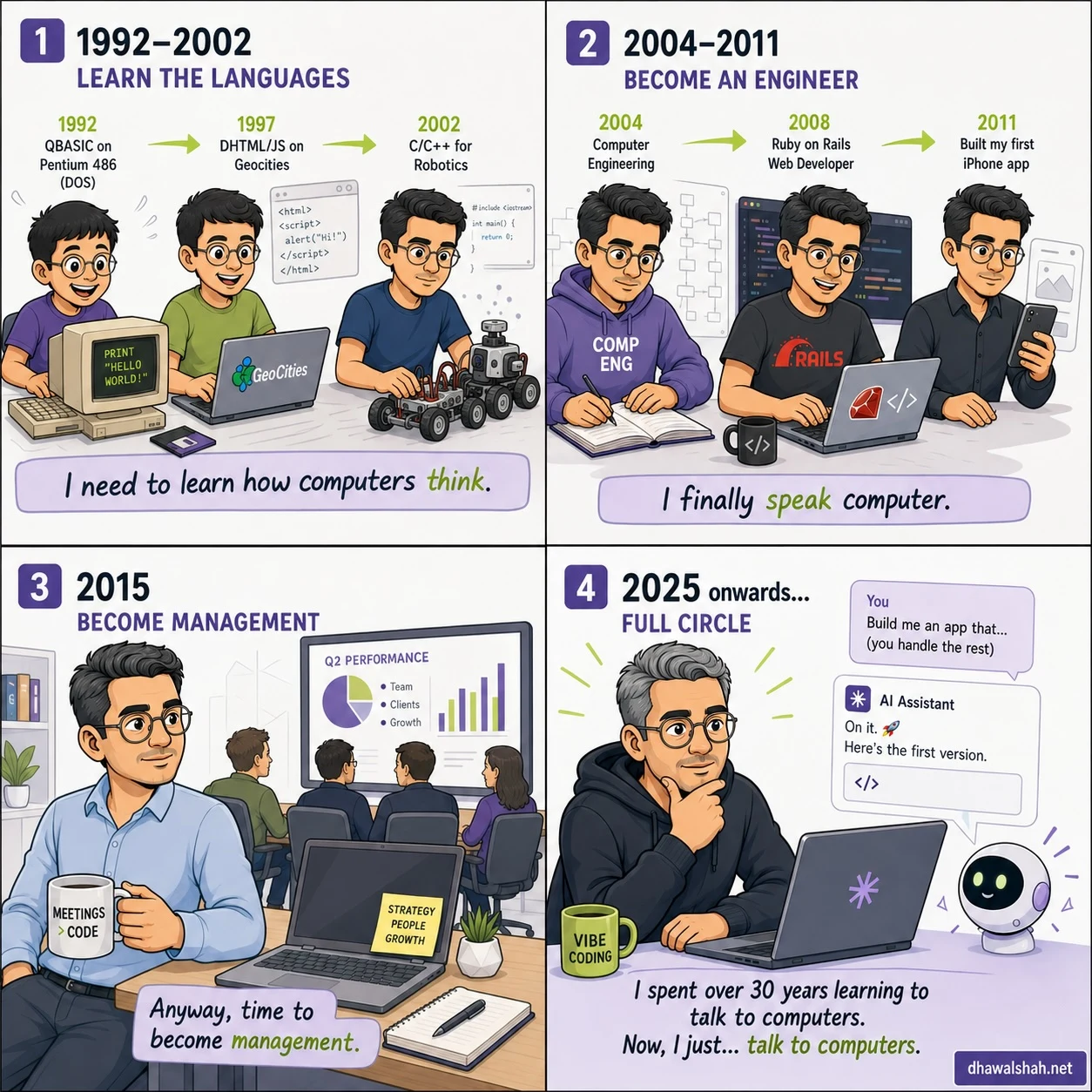
QBASIC, Geocities, C++, a Computer Engineering degree, Rails, an iPhone app, then management. Three decades of learning to speak machine, and the current state of the art is asking in plain English.
Panel-by-panel transcript
Panel 1 - 1992 to 2002: Learn the languages. Three stages of a young Dhawal side by side. In 1992 he sits at a beige Pentium 486 running QBASIC on DOS, green text on the screen reading PRINT "HELLO WORLD!", a floppy disk on the desk. In 1997 he is at a laptop showing a Geocities page with a block of DHTML and JavaScript beside it. In 2002 he is bent over a small wheeled robot trailing wires, a window of C and C++ open behind him. Caption: "I need to learn how computers think."
Panel 2 - 2004 to 2011: Become an engineer. In 2004 he takes notes over an open textbook in a purple "Comp Eng" hoodie, flowcharts on the wall behind him. In 2008 he types at a dark code editor in a Ruby on Rails t-shirt, a mug marked with a code bracket beside him. In 2011 he holds up a phone next to a laptop bearing a Rails logo, app mockups pinned behind. Caption: "I finally speak computer."
Panel 3 - 2015: Become management. Now in a shirt rather than a tee, he sits at the head of a meeting room holding a mug that reads "MEETINGS > CODE". A screen behind him shows a Q2 Performance dashboard with pie and bar charts labelled Team, Clients and Growth, and four colleagues watch it. A yellow sticky note on his laptop reads "STRATEGY PEOPLE GROWTH". Caption: "Anyway, time to become management."
Panel 4 - 2025 onwards: Full circle. Greying, in a black hoodie, chin resting on his hand, he watches his laptop beside a green mug reading "VIBE CODING". A chat panel floats to the right: his own message reads "Build me an app that... (you handle the rest)", and below it an AI Assistant replies "On it. Here's the first version." with a code block. A small friendly robot sits on the desk. Caption: "I spent over 30 years learning to talk to computers. Now, I just... talk to computers."
The idea behind the cartoon
Someone asked me recently when I stopped coding. The honest answer is that I never did, but the thing I mean by coding has been replaced about four times.
In 1992 it was QBASIC on a Pentium 486, printing “Hello World” to a DOS prompt and feeling like I had discovered fire. By 1997 it was DHTML and JavaScript on a Geocities page. In 2002 it was C and C++ for robotics, which is where I learned that a computer does exactly what you say and nothing you meant.
All of it was one project: working out how the machine thinks. You did not hand a computer an outcome in 1997. You broke the outcome into steps small enough that a machine could not misunderstand them, and then you typed the steps out.
The degree, the Rails work, the first iPhone app in 2011, that was the payoff. Somewhere in there I stopped translating and started thinking in the syntax.
Then I moved into management, which is its own kind of language problem. The mug in panel three is the most autobiographical object in this cartoon.
And now the tools have arrived at the place I started from. I open a laptop, write “build me an app that does this, you handle the rest” in plain English, and something on the other side breaks it into steps small enough that a machine cannot misunderstand them.
That step still happens. It just does not happen in my head any more.
People usually reach the same conclusion two drinks into this conversation, which is that the thirty years were wasted. I do not buy it. Knowing what is happening underneath is what tells me the first version is wrong, and the first version is often wrong. But I would be lying if I said there was nothing funny about ending up here.