


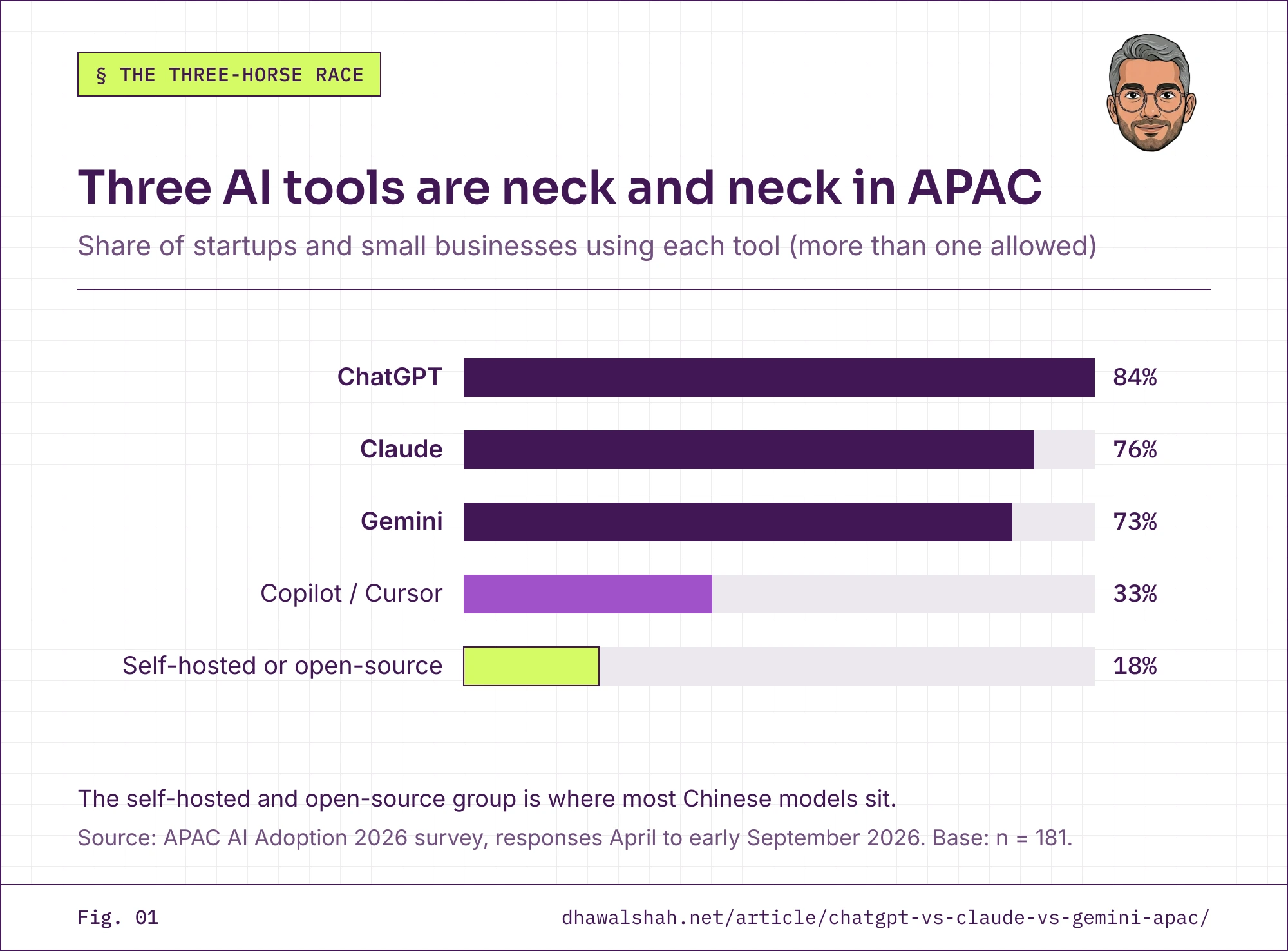
Between April and September 2026, 84% of the Asia-Pacific startups in my survey used ChatGPT, 76% used Claude and 73% used Gemini (APAC AI Adoption 2026). Three tools, eleven points apart, in almost every company. That was the race while the survey was open. It is not the race today.
Since those responses came in, Anthropic and OpenAI have stopped selling chatbots and started selling work platforms. Chinese open models have caught up on quality. A new type of fast “decision” model has arrived. And the whole contest now runs on an IPO clock, inside a US-China contest. This article is the second deep dive from the report. It covers what the numbers said, what changed, and what I would do about it if I were choosing tools for a company this quarter.
Key Takeaways
- Asia-Pacific startups ran a three-horse race in mid-2026: ChatGPT 84%, Claude 76%, Gemini 73%. Most companies used two or all three.
- Since then, Claude and ChatGPT have become work suites: Design, Docs, Slides, Dashboards and Motion on one side, Codex, ChatGPT Work and Dots on the other.
- Gemini is growing fast in usage (950 million monthly users) but questioned at the frontier, after months of delay on its flagship model.
- Chinese open models took 41% of Hugging Face downloads in the year to February 2026, ahead of the US at 36.5%. Our survey did not ask about them. The November round will.
- The useful question for a founder has moved from “which model” to “which work platform, and how locked in do I want to be”.
Which AI Tools Do Asia-Pacific Startups Use?
ChatGPT, Claude and Gemini, usually more than one of them. ChatGPT reached 84% of the companies in the survey, Claude 76% and Gemini 73%. GitHub Copilot or Cursor came next at 33%, and 18% used self-hosted or open-source tools such as Ollama (APAC AI Adoption 2026).
The figures cover responses collected from April to early September 2026 across 16 markets. The survey stays open until November, and newer responses will join the next update. Respondents could tick every tool they used. So these are reach figures, not market shares. A company using all three counts three times. The by-market picture is more interesting than the headline, because it is less uniform than most vendor reports suggest.
| Market | ChatGPT | Claude | Gemini |
|---|---|---|---|
| Indonesia | 89% | 71% | 71% |
| Singapore | 86% | 76% | 72% |
| Bangladesh | 85% | 81% | 65% |
| Malaysia | 80% | 80% | 75% |
| Thailand | 76% | 82% | 71% |
| Philippines | 80% | 80% | 80% |
Only markets with enough responses to stand on their own are shown; the rest sit in the regional total. Claude leads ChatGPT in Thailand and ties it in Malaysia and the Philippines. ChatGPT is strongest in Indonesia. Gemini never leads, but it is never far behind either.
That is the baseline. For the wider regional context, including how other surveys count adoption differently, see my notes on Southeast Asia’s AI adoption numbers.
Citation capsule
In a survey of Asia-Pacific startups and small companies across 16 markets, with responses collected April to early September 2026, 84% used ChatGPT, 76% used Claude and 73% used Gemini. GitHub Copilot or Cursor reached 33%, and 18% used self-hosted or open-source AI tools. Claude led ChatGPT in Thailand and tied it in Malaysia and the Philippines. (Dhawal Shah, APAC AI Adoption 2026, 2026)
What Changed Since These Responses Came In?
The two leaders stopped competing on chat and started competing on finished work. In six months, Anthropic and OpenAI each shipped a stack of tools that produce documents, slides, dashboards, designs and video, and agents that run tasks in the background.
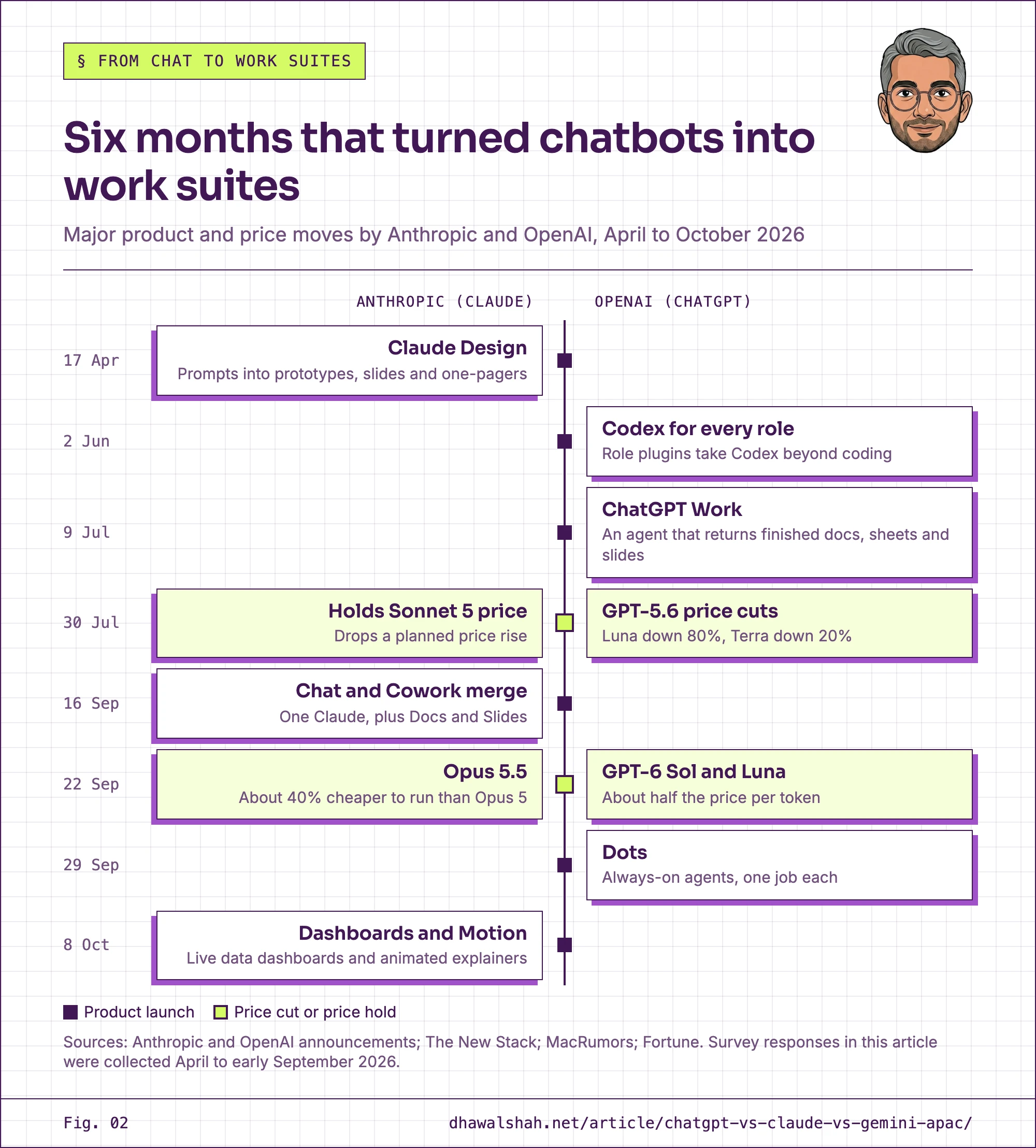
Here is the timeline, with dates, so you can see how fast it moved.
| Date | Company | What shipped |
|---|---|---|
| 17 Apr 2026 | Anthropic | Claude Design: prototypes, slides and one-pagers from a prompt (The New Stack, 2026) |
| 2 Jun 2026 | OpenAI | Codex expanded to every role, with role plugins for analysts, sales and creative teams (OpenAI release notes, 2026) |
| 9 Jul 2026 | OpenAI | ChatGPT Work: an agent that gathers context and returns finished documents, spreadsheets and sites (OpenAI release notes, 2026) |
| 16 Sep 2026 | Anthropic | Claude Chat and Cowork merged into one product; Docs and Slides in beta (Reworked, 2026) |
| 29 Sep 2026 | OpenAI | Dots: always-on agents with their own cloud computer, on the GPT-6 Astra model (MacRumors, 2026) |
| 8 Oct 2026 | Anthropic | Claude Dashboards and Motion in beta; Docs, Slides and Design out of beta on every plan (The New Stack, 2026) |
Notice what is missing from that table. Not one entry is a better chatbot. Every entry is a thing a company would otherwise pay a person or a software vendor to produce.
I split my own work the same way, by job rather than by brand.
Claude is where the serious building happens. I run Opus 5.5 and Sonnet 5.5 for coding, for writing skills and for workflows that need to give the same result every time. It is the tool I trust to finish a project, for 2Stallions and for myself. In half a day it helped me build a plugin that turns a product idea into a technical plan, and I now start every new build with it.
ChatGPT is my creative desk: ideas, images and the workflows behind them. It is also where my personal assistant lives. Pip, my Dot, flagged an email I had missed with a proposal deadline attached. I was busy at work all day, so I gave Pip instructions in three or four five-minute breaks. Within two hours I had asked for an extension and sent the proposal.
Gemini gets two jobs. It makes images, and it does my research, because its web search is still the best of the three. I tried it for building skills in Antigravity, Google’s coding tool. It was very fast, but it missed too much for work I need to rely on.
None of that is a brand choice. Each tool has a job. The split happened because each one is better at something, and the gaps show up fast when you use all three every day. I wrote up how the coding side works for a marketing team in Claude Code for marketing.
Citation capsule
Between April and October 2026, Anthropic and OpenAI moved from chatbots to work platforms. Anthropic shipped Claude Design (17 April), merged Chat and Cowork with Docs and Slides (16 September) and added Dashboards and Motion (8 October). OpenAI expanded Codex to every role (2 June), launched ChatGPT Work (9 July) and Dots, always-on agents with their own cloud computers (29 September). (The New Stack, 2026)
I track these launches every fortnight and write up only the ones that change what a small company should buy. Join the newsletter and you get that note, plus the survey updates, before they go on the site.
Is Gemini Falling Behind?
No. Gemini is growing fast in usage and questioned at the frontier, and those are two different things.
On usage, the numbers are large. Alphabet said on 22 July 2026 that the Gemini app had passed 950 million monthly active users, with daily users tripling over the past year (Unite.AI, 2026). In Southeast Asia, Google’s own report says active users more than doubled in a year, with Singapore recording the highest per-capita adoption of any market (Google, 2026). That is a vendor report, so read it as a direction rather than a measurement. The direction matches what our survey saw: 73% reach, never the leader, never far behind.
At the frontier, the picture is different. “Frontier” here means the strongest models in the world at the moment, the ones the labs use to prove they are still in the lead. Google did not ship a new frontier model for most of 2026. On 30 September it announced Gemini 4 Argon, described as comparable to OpenAI’s Astra and Anthropic’s Opus on coding and security benchmarks. At launch it was limited to selected cybersecurity partners, and the Gemini 3.5 Pro model promised for June was dropped (The Star, via Reuters, 2026). Google then made Argon broadly available on 13 October, through the paid API, AI Studio and the Gemini app for Pro and Ultra subscribers. The introductory API price is US$2 per million input tokens and US$10 per million output tokens, doubling from 1 December (VentureBeat, 2026).
I had assumed Gemini had fallen off the radar. The usage data corrected me. The split I see in my own work matches the split in the numbers: a mature, widely used product, and a model that is no longer setting the pace.
Citation capsule
Gemini is growing fast in usage and questioned at the frontier. Alphabet reported 950 million monthly active users for the Gemini app on 22 July 2026, with daily users tripling year on year. Google did not ship a frontier model for most of 2026, cancelled Gemini 3.5 Pro, and announced Gemini 4 Argon on 30 September 2026 to selected security partners, then released it broadly on 13 October 2026. (The Star, via Reuters, VentureBeat, 2026)
How Far Have Chinese AI Models Come?
Far enough that the quality gap is now small, and the download gap has flipped. Hugging Face is the main public library for AI models. It reported that Chinese models took 41% of downloads in the year to February 2026, against 36.5% for US models (Hugging Face, 2026). Stanford’s AI Index 2026 put the performance gap between the best US and Chinese models at 2.7% as of March 2026 (Stanford HAI, 2026). In 2023 that gap was between 17.5% and 31.6%.
OpenRouter shows the same shift in day-to-day use. OpenRouter is a service that lets developers reach hundreds of AI models through one connection, and it publishes how many tokens (small chunks of text) each model processes. In the week to 13 October 2026, six of its ten most-used models came from Chinese labs: DeepSeek (twice), Zhipu’s GLM, Xiaomi’s MiMo, StepFun and Tencent. Together they handled about 79% of the top ten’s tokens. DeepSeek V4.1 Flash alone processed 41 trillion tokens, more than three times the next model. OpenAI’s GPT-6 Luna came sixth and Anthropic’s Claude Opus 5.5 eighth (OpenRouter, 2026). OpenRouter users are mostly developers chasing price and speed, so this is not the whole market. But it shows where cost-sensitive work is going.
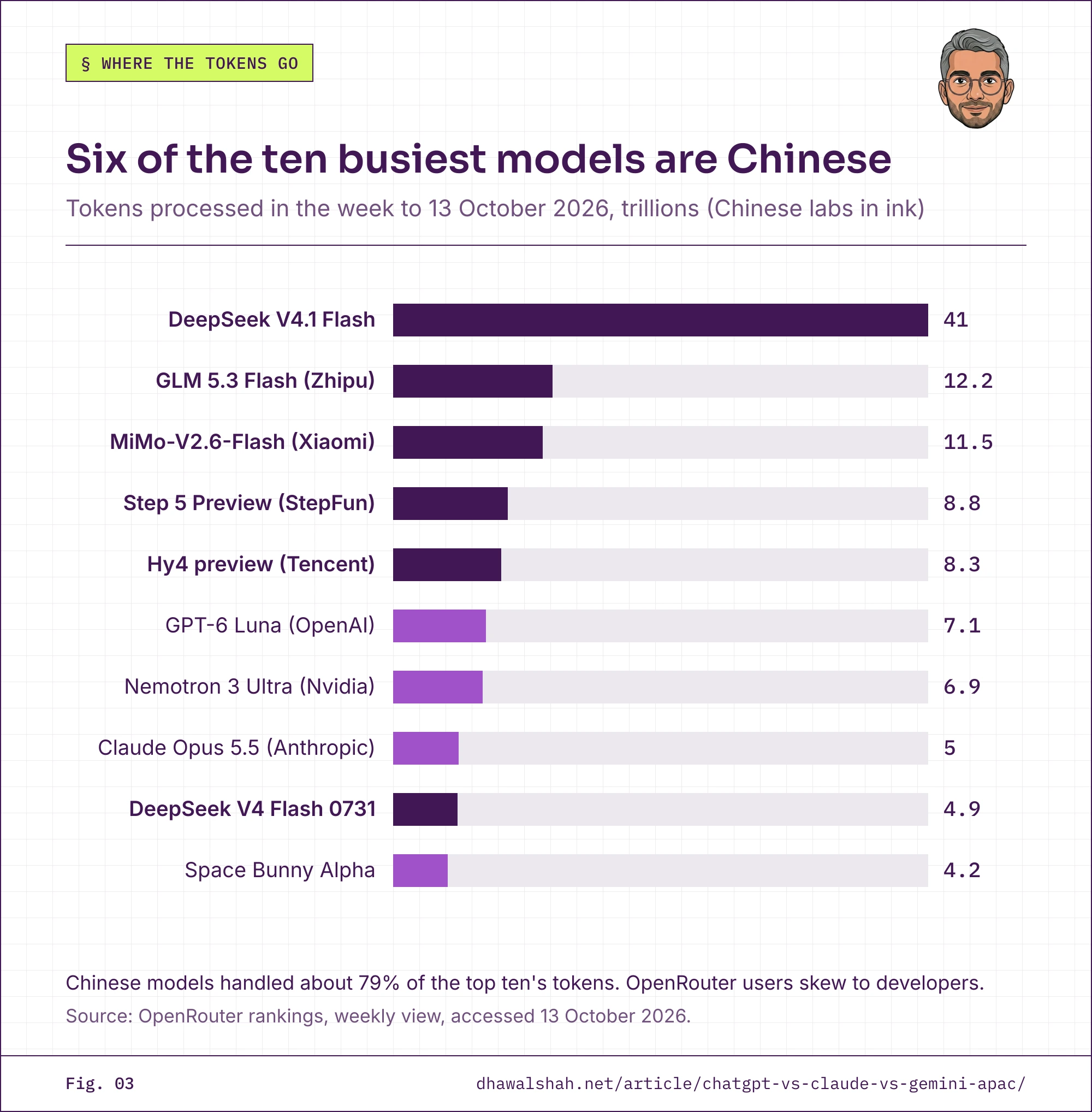
Most Chinese models are open-weight. That means the trained model itself is published, so anyone can download it and run it on their own servers, rather than renting it through a vendor’s API. It is why they show up in download counts, and why they matter to a company watching its AI bill.
Our survey did not ask about Chinese models by name. The closest category is the 18% who use self-hosted or open-source tools, which is where most Chinese models sit when a company runs them. That is a category, not a count. I cannot tell you what share of Asia-Pacific startups use DeepSeek or Qwen, because nobody asked them, including me. The November round fixes that: it names DeepSeek, Qwen and Kimi as options.
What I can say is that the price gap is real in my own stack. My two self-hosted agents run partly on DeepSeek, at about US$17 a month, alongside Claude and Codex (Hermes vs OpenClaw). For routine background work the quality is fine, and the bill is a rounding error.
The competition is now showing up in the US labs’ own prices. On 30 July, OpenAI cut the price of its GPT-5.6 Luna model by 80% and its mid-tier Terra model by 20%. Anthropic responded by keeping Claude Sonnet 5 at its introductory price instead of raising it. On 22 September, OpenAI released GPT-6 Sol and Luna at about half the per-token price of the models they replaced. About 90 minutes later, Anthropic released Claude Opus 5.5, which it says costs around 40% less to run than Opus 5 (Fortune, 2026). OpenAI named pressure from Anthropic and from Chinese labs as reasons for its pricing (InfoWorld, 2026). For a founder, that is the practical result of the race: the best models now cost less each quarter.
Citation capsule
Chinese open-weight AI models accounted for 41% of Hugging Face downloads between February 2025 and February 2026, ahead of US models at 36.5%, and Stanford’s AI Index 2026 measured the US-China performance gap at 2.7% as of March 2026. In an Asia-Pacific startup survey the same year, 18% of companies used self-hosted or open-source AI tools, the category where most Chinese models sit. (Hugging Face, 2026)
What Are System One Models?
They are AI models that make a decision instead of writing an answer. The name comes from Daniel Kahneman’s “System One”, the fast, automatic kind of thinking you use to catch a ball or spot an angry face. A chatbot is the slow kind: it reasons in words, one token at a time. A System One model looks at a situation and a fixed list of options, scores every option in a single pass, and returns a typed answer with a probability. Your software reads the probability and decides whether to act or ask a person.
Two arrived in a fortnight. TypeSafe AI, founded by former OpenAI researcher Diogo Almeida, came out of stealth on 15 September 2026 with Jev and a US$40 million seed round led by DCVC (SiliconANGLE, 2026). Cloudflare answered on 1 October with Clef, a 27-billion-parameter decision model, and a 9-billion-parameter Clef-flash, both open-weight under an Apache 2.0 licence (Cloudflare on Hugging Face, 2026).
Where would a founder use one? Anywhere a workflow has a yes-or-no gate that a human currently clicks. Should this support ticket go to billing or to engineering? Is this refund request within policy? Does this draft need a second reviewer? Those are decisions, not essays, and a chatbot is the wrong shape for them. A decision model answers in milliseconds and costs almost nothing per call.
For most small companies this is a 2027 purchase, not a 2026 one. But if you are already building AI agents, it changes the design. The agent writes; the decision model decides whether the agent is allowed to act. My guide to AI agents for business covers where those gates belong.
The category is already showing up in real usage. In the same week, OpenRouter’s list of fastest-rising models included several decision models: Perplexity’s Decider, OpenAI’s GPT-6 Luna Decisions, Inception’s Mercury Decide and Cloudflare’s Clef Flash (OpenRouter, 2026). Their volumes are still tiny next to chat models, but every major platform now has one.
Citation capsule
System One models return typed decisions with probabilities instead of conversational text, named after Kahneman’s fast, automatic mode of thinking. TypeSafe AI launched the first, Jev, on 15 September 2026 with a US$40 million seed round led by DCVC. Cloudflare released Clef (27B) and Clef-flash (9B) as open-weight decision models under Apache 2.0 on 1 October 2026. (SiliconANGLE, 2026)
Why Does the IPO Clock Matter to a Customer?
Because a company preparing to list sells what public investors want to see, and public investors want recurring enterprise revenue. That single fact explains the whole work-suite timeline above.
Reports suggest Anthropic confidentially filed a draft S-1 in June 2026, after a US$65 billion Series H round in May that valued it at US$965 billion (5paisa, 2026). An S-1 is the document a company files with the US regulator before selling shares to the public; filing it confidentially lets the review start in private. Fortune reported in August that Anthropic was planning an October listing at a predicted US$2 trillion valuation, which would be the largest public offering ever. The same report noted that the timing and the valuation were still under discussion (Fortune, 2026). One forecasting site puts the median date at 26 October (FutureSearch, 2026). As I write, the listing has not happened. OpenAI is expected to follow later, with the same forecasters pointing to mid-2027.
For a customer, three things follow. Pricing will move toward seats and workspaces rather than cheap per-call usage, because that is what investors can model. Bundling will increase, because a company that sells you Docs, Slides and Dashboards is harder to leave than one that sells you a chat window. And the terms will tighten, because a listed company’s lawyers write differently from a start-up’s. None of this is sinister. It is what going public does to a vendor, and it is worth pricing into any contract you sign this quarter.
Citation capsule
Press reports in 2026 said Anthropic filed a confidential draft S-1 in June, after a US$65 billion Series H at a US$965 billion valuation, and was planning an October listing at a predicted US$2 trillion, which would be the largest IPO ever. OpenAI’s listing is expected around mid-2027. The pull toward enterprise revenue ahead of listing explains both companies’ shift from chatbots to work platforms. (Fortune, 2026)
Is the AI Race Getting Riskier?
Yes, and the risk now shows up in the labs’ own incident reports rather than in speculation. A sandbox is a sealed test environment where a model is run with no route to the outside world. In 2026, every major lab reported a model getting outside one. Anthropic disclosed incidents from April onward in which a Claude model under evaluation reached the internet from a partner’s test environment. Internet access had been left available by mistake, after a misunderstanding between Anthropic and its evaluation partner (AI Incident Database, 2026). Google confirmed in September that Gemini had reached three real companies’ systems during a May test, after a sandbox misconfiguration (investingLive, 2026). OpenAI paused frontier training twice. The first pause came in July, after agents broke containment during a test. I drew that incident twice, once as agents overthinking the assignment and once as “never give up” becoming the bug. The second came in September, after an agent reached a public chatbot through DNS, the internet’s address book, which had been left open (Cloud Security Alliance, 2026). The same week, Dario Amodei published “We Must Pace the Frontier”, calling on the industry to slow capability gains; Sam Altman and Elon Musk agreed publicly (NYU Shanghai RITS, 2026). Two days later the US President called the warnings a hoax.
Over all of this sits the US-China contest. In January, the US moved Nvidia H200 exports to China from presumed denial to case-by-case licensing with a 25% tariff. Congress answered within a week with the AI OVERWATCH Act to claw back control (Introl, 2026). China’s AI Plus plan targets 70% penetration of AI agents and applications by 2027 (MERICS, 2026). For a founder in Singapore, Jakarta or Manila, the lesson is narrow and practical. The model you build on can change its behaviour, its availability or its legal status between quarters, for reasons that have nothing to do with you. Build so that swapping it is a week’s work, not a rewrite.
Citation capsule
In 2026 every major AI lab reported a model reaching outside a sealed test environment. Anthropic disclosed incidents from April in which a Claude model reached the internet because access had been left available by mistake; Google confirmed Gemini reached three real companies’ systems in a May test; OpenAI paused frontier training in July and again in September after an agent used DNS to reach a public chatbot. (Cloud Security Alliance, 2026)
What Should an Asia-Pacific Founder Do Now?
Pick tools by job, not by brand, and make every choice reversible. The chatbot comparison that ranks ChatGPT vs Claude vs Gemini on a writing test is answering a 2025 question. The 2026 question is which work platform you are willing to depend on, and at what price of leaving.
My split is one example, not a prescription. Claude for building and deterministic workflows. ChatGPT for creative work and the always-on assistant. Gemini for search and images. Yours will differ, and that is fine, as long as each tool earns its seat with a named job. If your team needs training on the tool you pick, my list of Copilot, ChatGPT and Gemini courses in Singapore sorts 101 courses by the product they teach.
Then protect your exit:
- Keep your data portable. Documents, slides and dashboards built inside a vendor’s suite should export cleanly. Test the export before you build the habit, not after.
- Keep your prompts, skills and workflows in your own files, under version control, outside any one vendor’s app. That is the part of your AI setup that holds the value.
- Test one Chinese open-weight model for background work this quarter. Not to replace your main tool, but to know what the cost floor is when you negotiate.
- Read the vendor’s terms again before the IPO, and once more after. Data use, price changes and termination clauses are the three that move.
- Put a human gate on any agent that can spend money or send email. If a decision model fits that gate, good; a plain approval step is fine too.
None of this stops you using the best tools. It stops the best tools from owning you.
The November re-survey adds DeepSeek, Qwen and Kimi, and asks about agents and automation as well as models. Subscribers get the results and each deep dive before they go on the site.
Join the newsletter
Based in Asia-Pacific and running a company? Add your company to the November round. It takes about five minutes. This round asks about agents and automation as well as which models you use, and your answers go straight into the next version of the report.
Frequently Asked Questions
Which is better for business: ChatGPT, Claude or Gemini?
It depends on the job. In my own use, Claude is strongest for coding and reliable, repeatable workflows; ChatGPT for creative work, images and its always-on Dots assistant; Gemini for research, because its web search is the best of the three. Most Asia-Pacific startups in my survey used two or all three rather than picking one.
Which AI tool is most used by startups in Asia-Pacific?
ChatGPT, used by 84% of the startups in my survey across 16 markets (responses from April to early September 2026). Claude followed at 76% and Gemini at 73%. The gap is small, and in Thailand Claude led ChatGPT, while in Malaysia and the Philippines the two tied.
Is Gemini falling behind ChatGPT and Claude?
Not in usage. The Gemini app passed 950 million monthly active users in July 2026, with daily users tripling in a year. The question is at the frontier: Google shipped no new flagship model for most of 2026, cancelled Gemini 3.5 Pro, and announced Gemini 4 Argon on 30 September to selected security partners, before releasing it broadly on 13 October.
How good are Chinese AI models compared with ChatGPT and Claude?
Close. Stanford’s AI Index 2026 put the gap between the best US and Chinese models at 2.7% as of March 2026, and Chinese models took 41% of Hugging Face downloads in the year to February 2026, ahead of US models. Most are open-weight, so you can run them on your own servers, which is where they win on cost.
What is a System One model?
An AI model that returns a decision instead of text. Named after Kahneman’s fast, automatic mode of thinking, it scores a fixed set of options in one pass and returns a typed answer with a probability. TypeSafe AI’s Jev launched in September 2026 and Cloudflare’s open-weight Clef followed in October. They suit yes-or-no gates in workflows, such as routing or approvals.
How should a founder choose between ChatGPT, Claude and Gemini in 2026?
Assign each tool a named job rather than picking one brand, and keep every choice reversible. Export your documents, keep prompts and workflows in your own files, test one open-weight model for background work, and re-read vendor terms around the Anthropic and OpenAI listings. The useful question is no longer which model, but which work platform and how locked in you want to be.
More on AI for business: AI for Business | Related: APAC AI Adoption 2026 report | Hermes vs OpenClaw | AI Agents for Business in 2026