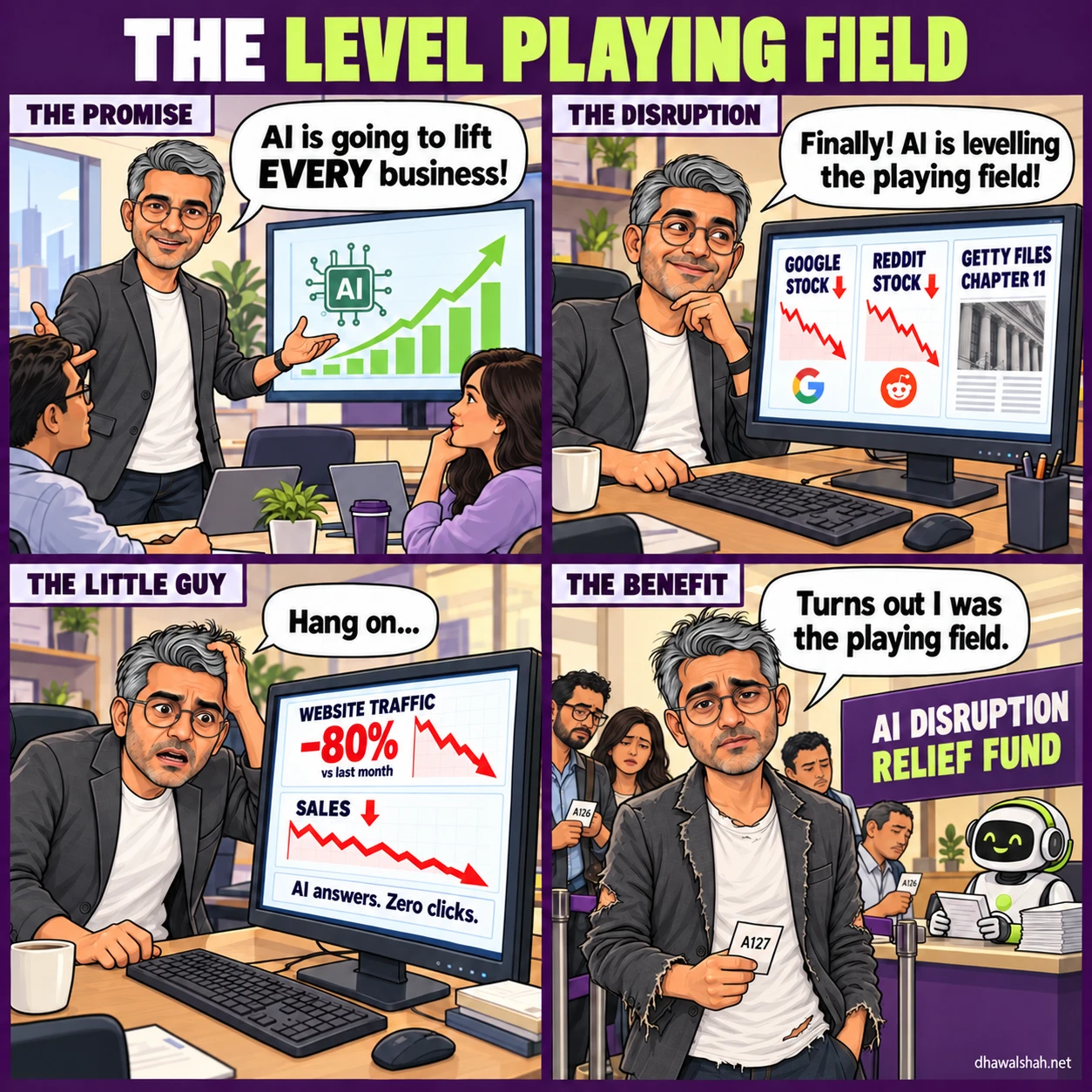
Everyone loves a level playing field until they realise they might be part of the ground being flattened. A cartoon about cheering AI disruption, right up to the moment it reaches your own traffic and sales.
§ TranscriptPanel by panel
Title bar. "THE LEVEL PLAYING FIELD", with "THE" in white and "LEVEL PLAYING FIELD" in lime on deep purple.
Panel 1 - "THE PROMISE". A bright office. Dhawal, in a grey blazer over a white T-shirt, stands smiling with his arms open. Two colleagues sit at laptops and listen. Beside him, a monitor shows an AI chip icon and a green chart rising steeply. He says "AI is going to lift EVERY business!"
Panel 2 - "THE DISRUPTION". Dhawal sits at his desk, leaning back with a pleased smile and a hand under his chin. His monitor shows three tiles: "GOOGLE STOCK" with a falling red line, "REDDIT STOCK" with a falling red line, and "GETTY FILES CHAPTER 11" above a newspaper photo of a building. He says "Finally! AI is levelling the playing field!"
Panel 3 - "THE LITTLE GUY". At the same desk, Dhawal leans forward with one hand gripping his hair, eyes wide. The monitor shows "WEBSITE TRAFFIC -80% vs last month" beside a falling red line, a second falling chart labelled "SALES", and a note reading "AI answers. Zero clicks." He says "Hang on..."
Panel 4 - "THE BENEFIT". Dhawal stands in a queue, hair untidy, his blazer and T-shirt torn and frayed, holding a ticket numbered "A127". Other tired people wait behind and beside him with their own tickets. At a counter under a purple sign reading "AI DISRUPTION RELIEF FUND", a cheerful robot with a headset sorts a stack of forms. Looking at the reader, he says "Turns out I was the playing field."
Footer. "dhawalshah.net" in the bottom-right corner.
§ 01Behind the strip
The idea behind the cartoon
“AI levels the playing field” sounds best when you picture yourself winning.
A small team can now do work that once needed a much bigger budget. I use and teach AI every day, and I find that genuinely exciting.
The awkward part is assuming the benefits stop at our own business model.
The same technology that helps us produce work can change how customers find it, what they expect to pay for it, and whether they need to visit our website at all. Being smaller does not put us on the winning side by default.
That is the reversal in this strip. The cartoon version of me cheers as large companies get disrupted. Then I open my own dashboard.
The final queue takes that worry to an absurd end. The keen advocate becomes an applicant for relief, and a cheerful robot still runs the counter.
I’m still optimistic about AI. But “we can produce more with fewer people” and “customers will still find and pay us” are two different assumptions. It’s probably worth testing both. If customers now get their answers from AI, the checks in my guide to generative engine optimisation are a good place to start on the second one.
The headlines on the monitor are real, but they don’t share one cause. Alphabet fell after its earnings and questions about its AI spending. Reddit warned that Google’s AI search was hurting its referral traffic. Getty’s Chapter 11 is a planned restructuring, and the business is still trading.
The 80% traffic drop, falling sales, torn clothes and relief queue are fictional, not a report on my business. Anthropic’s real Public Benefit Fund inspired the last panel, but it has not announced a walk-up relief scheme like the one shown here.