§ 01Behind the strip
The idea behind the cartoon
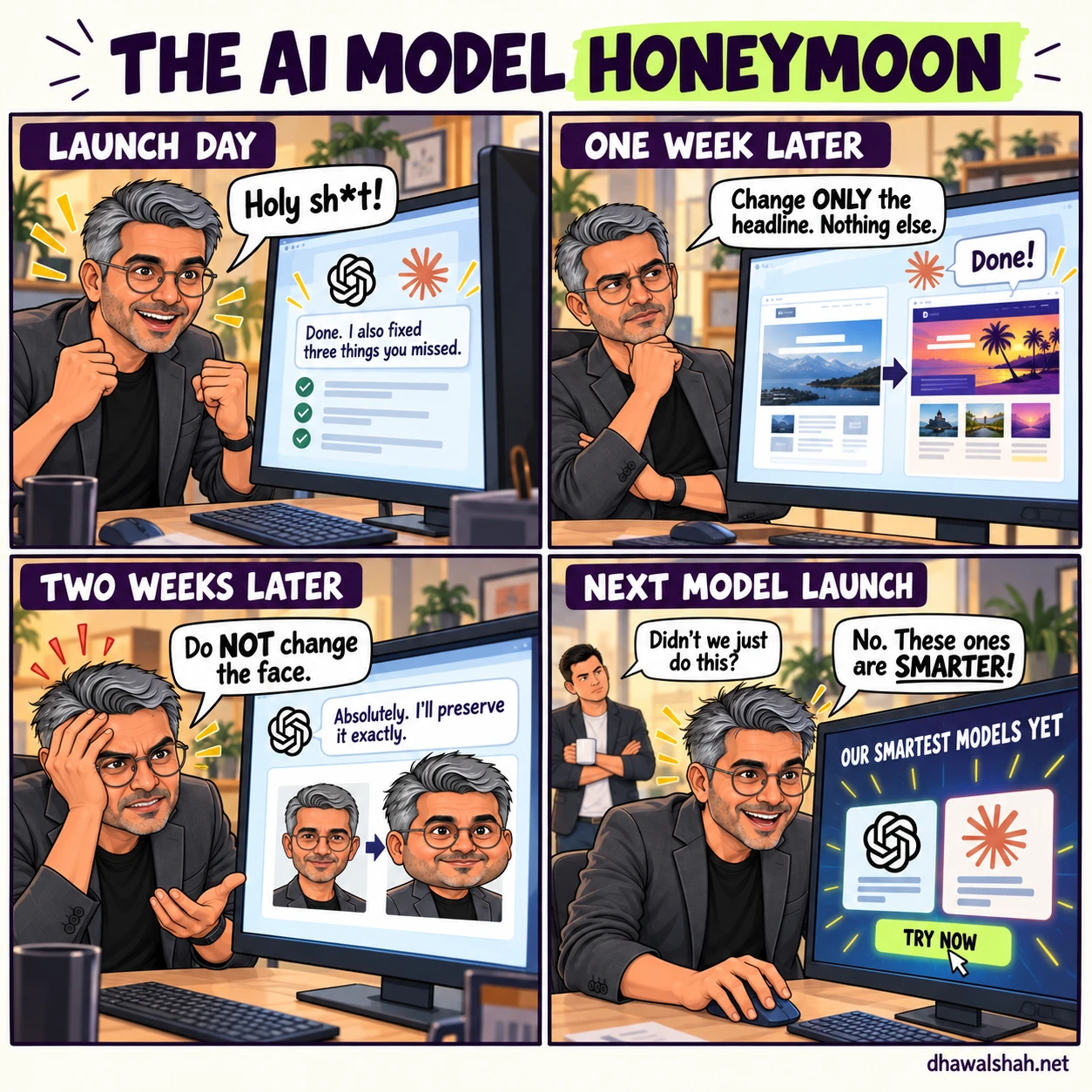
Every new AI model seems to have a honeymoon period.
Launch week, it feels like magic. You give it a complicated task, it understands the context, anticipates what you need and fixes things you hadn’t even thought to ask for.
A week later, you’re typing: “Change ONLY the headline. Nothing else.”
Two weeks later: “Do NOT change the face.”
And somehow you’re still staring at a completely redesigned website, or a caricature of yourself that looks like a distant relative.
These aren’t entirely hypothetical examples.
I use Claude heavily for coding and ChatGPT for image generation, and I’ve experienced both sides of this cartoon. They’re very capable tools. They’re also very capable of confidently doing exactly what you told them not to do.
Are AI models actually getting worse?
That’s the more interesting question behind the joke.
I’m not convinced they are. The viral version of this complaint, a meme of model releases drawn as portraits that decay into scribbles, got a fair hearing from Memeburn, and the research it pulls together points mostly elsewhere: lowered default reasoning effort, caching bugs, accuracy that drops as the context gets longer, and the plain fact that launch-week excitement wears off.
Part of the honeymoon may simply be how our behaviour changes. When a new model launches, we test it carefully and marvel at things the previous generation struggled with.
Then we start trusting it.
We give it larger codebases. Longer conversations. More context. More complicated edits. More autonomous work. And our expectations rise along with its capabilities.
Eventually, we’re no longer impressed that it can do 95% of something extraordinarily difficult. We’re annoyed by the 5% where it ignores the sentence we wrote in capital letters.
And then, right on schedule: “Our smartest model yet.”
Suddenly I’m optimistic again.
Maybe this one won’t redesign the whole page when I ask it to change a headline.
Maybe this one will actually leave the face alone.
There’s only one way to find out.
Try now.