
Generative engine optimization (GEO) is the work of getting AI systems to use your content when they write an answer. Those systems are ChatGPT, Google’s AI Overviews and AI Mode, Gemini, Perplexity and Microsoft Copilot. SEO earns you a place in a list of links. GEO earns you a place inside the answer itself.
You’ll also hear AEO, AI SEO and LLM SEO. They overlap heavily, but they aren’t quite the same thing, and the differences change what you work on. The first section sorts them out.
I teach this as an AI search workshop for in-house marketing teams, and this guide follows the same order. It starts with what changed and how AI engines pick their sources. Then come four checks you can run on any page, and what to do when someone else controls your website. I use one invented example throughout: a regional maker of plastic pipe systems that sells to contractors, engineers and water utilities. Whenever it comes back, look for this tag: Pipe example
Key Takeaways
- With an AI summary on the page, Google users click a normal result in 8% of visits, not 15% (Pew Research Center, 2025).
- 84% of what AI engines cite is earned media, not brand websites (Muck Rack, 2026).
- Four checks decide citation: can AI find, understand, trust and quote your page?
- Skip llms.txt files and anything sold as “GEO markup”.
Want the working version? Download the AI Engine Optimisation Checklist: the four checks, the buyer-question stages and a baseline template on one sheet.
What Is the Difference Between GEO, AEO, AI SEO and LLM SEO?
They’re layers of one job with different targets. The term GEO comes from a 2023 research paper, whose authors found that adding sources, quotations and statistics raised a page’s visibility in AI answers by up to 40% (Aggarwal et al., KDD 2024). In short, SEO gets you found, AEO makes you the answer, and GEO gets you used inside an answer an AI writes.
| Term | Where it came from | What it targets | The goal |
|---|---|---|---|
| SEO | Classic search engines | Rankings in a list of links | Be found |
| AEO (answer engine optimization) | Featured snippets, “People also ask” boxes and voice assistants | One direct answer to one question | Be the answer |
| GEO (generative engine optimization) | A 2023 paper by Princeton, Georgia Tech, the Allen Institute for AI and IIT Delhi | Answers an AI writes from several sources | Be used and cited in the answer |
| LLM SEO | Practitioners working on chatbots | ChatGPT, Claude and similar, including what the model learned in training | Be known to the model |
| AI SEO | Vendors and agencies, as an umbrella | Any AI search surface, and sometimes using AI tools to do SEO | Depends who is selling it |
The nuances show up in the work. AEO rewards one clean answer, such as a precise definition or a short numbered process. GEO rewards facts an engine can blend with other sources and still attribute to you. LLM SEO adds a slower game: a chatbot answering from memory draws on what was written about you before its training data was collected, not only on what’s live today.
AI SEO is the term to pin down before you pay for it. Some people mean optimising for AI search. Others mean using AI agents to do ordinary SEO faster. Both are legitimate, but they’re different services.
Each layer sits on the one below. A page that isn’t indexed can’t be the answer, and a vague answer won’t be quoted. So it makes little sense to run GEO as a separate service with a separate team. Semrush surveyed marketing leaders alongside its 2026 AI Visibility Index. Teams that ran search and AI visibility together reported gains in AI traffic and leads 81% of the time, against 36% for teams that ran them apart (Semrush, Jun 2026). Semrush sells the tools and didn’t publish a sample size, but the logic holds without the number.
Citation capsule
SEO earns rankings, answer engine optimization (AEO) earns the single direct answer in snippets and voice results, and generative engine optimization (GEO) earns citation inside answers AI systems write from several sources. GEO was named in a 2023 paper that found adding sources, quotations and statistics raised visibility in AI answers by up to 40%. (Aggarwal et al., 2024)
GEO vs SEO: What Actually Changes?
The groundwork stays the same. What changes is the scoreboard, whose content counts and what kind of writing gets picked. Google says optimising for its AI features “is still SEO”, and a page that isn’t indexed can’t be cited anywhere. So GEO starts where the technical work of SEO ends.
| SEO | GEO | |
|---|---|---|
| What you win | A position in a list of links | A mention or citation inside an AI answer |
| How you measure it | Rankings, clicks and sessions | How often you’re named for the questions buyers ask |
| Whose content counts | Mostly your own pages, plus the links pointing at them | Mostly other people’s: 84% of AI citations point to earned media |
| What gets picked | A page that ranks for a keyword | A specific fact or passage an engine can quote and attribute |
| Where the click goes | To your site | Often nowhere: 1% of Google visits click a link inside the AI summary |
Three of these change how you spend.
Measurement changes first. A ranking report can look healthy while buyers read an answer that never mentions you. You need a second view: the questions your buyers ask, checked every month, and whether you appear in the answers. I cover how to set that up in what you can actually measure in AI search.
Budget moves off your own site. If most of what AI engines cite is journalism, reviews and other companies’ blogs, then press coverage, reviews and partner content do work a new landing page can’t.
Writing gets more specific. A page can rank on breadth and still give an engine nothing to quote. Named figures, dated sources and plain definitions get lifted. General advice gets skipped.
The rest doesn’t change: crawlability, indexing, page speed, clear structure and content worth reading. That is most of the work, and it’s why splitting SEO and GEO across two teams wastes money.
Citation capsule
GEO vs SEO: SEO competes for a position in a list of links and is measured in rankings and clicks. GEO competes for a mention or citation inside an AI-written answer and is measured by how often a brand is named for the questions buyers ask. The groundwork is shared, since Google says optimising for its AI features is still SEO. The main difference is whose content counts: Muck Rack found 84% of links cited by ChatGPT, Claude and Gemini point to earned media. (Muck Rack, 2026)
What Has Changed for Buyers?
Buyers now get an answer before they get a list of websites, and many stop there. When Google shows an AI summary, people click a normal result in 8% of visits instead of 15%, and click a link inside the summary in just 1% (Pew Research Center, Jul 2025).
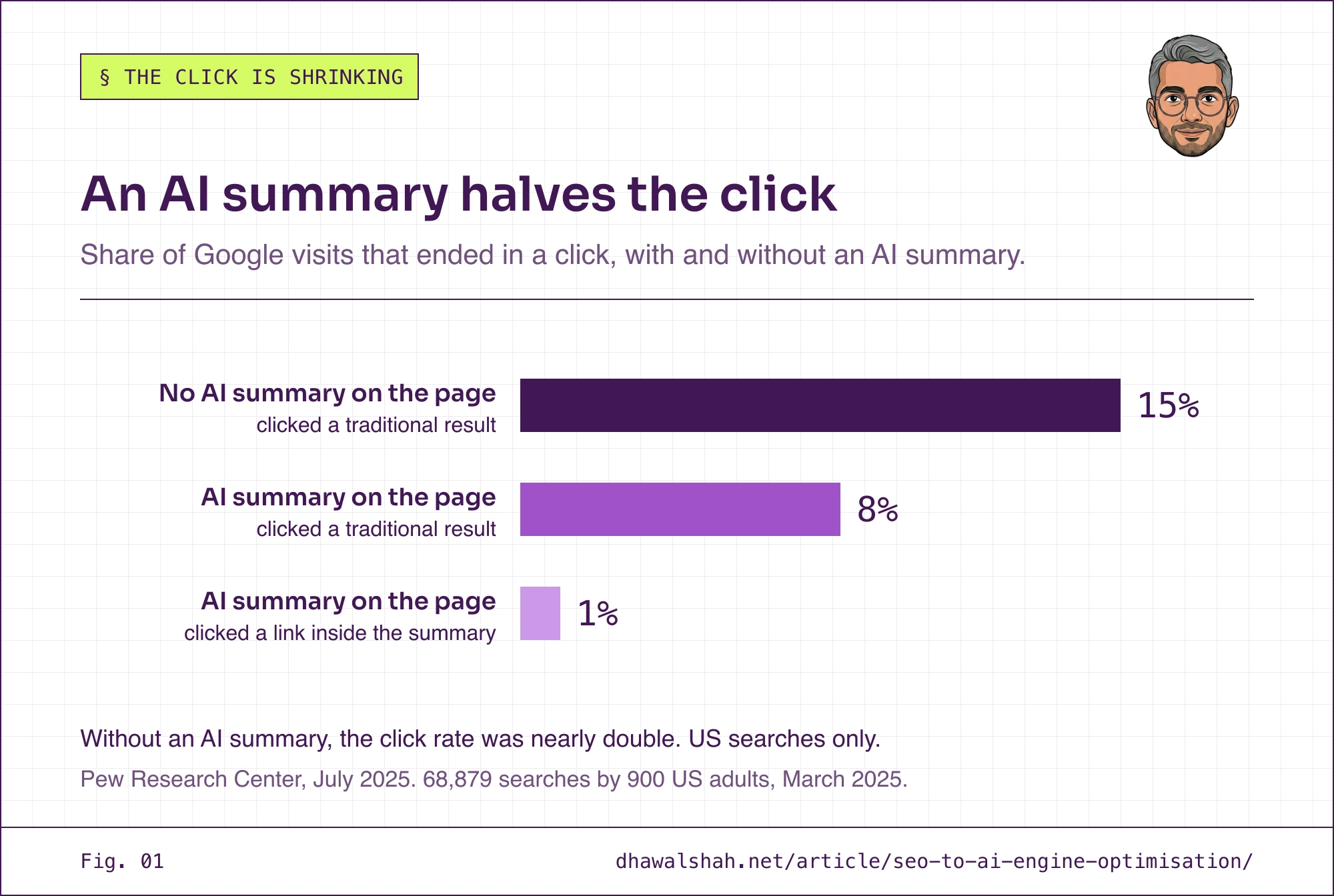
Pew’s figures come from 68,879 real searches by 900 US adults. Across all US Google searches, 68% ended without a click in the first four months of 2026 (SparkToro, Jun 2026). The engine searches, reads, picks a handful of sources and writes one answer. The buyer reads the answer, and the sources get a small link at most.
B2B buying has moved faster than most marketing plans. G2 surveyed 1,076 business software buyers. 51% now start their research in an AI chatbot more often than on Google, up from 29% the year before. 69% chose a different vendor than planned because of what the chatbot recommended (G2, Apr 2026). G2 runs a review site and gains from this finding, so treat the exact figures with care.
It matters because shortlists form early. In 6sense’s buyer research, the winning vendor was already on the day-one shortlist 95% of the time (6sense, 2025). If a chatbot helps build that shortlist, being in its answer means being in the running.
The questions change too. Pipe example A contractor used to search “HDPE pipe supplier”. Now they ask: “What pipe should I use for a buried water main in soft coastal ground, and who supplies it in Johor?” The unit you plan around grows from a keyword to a question, with a situation and a decision attached.
Citation capsule
AI answers are cutting the click SEO was built on. Pew Research Center’s study of 68,879 Google searches found users clicked a traditional result in 8% of visits with an AI summary present, against 15% without one. They clicked a link inside the summary in 1%. G2 found 51% of software buyers now start research in a chatbot. (Pew Research Center, 2025; G2, 2026)
What Does Google Say About GEO?
Google says GEO is still SEO, and that most GEO tricks are unnecessary. Its first guide to AI Overviews and AI Mode, published on 15 May 2026, says these features are “rooted in our core Search ranking and quality systems” and that optimising for them “is optimizing for the search experience, and thus still SEO” (Google Search Central, 2026).
The guide lists tactics you can skip: llms.txt files, “chunking” pages into fragments, rewriting content for AI, fake mentions and extra markup. It asks instead for “non-commodity” content, meaning expert or first-hand material that goes beyond what everyone else has already written.
The entry ticket is plain. A page “must be indexed and eligible to be shown in Google Search with a snippet” to appear as a supporting link, and “there are no additional technical requirements” (Google Search Central, 2025).
Two newer changes matter, and both reached every site worldwide on 31 August 2026. Search Console now reports your impressions in AI Overviews and AI Mode. It also has an opt-out: Settings, “Search generative AI”, where a site can be set to Include or Exclude (Google, 2026). Include is the default. Google says the setting isn’t used as a ranking signal elsewhere in Search, and that it doesn’t govern AI training, which is handled by a separate control called Google-Extended (Google Search Console Help, 2026). Check the setting anyway, since a site set to Exclude won’t appear in these features at all.
I agree with Google on Google. Its guidance stops at its own products, though. ChatGPT, Perplexity and Copilot pick sources their own way, and Google’s document says nothing about them.
Citation capsule
Google’s guidance of 15 May 2026 says optimising for AI Overviews and AI Mode “is optimizing for the search experience, and thus still SEO,” because both are rooted in its core ranking systems. It calls llms.txt files, chunking and extra markup unnecessary. Since 31 August 2026, any site can exclude itself from these features in Search Console. (Google Search Central, 2026; Google Search Console Help, 2026)
How Do AI Engines Decide What to Cite?
They search, pick a few sources that answer the question, and write from those. Most of what they pick isn’t written by the brand: in Muck Rack’s analysis of more than 25 million links cited by ChatGPT, Claude and Gemini, 84% pointed to earned media such as journalism and reviews (Muck Rack, May 2026).
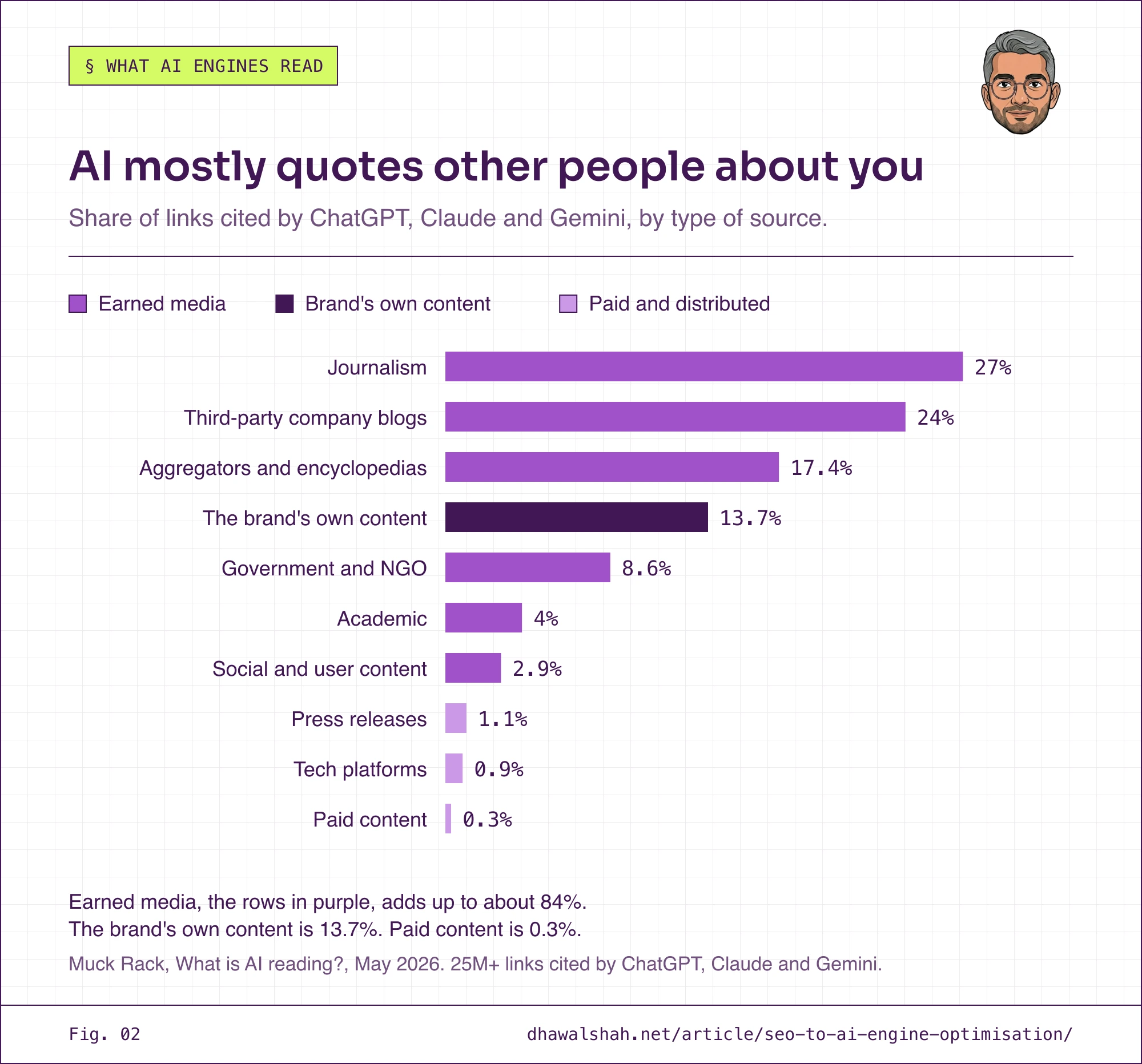
Content from the company named in the question made up 13.7%. Paid content was 0.3%. Muck Rack sells PR software, so it has a reason to like that result. The pattern is still the useful part: the engine mostly repeats what others say about you.
The steps below are a teaching model rather than a map of any one engine.
- The engine reads the question and works out what the person needs.
- It runs one or more searches, on its own index or a partner’s.
- It picks the sources that best answer the question.
- It writes an answer from them.
- It names, links or recommends some of those sources.
There’s also no single “AI ranking”. In the same data, ChatGPT’s most cited site was Wikipedia, Claude’s was PubMed Central, and Gemini’s was Reddit. The mix moves as well. Semrush found ChatGPT’s use of Reddit and Wikipedia dropped sharply within weeks in September 2025 (Semrush, Nov 2025). If someone sells you one playbook for “AI”, ask which engine it’s for.
Pipe example For the pipe maker, its own product pages are only part of the picture. Trade press, distributor listings, engineering forums, association directories and project case studies all feed the answer.
Citation capsule
Most of what AI engines cite is written by someone other than the brand. Muck Rack’s May 2026 analysis of more than 25 million links cited by ChatGPT, Claude and Gemini found 84% pointed to earned media, 13.7% to the brand’s own content and 0.3% to paid content. (Muck Rack, 2026)
Can AI Engines Find Your Page?
Only if the page is indexed, open to the right crawlers, and readable without running scripts. A study of the 100 largest private cloud companies tested the 77 that had public pricing pages. Only 57 could be read by AI crawlers, and 10 hid at least 40% of their content from bots (Growth Unhinged and Profound, Sep 2026).
This is the first of four checks I use in workshops. Each is a question you can ask of any page, and together they turn “we need GEO” into a list of gaps you can fix.
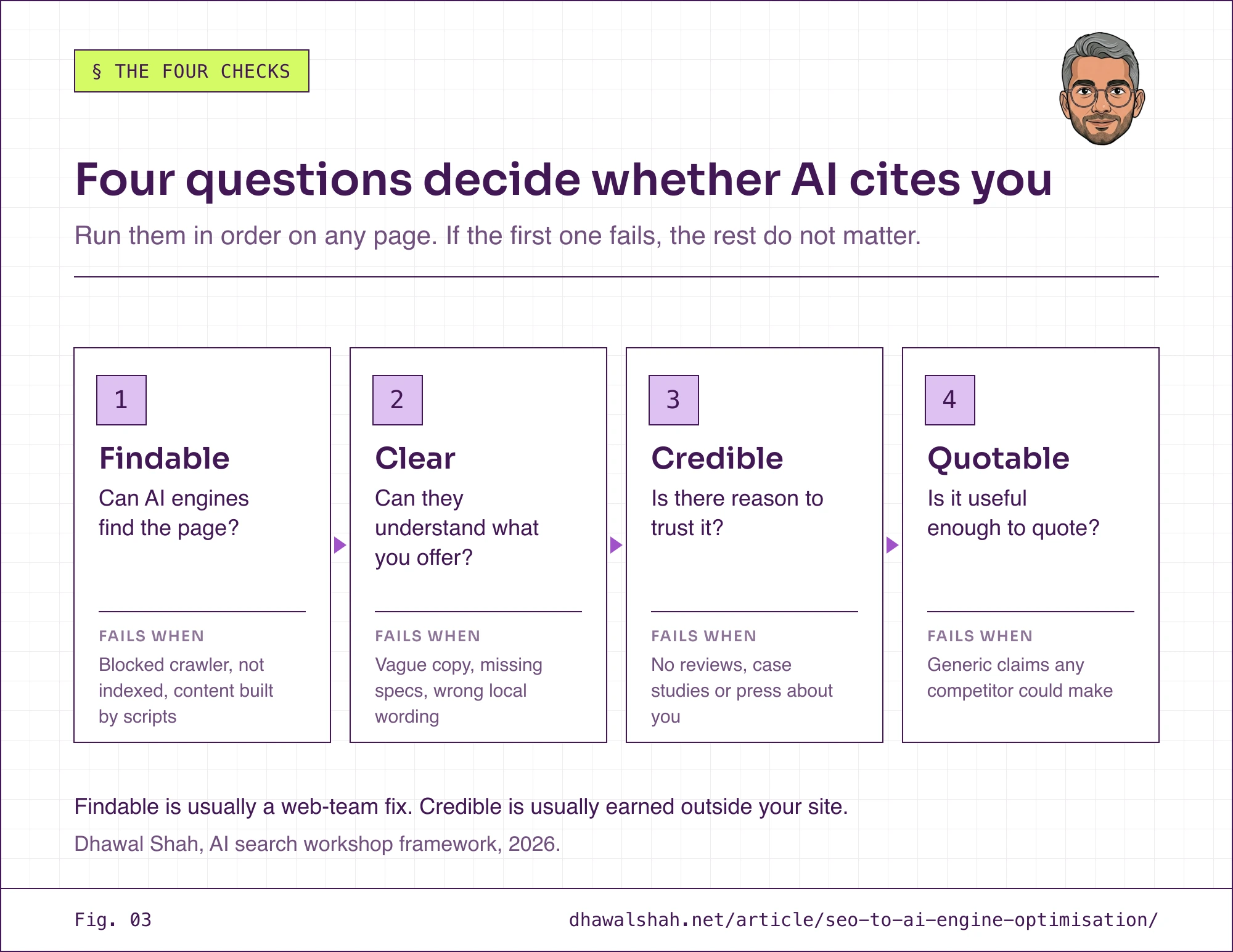
Start with the basics. Is the page public, indexed in Google and Bing, and the right page for the country? A Singapore buyer landing on a US page with US standards is a miss, even if it ranks.
Then check the crawlers. OpenAI uses OAI-SearchBot to decide what can appear in ChatGPT search, and GPTBot to collect content that may be used to train its models (OpenAI, 2026). Blocking GPTBot keeps you out of training without removing you from ChatGPT search. Blocking OAI-SearchBot removes you from search. Check robots.txt and any firewall or bot protection, because either can turn crawlers away without anyone noticing.
Last, check that the content is in the page itself. Many AI crawlers don’t run the scripts that build a page in the browser. In the pricing study, the causes were content built in the browser, tabs and accordions, sliders, blocked crawlers and embedded frames. A company’s own pricing page was the first source cited in only 12% of answers about its pricing (Growth Unhinged and Profound, 2026). The engines went to Reddit and review sites instead.
Pipe example For the pipe maker, the risk is the product selector. If sizes and pressure ratings appear only after a visitor picks options in a widget, a crawler sees an empty page. In many companies this check belongs to the web team or head office. Marketing’s job is to ask the questions and get the answers in writing.
Citation capsule
AI crawlers often cannot read content built by scripts or hidden in tabs. A September 2026 study of the 100 largest private cloud companies found only 57 of the 77 public pricing pages were readable by AI crawlers, and a company’s own pricing page was the first source cited in just 12% of answers about its pricing. (Growth Unhinged and Profound, 2026)
Can AI Engines Understand What You Offer?
They can if the page says plainly what the product is, who it’s for and when to use it. When they can’t, they guess, and pricing is where they guess worst: Profound checked more than 158,000 claims AI engines made about brands and found pricing was 12% of the claims but 24% of the wrong ones (Profound, Aug 2026). Profound sells AI visibility software, so read it as vendor data.
A reader, human or machine, should be able to answer six questions in under a minute. What is this? What problem does it solve? Who is it for? What are the key specifications? Where is it available? What do local buyers call it?
Pipe example Take the pipe maker’s product copy.
Weak: “We deliver innovative, high-quality piping solutions for every project.”
Better: “Our PE100 HDPE pressure pipe comes in diameters from 20mm to 800mm, rated to PN16 (16 bar), for buried water mains and industrial lines.”
Best: “For a buried water main in soft coastal ground, engineers usually weigh three things: pressure rating, how the joints are made, and how the pipe copes with ground movement. Here is how our HDPE and PVC ranges compare on each, and where each one is the wrong choice.”
The weak version could belong to any company on earth. The better one is specific. The best one answers the question a buyer actually asks, which makes it the version an engine can lift.
Structured data, the schema.org code that labels products, prices and addresses, helps machines read a page accurately. It doesn’t make a vague page worth citing, and Google says no special AI markup is needed. Its job is accuracy.
Local wording matters more than most teams expect. Pipe example If buyers in Malaysia say “HDPE pipe” and your page says “polyethylene pressure systems”, the engine has to guess they’re the same thing. Use the words your sales team hears on calls.
Citation capsule
AI engines get pricing wrong more than anything else about a brand. Profound’s August 2026 review of more than 158,000 claims made by AI engines found pricing was 12% of all claims but 24% of the inaccurate ones. Clear, readable facts on the page, in the words local buyers use, reduce the room for guessing. (Profound, 2026)
Is There Reason to Trust What You Say?
Trust comes mostly from proof that lives outside your own website. Ahrefs studied 75,000 brands and found that mentions of a brand across the web lined up with AI Overview visibility far more closely than backlinks did, with a correlation of 0.664 against 0.218 (Ahrefs, 2025).
Ahrefs is careful to say correlation isn’t cause. It’s still a strong hint about where to spend time, and buyers behave the same way. Wynter asked 100 senior B2B marketing leaders what gets a vendor onto a shortlist. Peer recommendation came first at 87%. Messaging that stands out came fourth at 29% (Wynter, Jun 2026).
The same study ran a test worth repeating with your own team. It stripped the names from the value propositions of five well-known software brands: Salesforce Agentforce, HubSpot, Zoho, Pipedrive and Oracle. The marketers then tried to match each one to its company. The average score was 1.86 out of 5, where random guessing scores 1. The chief marketing officers scored 1.70. When every brand sounds the same, nothing in the copy gives an engine a reason to prefer one.
Pipe example The pipe maker could gather evidence such as:
- Certification to the local water authority’s standard, stated on the page with the certificate number
- Named project case studies, with pipe sizes, ground conditions and install dates
- Coverage in construction trade press
- Listings with distributors and industry associations
- A plain-language guide to choosing between HDPE and PVC, written under an engineer’s real name
This is ordinary marketing work. The difference now is that it feeds the answer directly, before a buyer ever reaches your site.
Citation capsule
Third-party proof matters more to AI visibility than links. Ahrefs’ study of 75,000 brands found web mentions correlated with Google AI Overview visibility at 0.664, against 0.218 for backlinks. In Wynter’s June 2026 survey of 100 senior B2B marketing leaders, peer recommendation was the top shortlist factor at 87%, while distinctive messaging ranked fourth at 29%. (Ahrefs, 2025; Wynter, 2026)
Is Your Content Useful Enough to Quote?
It is if one paragraph can answer a real question on its own, with facts a reader can check. A Sprinklr team ran 252,000 controlled trials across six AI models, in a paper presented at SIGIR 2026. Relevance to the question and position in the results mattered most, explicit prices and recent dates helped, and formatting changes alone did very little (Vishwakarma et al., 2026).
That was a lab test with two pages at a time rather than live search. It still agrees with Google’s guidance, which puts substance well ahead of layout.
The best test I know comes from marketer Kieran Flanagan. Could your closest competitor paste their name into this sentence and have it still be true? If yes, no engine has a reason to quote it for you.
Prices deserve their own line. If your price isn’t on a page an engine can read, it’ll use someone else’s guess. Where pricing is custom, publish its shape: a starting point and what pushes it up or down. Pipe example For the pipe maker, that could be a price range per metre by diameter class, with delivery and fittings listed separately.
Pages that get quoted usually have:
- A direct answer in the first sentence under each heading
- Numbers with a named source and a date
- Specific conditions, such as which projects, which ground and which country
- Honest limits, including where your product is the wrong choice
- A comparison table wherever buyers compare
The honest limits carry more weight than they seem to. A page that says “PVC is cheaper for shallow, stable ground” reads as advice. A page that says your product is best for everything reads as an advert, and engines, like people, discount adverts.
Citation capsule
Substance beats formatting for AI citation. A SIGIR 2026 paper by researchers at Sprinklr ran 252,000 controlled trials across six AI models and found relevance to the question and position in results were the strongest drivers of citation. Explicit pricing and recent timestamps helped, while formatting-only edits had little effect. (Vishwakarma et al., 2026)
What Counts as AI Visibility: Mention, Citation or Recommendation?
They’re different results, and one visibility score hides which one you’re getting. Clicks are the smallest layer: AI assistants sent about 0.17% of visitors to the average site in Ahrefs’ 2025 study of 3,000 websites (Ahrefs, 2025). Measure them, but don’t judge AI visibility on referral volume alone.
| Result | What it means | Pipe example |
|---|---|---|
| Citation | Your page is listed as a source | The answer links to your HDPE vs PVC guide |
| Mention | Your brand name appears | ”Suppliers include Company X, Company Y and yours” |
| Description | The engine says what you’re known for | ”Known for large-diameter HDPE” |
| Recommendation | You make the shortlist | ”For this project, consider…” with you on the list |
| Click | Someone visits your site | A visit tagged as coming from ChatGPT |
| Business result | Someone acts | A quote request or a call from a specifier |
A brand can be mentioned often and cited rarely, because the engine is quoting distributors and trade press about it. Another can be cited often and never recommended. These need different fixes. That’s why a single “72 out of 100” score tells you so little about what to do next.
The layers also move at different speeds. Fixing a blocked crawler can pay off as soon as the crawlers come back. Changing how an engine describes you takes months of outside coverage, because the description comes from what others write.
I cover measurement in depth in what an AI visibility audit can actually measure. That includes why the same question returns different sources each time, and what the free Google and Bing reports can and can’t tell you.
The Buyer-Question Map: From Keywords to Questions
Map the questions buyers ask at each stage of a decision, then check which ones you answer well. Longer, question-shaped searches are where AI answers show up most. Pew found an AI summary on 53% of searches with ten or more words, and on about six in ten searches that began with a question word such as “what” or “why” (Pew Research Center, 2025).
Keyword research still matters. It just stops being the whole plan. I use eight stages, shown here with the pipe maker’s questions:
| Stage | The buyer is asking | Pipe example |
|---|---|---|
| Discover | What options exist? | What types of pipe are used for underground water mains? |
| Understand | How does this work? | How does electrofusion jointing work? |
| Solve | What suits my situation? | What pipe suits a water main in soft, shifting ground? |
| Compare | What’s the difference? | HDPE vs PVC pipe for water mains |
| Evaluate | Who should I consider? | Which HDPE pipe manufacturers supply projects in Malaysia? |
| Validate | What proves it? | Is this brand certified to the local water authority’s standard? |
| Localise | What applies in my market? | HDPE pipe suppliers in Johor |
| Decide | Which one fits? | Which pressure class do I need for a 10-bar line? |
Don’t try to build a list of 500 prompts. Pick the 10 to 20 questions that matter commercially. The best source is your own sales and service team, who hear these questions every week. Ask them what buyers asked last month, in the buyers’ words, and write it down.
Sites tend to answer the Discover and Understand questions reasonably well. Compare, Validate and Localise are often thin, and those are the stages closest to a purchase.
A First GEO Check You Can Run This Month
Ask your 10 to 20 buyer questions in two or three AI engines and record what comes back. Most teams haven’t done even this: in a Semrush survey, 45% of marketing leaders said they couldn’t measure AI visibility at all, and only 9% tracked every metric they cared about (Semrush, Jun 2026).
Run it as a monthly loop.
- Select 10 to 20 important buyer questions.
- Ask them in the same engines each time, logged out.
- Record who appears, what is said, and which sources back it up.
- Pick the most important gap.
- Fix one thing.
- Repeat with the same questions next month.
For each answer, note five things: whether you appear, whether you’re cited, how you’re described, which competitors appear, and which sources the engine used.
Treat what you see as a hint, not a verdict. The same question can return different answers minutes apart. One run proves nothing, while a pattern across 20 questions over three months tells you something real.
The free reports cover what you can’t see by hand. Search Console shows your impressions in Google’s AI features. Bing Webmaster Tools reports how often Copilot and Bing’s AI answers cite your pages, and which ones (Microsoft Bing, Feb 2026). ChatGPT tags the links it sends with utm_source=chatgpt.com, so those visits show up in your analytics.
At 2Stallions we’ve run this kind of check for clients since late 2024. If you want to put the results next to the rest of your reporting, a decision-first marketing dashboard is the natural home for them.
Diagnose Before You Create
Fix what you have before you write anything new. Your own pages are a minority of what engines cite, at 13.7% of citations in Muck Rack’s analysis (Muck Rack, 2026). So another blog post is often the wrong fix, even though it’s usually the first one a team reaches for.
Take the weak result and ask which check failed:
- Findable: the right page exists but is blocked, hidden behind scripts, or not indexed.
- Clear: the page exists but doesn’t say plainly what the product is for.
- Credible: the page is fine, but nobody else vouches for you.
- Quotable: the page is accurate but generic, with nothing specific to lift.
- Local: the page answers the question for the wrong market.
Each gap has a different fix, and only some involve writing. A credibility gap closes with a case study, a review or a trade press story, not a new page. A findability gap is a ticket for the web team.
Where the fix is content, improve an existing page before starting a new one. Move it along this chain: generic copy, then a clear question, a direct answer, specific facts, evidence, local context, use cases, and finally comparisons and real FAQs.
FAQs earn their place when they come from real buyer questions and give real answers. They aren’t a shortcut, though. FAQ markup won’t get a page cited on its own, and Google says no special markup is needed.
GEO Tactics Not Worth Paying For
Skip anything sold as a trick that works on every engine, starting with llms.txt. Ahrefs checked 137,210 domains and found 28% published one. Of those files, 97% received no requests at all, from AI or anyone else, in the month measured (Ahrefs, Jun 2026).
An llms.txt file is a text file that tells AI systems which pages on your site matter. Agencies charge to write them, and Google says it doesn’t use them. This site has one, because it costs nothing to keep. I wouldn’t pay anyone to write one.
Other tactics that fail the same test:
- Rewriting pages into short “chunks” for AI, which Google lists as unnecessary
- Schema sold as GEO markup, when it helps accuracy rather than citation
- Bought mentions or fake reviews, which Google’s guide warns against
- One playbook for all engines, when each cites different sources
Copying whatever everyone else does has a deeper problem. Researchers tested what happens when every brand in a category runs the same GEO playbook. The benefit to each brand fell from +0.802 to +0.007, close to nothing, while brands that sat out got no recommendations at all (Chu and Hou, 2026). It covered one product category in a preprint, but the logic is familiar: a tactic everyone uses stops being an advantage.
Finally, ask who checked the results. A July 2026 review of GEO research found no technique with a stable, long-term effect across platforms (arXiv, 2026). I couldn’t find an independently audited case study either. Most before-and-after numbers in this field are vendor or agency self-reports, so build your own baseline and trust that.
Citation capsule
llms.txt files do little for AI visibility. Ahrefs’ June 2026 study of 137,210 domains found 28% published an llms.txt file, and 97% of those files received no requests of any kind in the month measured, May 2026. Google’s May 2026 guidance says it doesn’t use llms.txt and that AI-specific files, chunking and extra markup are unnecessary for its AI features. (Ahrefs, 2026)
If Someone Else Controls Your Website
Focus on the local substance only you can supply, and send technical requests to whoever owns the site. Earned media, local proof and buyer language make up most of what engines cite, with 84% of citations pointing to earned media in Muck Rack’s 2026 analysis (Muck Rack, 2026). That’s work a local team can do without touching the site.
Many marketers don’t own their website. Regional and country teams in Asia often sit under a global head office that runs the site and its technical SEO. Others depend on IT, an outside agency or a franchise template. A split that works for most setups:
| Usually the site owner (head office, IT or agency) | Usually the local marketing team |
|---|---|
| Crawling, indexing and site speed | Local buyer questions |
| Site structure and templates | Local keyword and terminology insight |
| Structured data | Local examples and use cases |
| Crawler and firewall settings | Real FAQs from sales and service |
| Product data across all markets | Case studies and local proof |
| Monitoring tools at scale | Trade press, associations and distributors |
Adjust it to your own setup. The aim is to know which fixes you can make yourself and which need a request.
Two to three hours a week is enough to start:
| Activity | Time |
|---|---|
| Collect questions and wording from sales and customers | 30 min |
| Check your priority questions in AI engines | 30 to 45 min |
| Improve one piece of content | 45 to 60 min |
| Work on one piece of outside proof | 30 min |
| Note what changed and what needs a request | 15 min |
Then sequence it. Now: define your questions, take a baseline and improve existing pages. Next: fill real content gaps, build case studies and agree on measurement with head office. Later, usually led centrally: site changes, structured data and monitoring tools. If you run several markets, build the question framework and tracking template once and let each country add its own questions and proof.
The four checks, the eight buyer-question stages and a baseline template you can fill in this week.
Get the ChecklistI teach this as an AI search workshop for marketing teams, and run it for clients through my digital marketing agency. If your team needs to get started, get in touch.
Frequently Asked Questions
What is GEO in SEO?
GEO stands for generative engine optimization: making your content easy for AI systems such as ChatGPT, Google AI Overviews and Perplexity to find, understand, trust and quote. Google treats it as part of SEO, because its AI features run on the same ranking systems. The term comes from a 2023 paper that found sources and statistics lifted AI visibility by up to 40%.
What is the difference between AEO and GEO?
AEO, answer engine optimization, is the older term. It grew up around featured snippets and voice assistants, where the goal is to be the single direct answer to a question. GEO targets answers an AI writes by blending several sources, where the goal is to be cited inside that answer. So AEO rewards one clean answer, and GEO rewards specific facts an engine can combine and attribute.
What is AI SEO?
AI SEO is an umbrella term with two common meanings. Some use it for getting content into AI search tools such as ChatGPT, Perplexity and Google AI Overviews, which overlaps with GEO. Others mean using AI tools to do ordinary SEO faster. Both are legitimate, but they’re different services, so check which one you’re buying.
What is the difference between GEO and SEO?
SEO competes for a position in a list of links and is measured in rankings and clicks. GEO competes for a mention or citation inside an answer an AI writes, and is measured by how often you’re named for the questions buyers ask. The groundwork is shared: Google says optimising for its AI features is still SEO. The biggest difference is whose content counts, because 84% of AI citations point to earned media such as journalism and reviews, according to Muck Rack.
Does GEO replace SEO?
No. Google says AI Overviews and AI Mode are rooted in its core ranking systems, and a page must be indexed and eligible for a snippet to appear as a supporting link. What changed is the click: with an AI summary present, Google users click a normal result in 8% of visits instead of 15%, according to Pew.
Do you need an llms.txt file for GEO?
No. Google says it doesn’t use llms.txt files. Ahrefs studied 137,210 domains, in research published in June 2026, and found that 97% of published llms.txt files received no requests at all in the month measured. A file costs little to publish, but it isn’t worth paying for, and it won’t make up for content that is hard to find or not worth quoting.
Can you opt out of Google AI Overviews?
Yes. Since 31 August 2026, Search Console has a setting called “Search generative AI” under Settings, where any site can include or exclude itself from AI Overviews and AI Mode. Include is the default. Google says the setting doesn’t affect ranking elsewhere in Search, and it doesn’t control training, which Google handles through its separate Google-Extended control.
How long does GEO take to work?
Nobody can honestly promise a timeline. A July 2026 review of GEO research found no technique with a stable long-term effect across platforms. Fixing a blocked crawler can pay off as soon as crawlers return. Building outside proof like reviews and press coverage takes months. Track the same buyer questions monthly to see a trend, not one lucky answer.
More on marketing and AI strategy: Marketing & Growth | Related: AI Visibility Audit: What You Can Actually Measure | Claude Code for Marketing | Building an AI Tool Without Code