



Three in four Asia-Pacific startups and small businesses spend US$500 a month or less on AI (APAC AI Adoption 2026). Yet almost half of all the firms surveyed name cost as their biggest obstacle. The firms that see real results are not the ones that found the cheapest tools. They are the ones that put AI to work across the whole business first.
This is a deep dive from my APAC AI Adoption 2026 report. It covers what AI agents do for a small business, what firms like yours spend, and what separates the ones getting results. The short version: go deep before you spend more. Money starts to pay off only once AI is part of how the business runs.
Key Takeaways
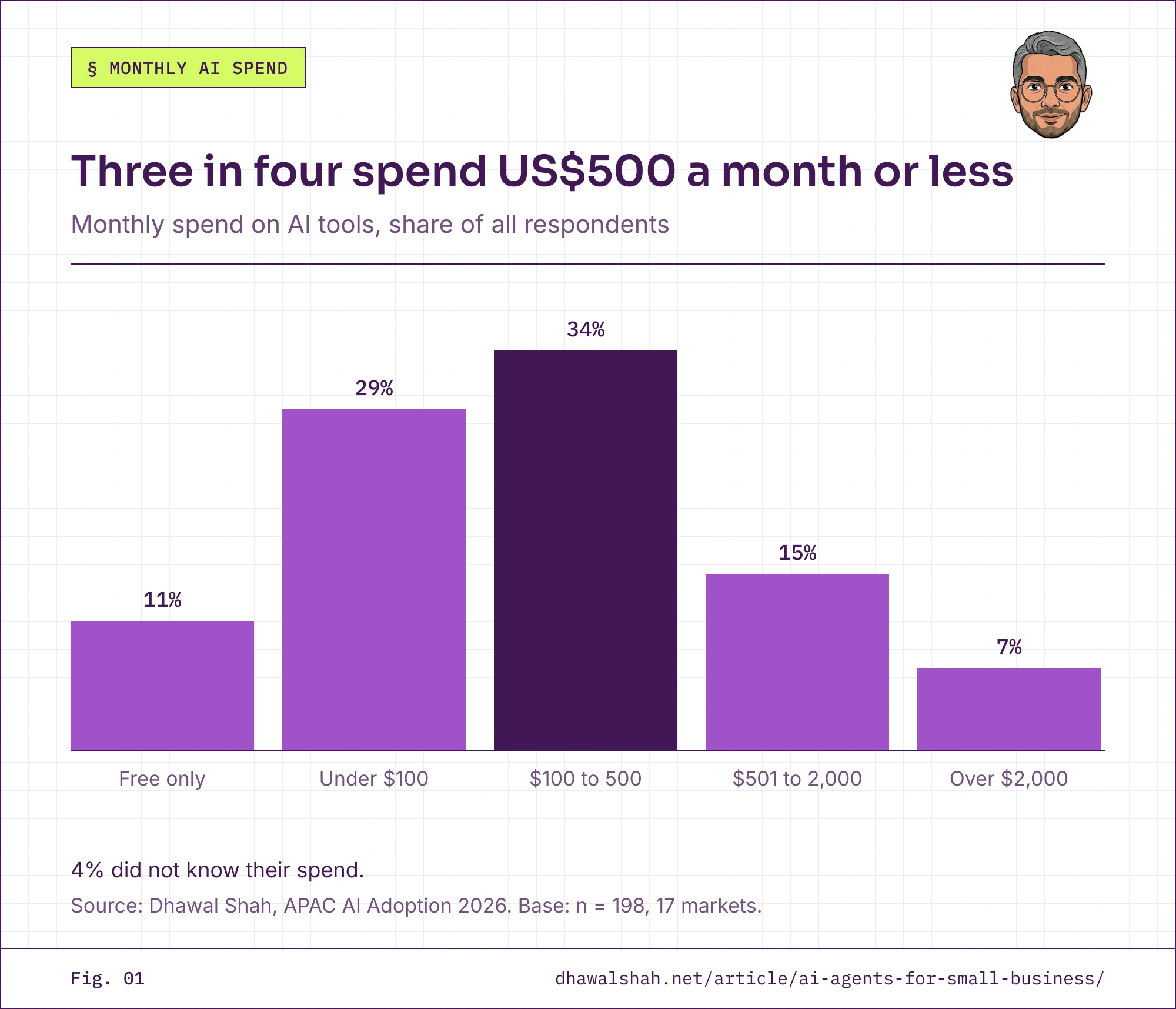
- 74% of Asia-Pacific small businesses in my survey spend US$500 a month or less on AI, and 40% spend under US$100.
- 49% name cost as their top obstacle. But firms that use AI in one area and firms that use it everywhere complain about cost at the same rate.
- What separates the two groups is skills and time to evaluate tools, not budget.
- Firms with AI across the business report lower costs (59% vs 32%) and more revenue (28% vs 11%) about twice as often.
- Among those deep users, the ones spending over US$500 a month report revenue gains far more often. Spend pays once depth is there.
What Do AI Agents Actually Do for a Small Business?
They take a task from start to finish, using your apps, and stop to ask you at set points. A chatbot answers when you ask it something. An agent is given a goal, works out the steps, and does them. It might read your inbox each morning, draft the replies, and wait for your approval before sending.
Most small businesses start with the chatbot and grow into agents. In my survey, the most common use of AI was content and marketing, at 76% of firms. Software and coding came next (72%), then product work (54%) and internal operations (52%). Sales and customer relationship work came next at 39%, and customer support at 31% (APAC AI Adoption 2026).
Those are the areas where agents earn their keep first. Marketing and operations are full of repeat tasks with clear inputs and outputs. That is exactly the work an agent can take off your desk. Not sure how a chatbot, an automation and an agent differ? My guide to what AI agents are covers it in plain terms.
The firms in this survey are small. 91% have 50 or fewer staff, and 44% have five or fewer. So these figures describe businesses where the founder often runs the tools personally.
Citation capsule
In a 2026 survey of startups and small businesses across 17 Asia-Pacific markets, 91% with 50 or fewer staff, the most common uses of AI were content and marketing (76%), software and coding (72%), product development (54%) and internal operations (52%). Sales and CRM followed at 39% and customer support at 31%. (Dhawal Shah, APAC AI Adoption 2026, 2026)
How Much Do Small Businesses Spend on AI?
Most spend US$500 a month or less, and two in five spend under US$100. The largest single group, 34%, spends between US$100 and US$500. Another 29% spend under US$100, and 11% use free tiers only. Above that, 15% spend US$501 to 2,000 and 7% spend more than US$2,000 (APAC AI Adoption 2026).
For context, US$500 a month buys a lot. Two or three paid chatbot seats cost US$20 to 30 each. A small agent server costs me US$7 a month. The biggest cost in most agent setups is the AI model itself, and plans for that run from US$20 to 200 a month.
So the typical small firm in this region is not priced out. It can afford a working agent setup today. The question is whether it is getting value from what it already pays for.
Citation capsule
74% of Asia-Pacific startups and small businesses spend US$500 a month or less on AI tools, free tiers included, and 40% spend under US$100. The largest group (34%) spends US$100 to 500 a month; 15% spend US$501 to 2,000 and 7% more than US$2,000. Data from a 2026 survey across 17 markets. (Dhawal Shah, APAC AI Adoption 2026, 2026)
Is Cost Really What Stops Small Businesses Using AI?
No. Cost is the most common complaint, but it does not explain who gets ahead. 49% of firms named the cost of paid tools as an obstacle, more than any other answer. Data privacy came next at 29%, then skills at 24%. Almost a third, 31%, said they had no significant obstacle at all (APAC AI Adoption 2026).
The interesting part is who complains. Firms that use AI in one area named cost 52% of the time. Firms that have AI across the whole business named it 47% of the time. That is close to the same. If cost were the real barrier, the deep users would complain far less.
The answers that do differ are skills and time:
| Obstacle | AI in one area | AI across the business |
|---|---|---|
| The team lacks the skills | 32% | 18% |
| No time to evaluate tools | 24% | 9% |
| The cost of paid tools | 52% | 47% |
So the firms stuck at “one area” are mostly stuck on know-how and attention. They have not had the time to learn the tools or redesign how the work gets done. A bigger budget does not fix that. A few focused weeks usually does.
Citation capsule
Cost is the most-named AI obstacle for Asia-Pacific small businesses (49%), but it does not separate light users from deep ones: 52% of firms using AI in one area and 47% of firms using it across the business named it. What differs is skills (32% vs 18%) and time to evaluate tools (24% vs 9%). (Dhawal Shah, APAC AI Adoption 2026, 2026)
What Do Small Businesses Get From Going Deeper With AI?
About twice the results on the outcomes that matter most. I call this the depth dividend. In the survey, 51% of firms had AI embedded across several parts of the business. Another 33% used it regularly in one area. Both groups saw time savings, at 89% and 83%. The gap opened on harder results (APAC AI Adoption 2026).
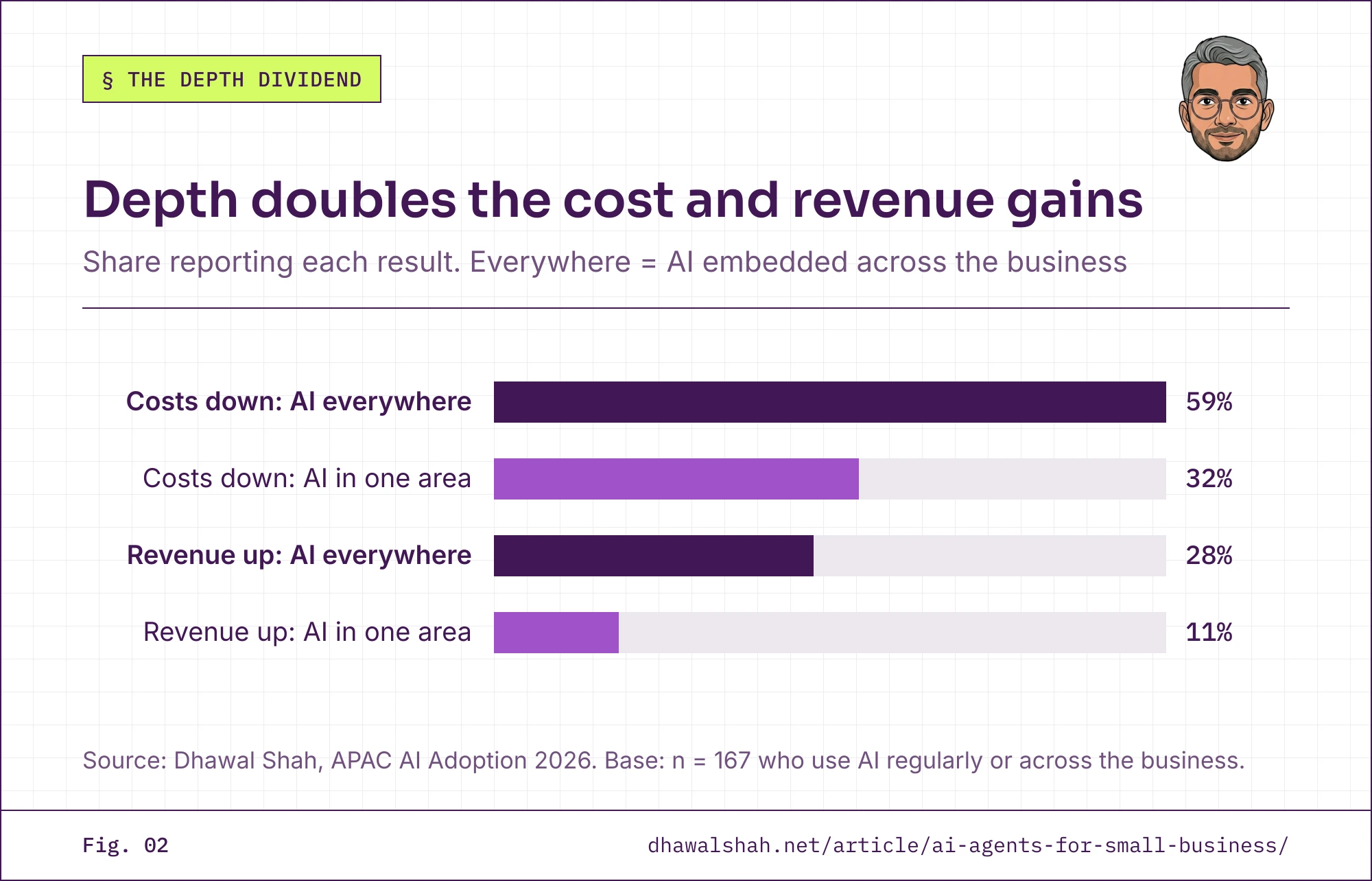
Firms with AI across the business reported lower operating costs 59% of the time, against 32% for firms using it in one area. They reported more revenue 28% of the time, against 11%. Faster product work showed the same gap, at 83% against 71%.
The reason is simple. Time saved in one task is easy to lose. The person who saved an hour fills it with other work, and the business looks the same at the end of the month. When AI runs through several connected tasks, the savings add up to fewer hours bought, faster delivery and more capacity to sell. That shows up in costs and revenue.
I write up what each of my own agents costs and what it actually does, every fortnight. Join the newsletter to get those notes before they go on the site.
Citation capsule
Asia-Pacific small businesses with AI embedded across the business report lower operating costs 59% of the time and higher revenue 28% of the time. Firms using AI regularly in only one area report those results 32% and 11% of the time. Time savings are similar for both groups (89% and 83%). (Dhawal Shah, APAC AI Adoption 2026, 2026)
When Does Spending More on AI Pay Off?
Once AI is already embedded across the business. Before that, extra spend mostly buys tools nobody has time to learn. After that, it buys capacity the business can actually use.
Among firms with AI across the business, the split by budget is sharp:
| Firms with AI across the business, spending | Report lower costs | Report more revenue |
|---|---|---|
| US$500 a month or less | 50% | 14% |
| Over US$500 a month | 76% | 53% |
Deep users who spend over US$500 a month report revenue gains almost four times as often. A caution on these figures: the two groups are small, so treat this as a strong signal from this sample, not a precise measure. The direction is clear, though, and it matches the order of events I have seen in practice.
Deep firms also spend more overall. 41% of them sit in the US$100 to 500 band and 34% spend over US$500. Among firms using AI in one area, half spend under US$100. Depth tends to come first, and the budget follows the work.
This is why “start free and stay cheap” and “buy the best tool” are both incomplete advice. The order matters. Get AI working across the business on a small budget. Then spend more on the parts that are already producing.
Citation capsule
Among Asia-Pacific small businesses with AI embedded across the business, those spending over US$500 a month reported revenue gains 53% of the time and lower costs 76% of the time, against 14% and 50% for those spending US$500 or less. The subgroups are small, but the pattern suggests spending pays off once AI is part of how the business runs. (Dhawal Shah, APAC AI Adoption 2026, 2026)
How Should a Small Business Start With AI Agents?
Pick one workflow, run it with an agent until it is reliable, then add the next. Spend more only on what is already working. In practice, that looks like four steps.
- Choose one repeat task that eats at least half an hour a day. Morning research, inbox triage, invoice processing and social posts are common first picks.
- Run it on the cheapest setup that works. A private assistant for morning briefings can cost US$2 to 5 a month in model fees on a small model. My guide to OpenClaw automations for small businesses lists seven that run on that kind of budget.
- Give it a checkpoint. Any agent that can send email or spend money should wait for your approval until you trust it.
- Measure it for a month. If it saves real hours, connect it to the next task. If it does not, fix it or drop it before adding anything new.
My own setup followed that order. My first private AI assistant ran morning briefings for about US$30 a month. My work agent, Hermes, started on a US$6 server and still costs under US$20 a month, server and model use included. As more agents went into daily use, my spend rose. My marketing agents now cost US$529 to 579 a month, mostly shared model plans, and I break that down in AI Agents for Marketing.
Both kinds of spend made sense at the time. The first was the cost of learning. The second was the cost of running work I already knew paid off.
The skills gap is the harder part, and it does not need a large budget. It needs one person with the time to own the tools. If that person is you, block two hours a week for it. If it is your team, short, hands-on training on their own tasks closes the gap faster than any new subscription. My AI workshops are built for exactly that.
Subscribers get new research and the results of my next survey before they go on the site.
Join the newsletter
The full results, including the breakdown by market, are in the APAC AI Adoption 2026 report. The founder survey is now closed. If you work in HR or L&D in Asia-Pacific, the APAC AI Upskilling Survey 2026/27 is open. It takes about five minutes, and respondents see the report before it goes public.
Frequently Asked Questions
How much should a small business spend on AI per month?
Most Asia-Pacific small businesses spend US$500 a month or less, and that is enough to run working AI agents. Start small, under US$100 if you can, while you get one workflow reliable. Spend more once AI runs across several parts of the business, because that is when extra spend shows up in costs and revenue.
Are AI agents worth it for a small business?
Yes, if you use them across the business rather than for one task. In my 2026 survey, small firms with AI embedded across the business reported lower costs 59% of the time and higher revenue 28% of the time. Firms using AI in only one area reported those results 32% and 11% of the time.
What is the biggest obstacle to AI in small businesses?
Cost is the most named obstacle, at 49% of firms, but it is not what holds them back. Light and deep users complain about cost equally. What separates them is skills (32% vs 18%) and time to evaluate tools (24% vs 9%). The fix is time and training, not a bigger budget.
Can a small business use AI agents for free?
Partly. 11% of the firms in my survey use free tiers only. Free tiers work for testing, but most useful agents need a paid model plan or API access. A simple self-hosted agent can run for under US$20 a month, server included, so the step up from free is small.
What are the best AI agent use cases for a small business?
Start with repeat work that has clear inputs and outputs. In my survey the most common areas were content and marketing (76% of firms), coding (72%), product work (54%) and internal operations (52%). Good first agents handle morning research, inbox triage, invoice processing or social posting, with a human approval step before anything is sent.
More on AI for business: AI for Business | Related: APAC AI Adoption 2026 report | ChatGPT vs Claude vs Gemini in Asia-Pacific | What Are AI Agents?