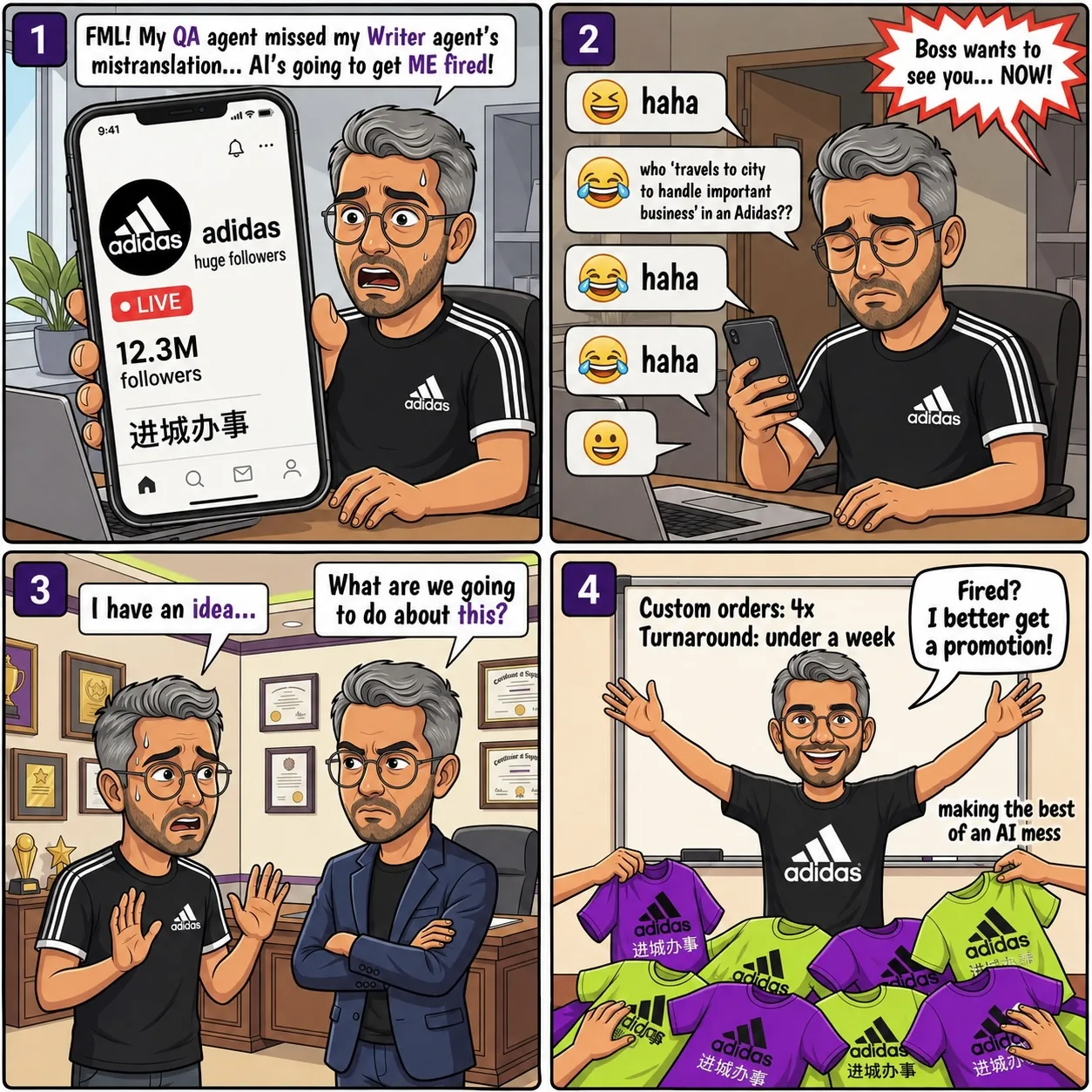
The idea behind the cartoon
The agent chain in this cartoon is invented. Everything printed on the T-shirts is real.
In early June 2026, an Adidas product page in China suggested pairing a jacket with jeans for “errands around town”. The machine translation turned that into 在城里办事, which in Mandarin sits much closer to “going into the city to handle official business”. It sounds like a villager putting on good clothes to catch the bus to the county office, not like sportswear copy. The words were accurate. The tone was wrong, and Xiaohongshu users spotted it within hours.
Adidas fixed the listing and then did the more interesting thing. Its Chinese social team replied to users in the same tone as the joke, recommended outfits suitable for handling important city business, and by 2 June was selling a custom-printed T-shirt through its app, mini-programme and five stores, at 448 yuan, fifty units a day. Online, the joke had already compressed 在城里办事 (handling business in town) into the snappier 进城办事 (going into town to handle business), and that shorter phrase is the one that got printed. Custom print orders across stores reportedly ran around four times higher afterwards. From bad translation to a product you could buy took less than a week. Panel four is the documented part of this cartoon.
The QA agent is the part I added, because that is where a lot of this work is heading: one AI writes, a second AI checks, and no person reads the result before it goes out. A QA agent does not know something is wrong just because the word QA is in its name. It checks only what it has been told to check. Ask it whether the translation is accurate, and 在城里办事 passes, because it is accurate. Nobody told it to ask the question any local reader answers in a second, which is whether this sounds like something a sportswear brand would say. No instruction, no check. The mistake goes through with a green tick on it.
Chain agents together and this gets worse. When a person hands over shaky work, the shakiness usually shows. When one agent hands work to the next, the handover always looks clean and confident, whether the work is right or not. Nothing in it warns that a native speaker would wince. Humans using AI already make mistakes faster than they used to. Agents passing work to each other make them faster still, and carry them further down the line before anyone notices.
The question worth asking about any agent workflow is a plain one. What is this agent allowed to do before a person sees its work? Letting an agent draft copy is a cheap permission: if the draft is bad, you bin it. Letting it publish that copy live, into a market where nobody on the approving side reads the language, is an expensive one. The two get granted together far more often than they should.
The part of the Adidas story worth copying has nothing to do with AI. Its Shanghai stores already offered in-store print customisation before any of this happened, which is the only reason a T-shirt could exist 48 hours after a meme. The recovery machine was already built and paid for. Generate as fast as you like, but assume something will go out wrong eventually, and decide now what you can do in the two days after it does.