The Difference Between AI Chat and Agentic Coding

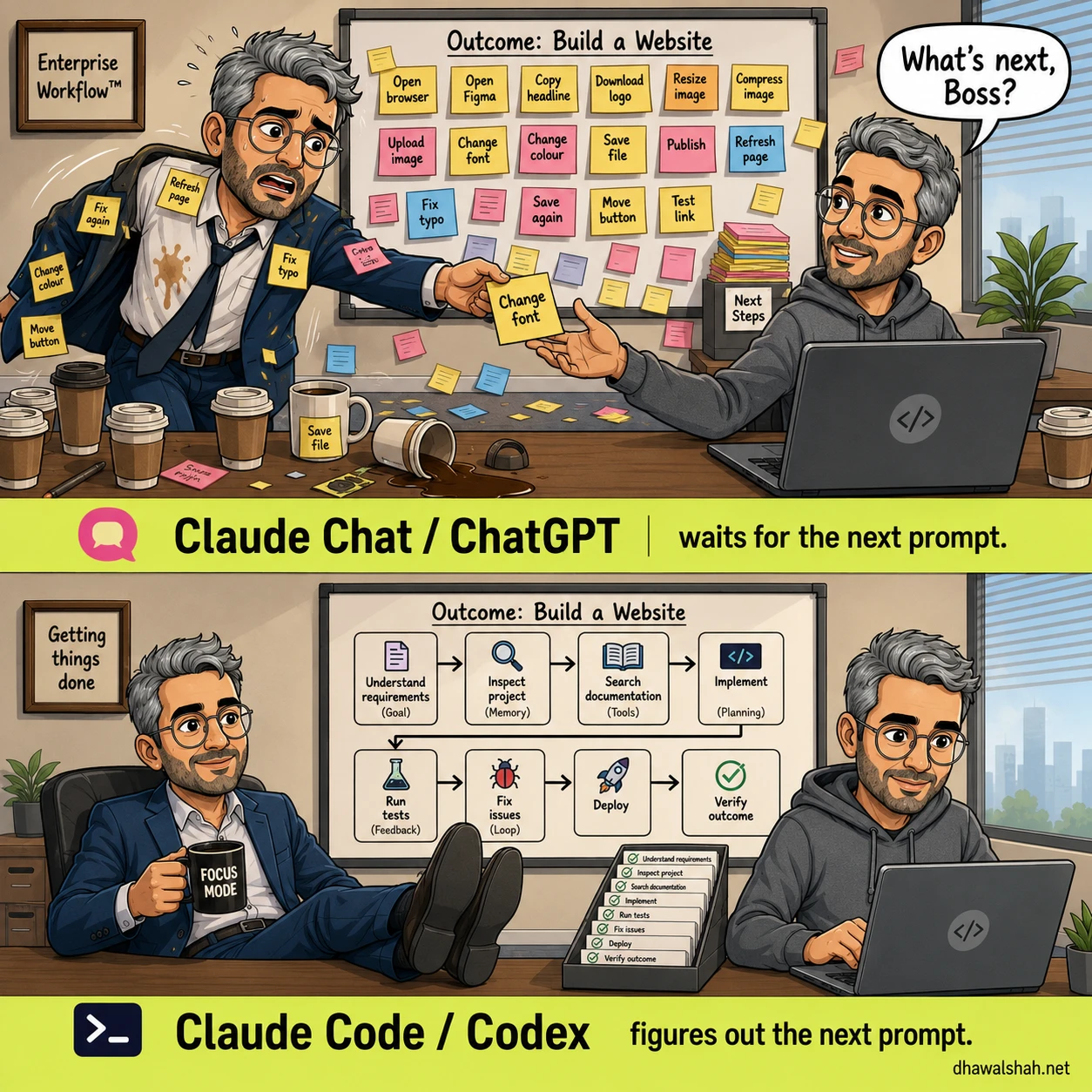
Two-panel cartoon contrasting AI chat with agentic coding. Top panel: a frazzled, coffee-stained boss hands his developer a stream of sticky-note micro-instructions like change font, fix typo and refresh page off a whiteboard labeled Outcome: Build a Website, under the heading Enterprise Workflow, while Claude Chat / ChatGPT waits for the next prompt. Bottom panel: the same two people relaxed with feet up, a whiteboard shows a self-running loop of understand requirements, inspect project, search documentation, implement, run tests, fix issues, deploy, verify outcome, under the heading Getting Things Done, while Claude Code / Codex figures out the next prompt on its own.

The biggest shift hasn't been a smarter chatbot — it's moving from "here's the next prompt" to "here's the outcome, figure out the next step." That change sounds small. It isn't.

Link copied successfully
Claude CodeCodexagentic codingAI agentsAI chat
29 July 2026
Panel-by-panel transcript

Panel 1 — labeled "Enterprise Workflow™." A disheveled, coffee-stained boss covered in sticky notes reading "Fix again," "Change colour," "Move button," "Refresh page" and "Fix typo" hands his developer another note, "Change font," off a whiteboard titled "Outcome: Build a Website" that's covered in dozens of micro-task sticky notes: open browser, open Figma, copy headline, download logo, resize image, compress image, upload image, change font, change colour, save file, publish, refresh page, fix typo, save again, move button, test link. The developer, sitting with a laptop, asks "What's next, Boss?" surrounded by empty coffee cups. Caption: "Claude Chat / ChatGPT waits for the next prompt."

Panel 2 — labeled "Getting Things Done." The same boss now relaxes with his feet up holding a mug that reads "Focus Mode," while the developer works calmly at a laptop. The whiteboard, still titled "Outcome: Build a Website," now shows a closed self-running loop: Understand requirements (Goal) → Inspect project (Memory) → Search documentation (Tools) → Implement (Planning) → Run tests (Feedback) → Fix issues (Loop) → Deploy → Verify outcome — with each step already ticked off on a checklist beside the developer. Caption: "Claude Code / Codex figures out the next prompt."

The idea behind the cartoon

Every “AI can code now” conversation I have eventually collapses into the same confusion: chat-based AI and agentic AI get talked about as one category, when the actual work of using them looks nothing alike.

Chat is prompt-by-prompt. You say “change the font,” it changes the font, then it waits. A finished, working website has to be assembled by you, one instruction at a time, which is why the top panel is a boss buried in sticky notes handing off micro-tasks nobody upstream ever wrote down as a plan.

Agentic coding starts from the outcome instead. You describe what “done” looks like, and the system runs its own loop: understand the requirement, inspect what already exists, search for how to do it correctly, implement, test, fix what breaks, deploy, verify, all without you supplying every intermediate step. Anthropic describes Claude Code’s loop in exactly those terms, and OpenAI positions Codex the same way, as software that completes engineering work end-to-end rather than answering one prompt at a time.

The model did not get smarter between these two panels. The unit of instruction changed from a task to an outcome, and that is the difference this cartoon is actually about.

Dhawal Shah
Dhawal Shah

14 years building businesses across Asia. Co-founded 2Stallions (40+ person agency), launched ChutneyAds (AI-powered ad network), and has worked with 30+ startups as advisor and investor. He draws these between building things.

Subscribe to the newsletter

Get Practical Insights Every 2 Weeks.

No spam. Ever.