


Marketing is full of people who will tell you what works. Most of them are selling the thing they say works.
I have spent 14 years in digital marketing. I co-founded 2Stallions, grew it to a 40+ person agency across Singapore, Malaysia, Indonesia, and India, and ran campaigns for clients like RedBull, Epson, and Sony. I have watched the industry cycle through mobile-first strategies, social media dominance, the privacy crackdown, and now AI reshaping everything. Through all of it, three principles have stayed constant: measure before you spend, build systems not campaigns, and cut what does not compound.
This page is where I collect my thinking on marketing and growth. Not a step-by-step guide. More a set of principles I come back to when decisions get complicated. The articles linked below go deeper on specific topics. This page is the operating philosophy underneath.
Measure Before You Spend
If I had one rule for every marketing leader, this would be it. Before you spend a dollar on advertising, build your measurement infrastructure.
I have watched companies burn through hundreds of thousands in ad spend with no way to tell which channels drove revenue. They looked at impressions and convinced themselves things were working. Then the board asked for ROI, and everyone scrambled.
Measurement is not analytics. Analytics is charts and dashboards. Measurement is knowing, with confidence, what happens when you invest $1 in channel X versus channel Y, and being able to act on that knowledge. Most teams have analytics. Very few have measurement.
What does measurement infrastructure actually look like? Proper event tracking across every funnel stage. Attribution that goes beyond last-click. A single source of truth for revenue data, not five spreadsheets that disagree. Clear definitions that the entire team shares, so when someone says “conversion,” everyone means the same thing.
Why most teams skip this
Measurement is boring. It does not look good in a board presentation. Nobody gets promoted for implementing UTM conventions. But every team I have worked with that struggled to scale marketing had the same root problem: they could not tell what was working.
The sequence matters. Measurement first, then channels, then scale. Most teams do it in reverse. They pick channels based on a competitor’s strategy, scale spend based on gut feel, and try to measure after the fact. That is how marketing budgets disappear.
What to track at each stage
- Awareness: Branded search volume, share of voice, new visitor traffic by source
- Consideration: Engagement depth, content consumption patterns, return visit frequency
- Conversion: Cost per acquisition by channel, pipeline velocity, close rates
- Retention: Churn rate, net revenue retention, customer lifetime value
- Advocacy: Referral rate, NPS, review volume
Retention metrics are the ones I ask about first in any advisory conversation. If a CMO cannot tell me their 90-day retention rate, that tells me more about their marketing maturity than anything on their media plan.
I wrote about how this measurement mindset applies to team-level decisions: Why Data-Driven Decision Making Belongs With Teams, Not Boards.
Systems, Not Campaigns
A campaign has a start date and an end date. When it stops running, the results stop too. A system compounds. What you build today continues working next month and next year.
SEO is a system. A library of content that drives traffic months after you publish it. A referral programme where every new customer brings another is a system. An email nurture sequence that converts leads while your team sleeps is a system. A paid social campaign that stops delivering the moment you pause spend is not.
Most marketing organisations are structured around campaigns. There is a Q1 campaign, a product launch campaign, a seasonal campaign. Each one starts from scratch. Each requires new creative, new briefs, new approvals. The energy spent on campaign launches that generate a temporary spike and then fade is staggering.
The shift I recommend: figure out the three or four systems that drive 80 percent of your growth, and spend most of your time making those systems better. Use campaigns sparingly, layered on top of systems for specific moments.
How I think about the funnel
Five stages. Most teams over-invest at the top.

Awareness gets you on someone’s radar. SEO, content, paid social, partnerships. The goal is not impressions. It is reaching the right people with a message that earns a second look.
Consideration earns you the shortlist. Case studies, thought leadership, comparison content, retargeting. If you cannot convert attention into genuine interest, more traffic is just more waste. I always build consideration-stage content before scaling top-of-funnel spend.
Conversion turns interest into action. Landing pages, email nurture, CRO. In B2B especially, conversion is a series of small decisions, not a single moment. Your job is to reduce friction at each step.
Retention keeps customers around. Acquiring a new customer costs five to seven times more than keeping an existing one (Harvard Business Review, 2014). This is the most underrated growth lever in marketing.
Advocacy turns customers into a channel. Referrals, reviews, community, word of mouth. Every advocate reduces your future acquisition cost.
These stages are not sequential. A buyer might go from a LinkedIn post to a case study to a webinar to a trial in days. Your systems need to support that fluidity.
Cut What Does Not Compound
I have a habit that some people find aggressive: I kill channels, campaigns, and content that are not compounding. Regularly. Without sentimentality.
Every quarter, I review what is actually driving results and what is coasting on habit. The blog series nobody reads but we keep publishing because we always have. The social channel that generates vanity metrics but zero pipeline. The partnership that looked great on paper but delivered nothing in practice.
Killing underperformers is hard because people are attached to them. Someone built that campaign. Someone negotiated that partnership. Cutting it feels like cutting their work. But every dollar and hour spent on something that does not compound is stolen from something that could.
The 70/20/10 rule
I allocate budgets with a simple framework: 70 percent on channels with proven, consistent results. 20 percent on channels you are actively testing and optimising. 10 percent on genuine experiments where you might discover something new.
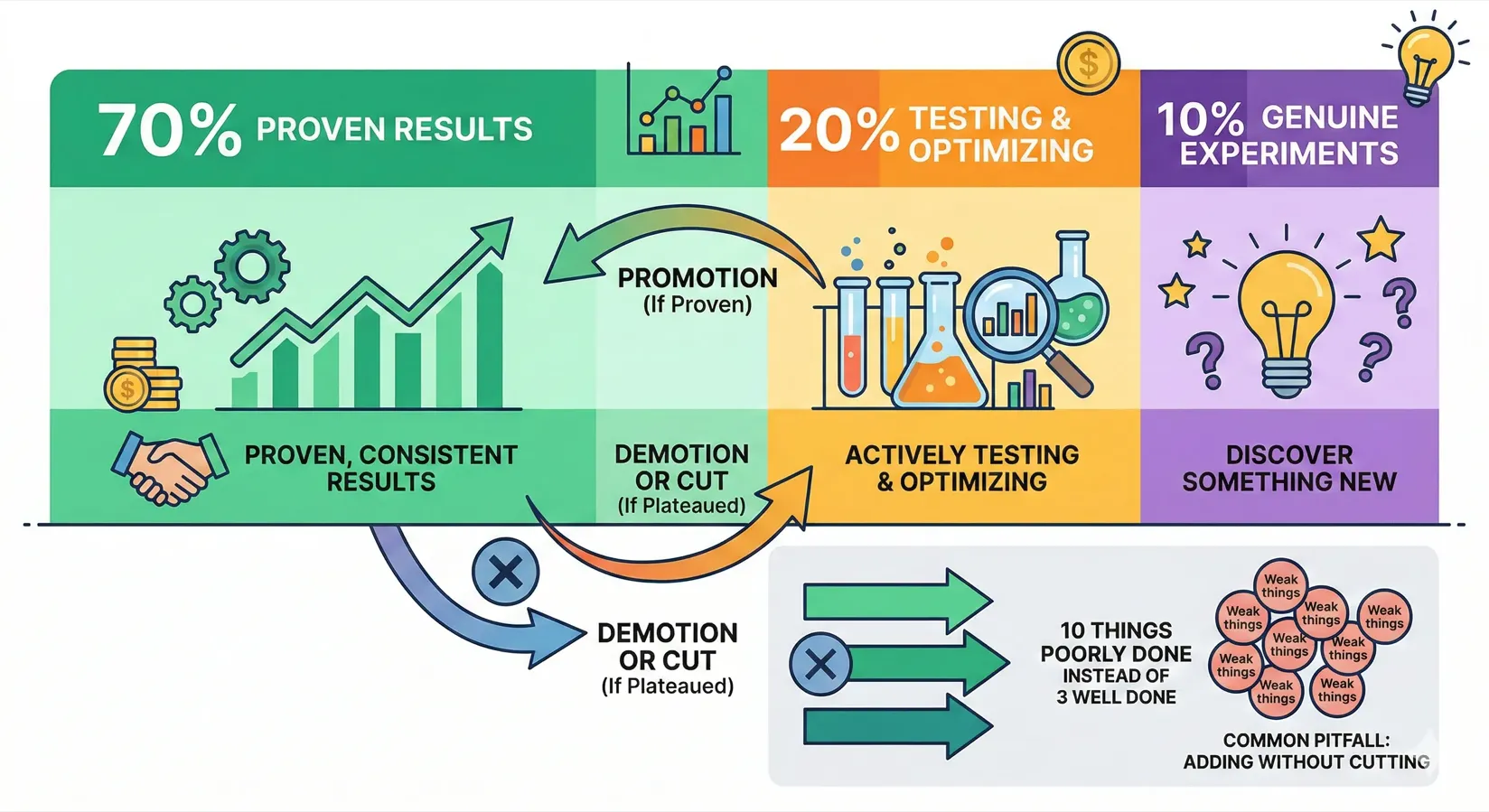
The discipline is in the transitions. When a “20 percent” channel proves itself, promote it to the 70. When a “70 percent” channel plateaus, demote or cut it. Most teams add new channels without ever cutting old ones. That is how you end up doing ten things poorly instead of three things well.
How I Think About Channels
Most CMOs ask me “which channels should we be on?” My answer is always: fewer than you think, and deeper than you are.
Channel selection should follow your audience, not industry trends. For B2B SaaS, that usually means LinkedIn and Google Search. For D2C, paid social and email. For local businesses, Google Maps and reviews. I have watched companies waste entire quarters building a TikTok strategy when their B2B buyers were on LinkedIn.
Sequencing matters as much as selection. Start with one channel and your measurement infrastructure. Prove it works. Add a second. This sounds slow, but teams that do this consistently outperform teams that try five channels at once.
Opinions I hold strongly
SEO is the highest-ROI channel over time. It requires patience, but the compounding effect is real. I treat it as non-negotiable for any serious growth effort.
Email is underrated. Litmus research shows email generates roughly $36 for every $1 spent (Litmus, 2023). The key is segmentation and relevance. Batch-and-blast is dead. Personalised, triggered sequences are not.
Messaging is where attention is shifting. A 2025 Kantar study commissioned by Meta found that 72 percent of consumers are more likely to buy from brands that offer messaging (Meta/Kantar, 2025). In Southeast Asia, WhatsApp Business is becoming a real marketing channel. The conversations feel personal in a way that batch email never will. The agencies and operators behind those messages are reaching for AI to keep up — my APAC AI Adoption 2026 survey found content and marketing is the most common first business area for AI deployment across the region.
Content marketing only works with distribution. Most content fails not because it is bad, but because the team published it and moved on. Content without a distribution plan is a tree falling in a forest.
Paid search captures demand. It does not create it. If nobody is searching for what you sell, Google Ads will not save you.
AI Is Changing Marketing (But Not How You Think)
The hype version is that AI replaces marketers. The reality is more interesting and less dramatic. AI is reshaping the workflows, tools, and decision-making speed of marketing operations. People who treat it as a productivity multiplier are getting real results. The ones waiting for it to replace their team will be waiting a long time.
Where I see AI delivering genuine value today: automating campaign reporting, generating content drafts and creative variations at speed, optimising ad spend allocation through real-time data, and handling tier-one customer queries. These are specific, measurable applications.
The harder question is what AI is doing to discovery. Traditional SEO still matters, but a growing share of information discovery now happens through AI-powered tools like ChatGPT, Perplexity, and Google’s AI Overviews. Marketers now need to think about optimising for both traditional search and AI-powered answers.
I wrote about this shift in depth: Why SEO Is Becoming AI Engine Optimisation. I have also built AI-powered marketing tools hands-on: Building an AI Tool With No Code.
What Most Teams Get Wrong
After running an agency for 14 years and advising marketing leaders across industries, I see the same patterns repeat.
Scaling spend without scaling measurement. Teams see early traction and pour money into ads without the infrastructure to know what is actually working. Scale measurement first, always.
Chasing channels instead of understanding customers. Channel strategy follows audience research, not the other way around. The question is never “should we be on TikTok?” It is “where do our best customers spend their time?”
Treating content as disposable. Content marketing only compounds when what you create today still drives traffic two years from now. If your content calendar is full of reactive posts with a one-week shelf life, you are running a news desk, not a growth engine.
Obsessing over acquisition while ignoring retention. When someone tells me they need more leads, my first question is about retention. If existing customers are leaving, more leads just accelerates the loss. Building a data-driven culture catches this early.
Underestimating the timeline. SEO takes 6 to 12 months. Content takes 12 to 18 months. Brand takes years. The teams that win are the ones who commit to realistic timelines and hold to them while competitors give up at month three.
Marketing & Growth FAQ
What is growth marketing?
Growth marketing treats the full customer lifecycle as an optimisation problem, not just the top of the funnel. It covers acquisition, activation, retention, and advocacy through data and experimentation. Unlike traditional marketing that focuses primarily on awareness and brand advertising, growth marketing is equally concerned with keeping customers and turning them into referral sources.
What does "measurement before media" mean?
It means building your analytics and attribution infrastructure before spending on advertising. Proper event tracking, attribution models, and shared metric definitions should be in place before you invest in channels. Most marketing waste comes from spending without the ability to measure what is working, which makes it impossible to optimise or scale effectively.
How do you decide which marketing channels to invest in?
Start with where your customers already spend time, not which channels are trending. Pick one or two channels where you have evidence of traction, invest deeply, and measure results before adding more. Most teams spread too thin across too many channels and do none of them well enough to compound.
How is AI changing marketing?
AI is changing marketing operations by automating reporting, generating content drafts, optimising ad spend through real-time data, and handling routine customer interactions. It is also reshaping how people discover information, with AI-powered search tools generating answers instead of showing links. Marketers now need to optimise for both traditional search engines and AI citation.
What is the most underrated part of marketing?
Retention. Acquiring a new customer costs five to seven times more than keeping an existing one, yet most marketing budgets and team structures are built around acquisition. Companies that invest in retention through onboarding, customer success, and advocacy programmes consistently outperform those that focus only on filling the top of the funnel.
What is the biggest marketing mistake companies make?
Scaling ad spend before having measurement infrastructure in place. Companies see initial traction, increase budgets, and have no way to distinguish which channels or campaigns drove actual revenue. They end up spending more and learning less. The fix is always the same: build your measurement foundation before you scale your media investment.
I write about marketing and growth from the operator side of the table, based on 14 years running 2Stallions and advising companies across Asia. If you want to discuss growth strategy for your business, let’s talk.