


The Click Is Disappearing
For twenty years, SEO was straightforward. Research keywords, publish content, earn backlinks, watch traffic climb. That playbook isn’t dead, but the game it was built for has changed. Generative engine optimisation is replacing the old model of ranking for ten blue links, and most marketing teams haven’t caught up.
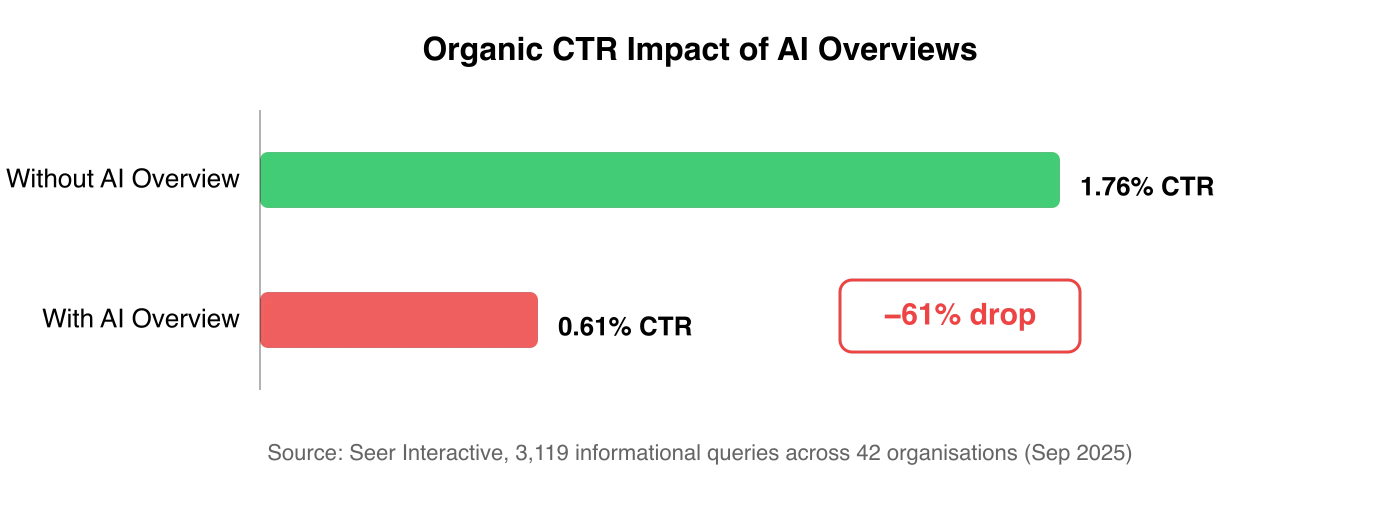
The numbers are stark. Seer Interactive tracked 3,119 informational queries across 42 organisations and found that organic CTR on queries with AI Overviews dropped 61%, falling from 1.76% to 0.61% (Seer Interactive, Sep 2025). An Ahrefs study of 300,000 keywords corroborates this: position-one organic CTR fell 58% when AI Overviews appeared (Ahrefs, Dec 2025).
Click-free outcomes are now the dominant case: roughly 65% of Google searches end without a click overall, 83% on AI Overview queries and 93% in Google’s AI Mode (SparkToro/Datos, 2026; Seer Interactive, AI Mode analysis). Google’s AI Overviews reach 2 billion users monthly as of Google’s last disclosure (Google Q2 Earnings, Jul 2025). ChatGPT crossed 900 million weekly active users in February 2026, more than double the prior year (TechCrunch, Feb 2026). Perplexity, Gemini, and Claude are pulling users away from traditional search entirely.
In Southeast Asia, where I run 2Stallions across four markets, we’re seeing this hit client campaigns in real time. If your growth model depends on organic clicks, understanding generative engine optimisation isn’t optional anymore. So what does the shift actually look like?
TL;DR: Organic CTR drops 61% on queries where AI Overviews appear, and zero-click searches now dominate at ~65% of all Google queries, rising to 83% on AI Overview queries and 93% in AI Mode (Seer Interactive, Sep 2025; SparkToro/Datos, 2026). This article covers what generative engine optimisation is, how AI in marketing changes your content strategy, a 5-step transition framework, and the mistakes most teams make when adapting.
Want the checklist version? Download the AI Engine Optimisation Checklist — 30 items across 5 steps, ready to action.
What Is Generative Engine Optimisation?
Generative engine optimisation (GEO) is the practice of structuring content so AI systems cite it as a source when generating answers. Where traditional SEO targets ranking positions on a search results page, GEO targets citations inside AI-generated responses from tools like ChatGPT, Perplexity, and Google AI Overviews.
The term was formalised in a 2024 study by researchers at Princeton, Georgia Tech, the Allen Institute for AI, and IIT Delhi, presented at KDD 2024 (Aggarwal et al., 2024). Their findings showed that specific content optimisations, including statistics with sources, expert quotes, and clear definitions, boosted visibility in generative engine responses by up to 40%.
The field is moving fast. A September 2025 study found that AI search systems show systematic bias toward earned media over brand-owned content (Chen et al., Sep 2025). A month later, researchers at CMU introduced AutoGEO, a framework for automatically learning what generative search engines prefer to cite (Wu et al., Oct 2025). The implication is clear: this isn’t a temporary trend.
You’ll also hear this called AI engine optimisation (AEO), AI SEO, or LLM SEO. The labels vary but the principle is the same: your content needs to be structured for extraction, not just discovery. Is your content built to be quoted by a machine, or just found by one?
How AI in Marketing Is Changing
AI Overviews peaked at 24.6% of Google queries in July 2025, settled to roughly 16% by November, then rebounded sharply: BrightEdge’s industry tracker now shows them on ~48% of tracked queries as of early 2026, a 58% year-on-year increase (BrightEdge via Search Engine Land, 2026). Two billion users interact with AI Overviews monthly. That alone would be enough to force a rethink. But AI in marketing isn’t just one channel shifting. It’s the entire retrieval model.
Citation replaces ranking. In traditional search, you competed for position one. In AI-generated responses, the model pulls from multiple sources and attributes them. Your goal is no longer to outrank competitors on a results page. It’s to be the reference an AI model trusts enough to cite. Seer Interactive found that brands cited in AI Overviews earn 35% more organic clicks than non-cited brands on the same query (Seer Interactive, Sep 2025).
How deeply you cover a subject now matters more than how many times you mention a keyword. Google’s AI Overviews and ChatGPT both assess source credibility before citing. Publishing one article on a topic isn’t enough. You need depth across related topics, which is why pillar pages linking to detailed articles are becoming essential architecture for AI visibility.
At 2Stallions, we started tracking AI citations alongside traditional rankings in late 2024. We quickly realised that ChatGPT, Perplexity, Gemini, and Google AI Overviews all retrieve differently. Some pull from web crawls. Some use real-time search. Some weight recent content more heavily. A page cited consistently by Perplexity may not appear in ChatGPT at all. Treating “AI visibility” as a single channel is like treating “social media” as one platform.
When someone asks “what is generative engine optimisation?” and your content opens with three paragraphs of preamble, the AI skips you. It cites the page that leads with a clear definition. Front-loading value isn’t a best practice anymore. It’s a requirement.
What We Changed at 2Stallions
When we saw the CTR data in mid-2024, we didn’t wait for a playbook. We started testing.
The first change was measurement. We added AI citation tracking to our internal workflow as part of our Search Everywhere Optimisation (SEO) service. For key topics, we search across ChatGPT, Perplexity, and Google AI Overviews monthly to check whether content appears. The AI Visibility Audit tool I built as a prototype started as a way to test the concept and became something we offer to clients during onboarding. That process, manual and imperfect as it is, catches gaps that traditional rank tracking misses entirely.
Then came content restructuring. We rewrote service pages and key blog posts to lead with direct answers, add structured data, and include the citable elements the Princeton GEO study identified: statistics with sources, expert quotes, and clear definitions (Aggarwal et al., 2024). What surprised us was how quickly the changes showed up. Not in rankings, those moved slowly, but in whether AI tools started referencing the restructured pages.
Creating AI Content vs Optimising for AI Search
There’s a confusion I hear regularly from marketing teams: they conflate using AI to create content with structuring content so AI cites it. These are different disciplines, and treating them as interchangeable is risky.
Using AI to generate blog posts, ad copy, or social content is a production question. It’s about efficiency. Generative engine optimisation is a distribution question. It’s about whether your content appears when someone asks ChatGPT or Perplexity a question in your domain.
You can write entirely with AI and still get zero AI citations if the content lacks structure, sources, and depth. Conversely, you can write every word by hand and dominate AI-generated answers if you structure content around clear questions, include verifiable data, and build topical authority. The two skills complement each other, but they aren’t the same skill. Which one is your team actually investing in?
A Framework for Transitioning From SEO to AEO
If you’re rebuilding your content strategy for generative engine optimisation, here’s the framework I use with clients and within 2Stallions.
-
Audit your AI visibility first. Search your key topics in ChatGPT, Perplexity, and Google AI Overviews. Note whether you’re cited, which competitors appear instead, and which queries return AI-generated answers at all. Try the AI Visibility Audit to benchmark where you stand. This gives you a baseline that traditional rank tracking can’t provide.
-
Map content to questions, not just keywords. AI models are question-answering systems. Reframe your content calendar around the specific questions your audience asks, and answer them directly in the opening paragraph of each section. Content structured around clear questions and direct answers performs significantly better in generative responses (Aggarwal et al., 2024).
-
Build structured, citable content. Think of each article as a reference document an AI could extract a clean, accurate paragraph from. Tables, numbered lists, clear definitions, and cited statistics all increase your citability. This article uses every one of those elements intentionally.
-
Invest in entity authority. Backlinks still matter, but so do brand mentions, expert quotes, presence across multiple credible platforms, and consistent topical coverage. The more an AI model encounters your brand in authoritative contexts during training and retrieval, the more likely it is to cite you.
-
Track AI metrics alongside traditional ones. Organic rankings and traffic remain useful, but add AI citation monitoring to your reporting, ideally inside a decision-first marketing dashboard. Tools like Otterly.AI, Profound, and Ahrefs’ AI tracking features are emerging for this purpose. The data will be imperfect. Start measuring anyway, because by the time perfect tools exist, the early movers will already have adapted.
ChatGPT drives 87.4% of all AI referral traffic across major industries (Conductor, Nov 2025). Perplexity accounts for roughly 15% in a separate global analysis (SE Ranking, 2025). Where your audience searches determines which platform you optimise for first.
30 items across 5 steps — audit your AI visibility, structure citable content, and track citations alongside traditional rankings.
Get the Checklist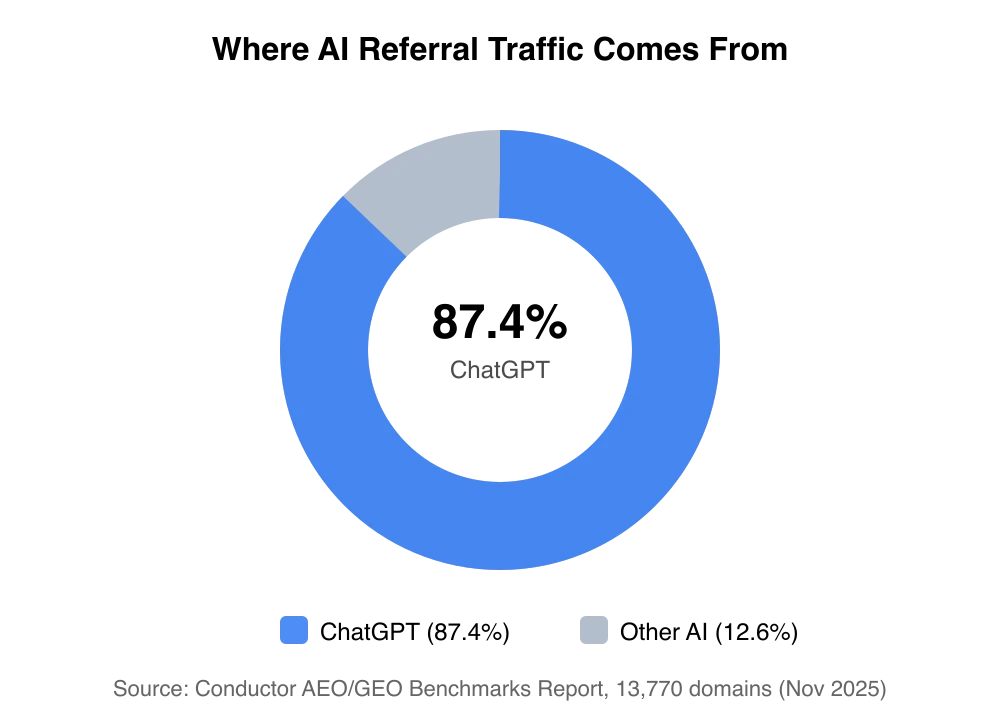
What Most Teams Get Wrong
The most common mistake is treating generative engine optimisation as a tactic you bolt onto your existing SEO workflow. Running the same keyword-stuffed playbook and hoping AI models pick it up doesn’t work. AI models are remarkably good at identifying thin, derivative content and skipping it entirely.
The second mistake is underestimating the scale. AI Overview penetration peaked at 24.6% of Google queries in July 2025, settled to roughly 16% by November, and has since rebounded to ~48% of tracked queries in early 2026 (BrightEdge via Search Engine Land, 2026). Google desktop searches per US user fell nearly 20% year-over-year (Datos/SparkToro, Q4 2025). Factor in ChatGPT with 900 million weekly active users, plus Perplexity, Gemini, and AI-integrated browsers, and the share of queries where AI mediates the answer is substantially higher. Are your quarterly reports even measuring this?
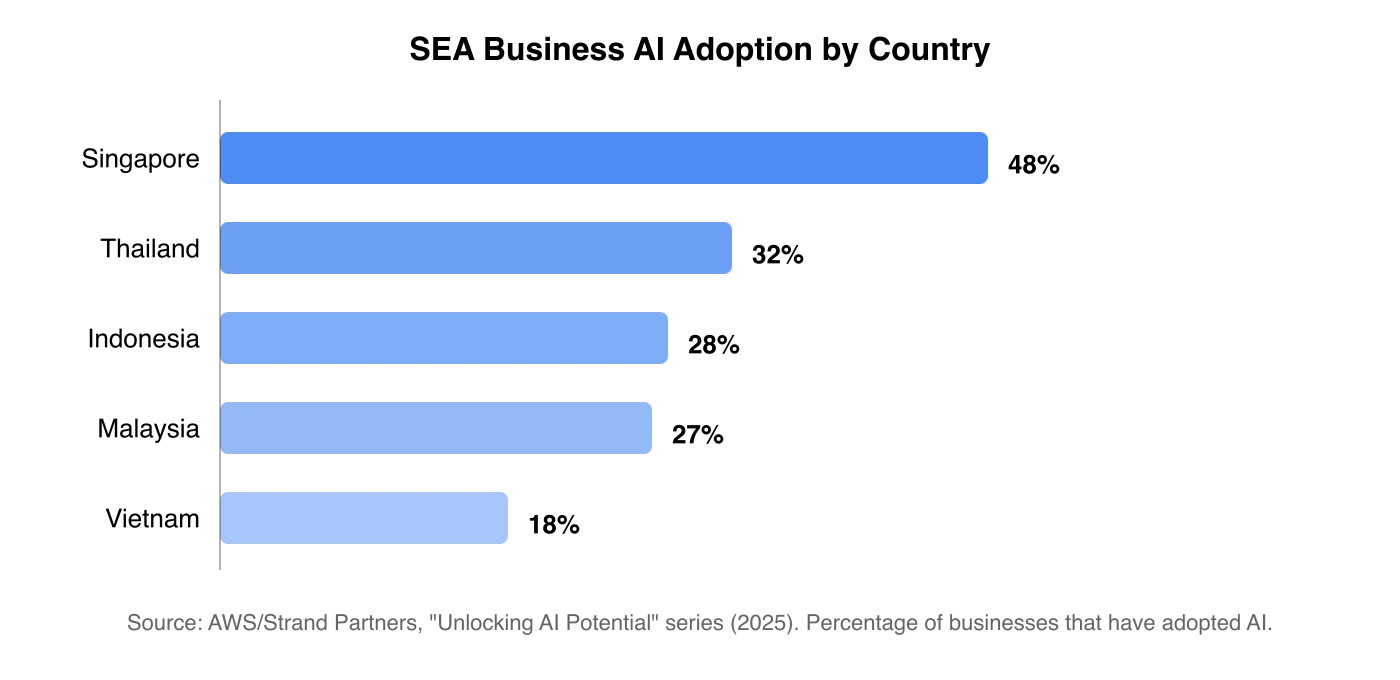
The third mistake is assuming this shift doesn’t apply to your market. In Southeast Asia, over US$55 billion has been committed to AI infrastructure across Singapore, Malaysia, Indonesia, and Thailand, with investment compounding at 25% annually (WEF, Nov 2025). Singapore leads the region with 48% of businesses having adopted AI. Thailand is at 32%, Indonesia at 28%, Malaysia at 27%, and Vietnam at 18% (AWS/Strand Partners, 2025).
If you run digital marketing in this region, your audience is already using AI search tools daily. You can’t game AI visibility the way you once gamed search rankings. There’s no equivalent of a title tag hack. What you can do is build content that is clearly authoritative, well-structured, and genuinely useful. That has always been the promise of good SEO. The difference now is that the “rankings” are citations inside AI-generated responses, and the bar for quality is higher than it’s ever been.
The five-step framework above is available as a printable checklist. Download the AI Engine Optimisation Checklist — 30 items you can work through section by section.
I run a digital marketing agency that’s adapting to this shift across four Southeast Asian markets. If your team needs to understand generative engine optimisation, let’s talk.
Frequently Asked Questions
What is AI engine optimisation (AEO)?
AI engine optimisation is the practice of structuring content so it gets cited by AI tools like ChatGPT, Perplexity, and Google AI Overviews when they generate answers. Unlike traditional SEO, which targets ranking positions on a search results page, AEO targets citations inside AI-generated responses. It involves clear definitions, sourced statistics, structured formatting, and building the topical authority AI models use to decide which sources to reference.
What is generative engine optimisation?
Generative engine optimisation (GEO) is a methodology for improving content visibility in AI-generated search responses. Formalised by researchers at Princeton and Georgia Tech in a 2024 KDD paper, GEO includes adding citations, statistics, and structured answers to content. Their research found these methods boosted source visibility by up to 40% in generative engine responses across multiple query types.
How is AI used in digital marketing?
AI in marketing spans content creation, campaign automation, and audience targeting. But the most significant strategic shift is the rise of AI search: ChatGPT, Perplexity, and Google AI Overviews are pulling users away from traditional organic results. ChatGPT alone drives 87.4% of all AI referral traffic. Optimising for AI citation, not just ranking, is becoming a core marketing discipline.
How do you optimise content for AI search engines?
Lead each section with a direct answer to a specific question. Include cited statistics and expert sources. Structure content with clear headings, tables, and numbered lists that AI models can extract cleanly. Build topical depth across related articles rather than publishing standalone pieces. Then track your visibility across ChatGPT, Perplexity, and Google AI Overviews regularly, not just traditional rankings.
Is SEO dead because of AI?
No. Traditional ranking factors like backlinks, content quality, and technical SEO still matter. What's changed is where users find answers. With AI Overviews reaching 2 billion monthly users and ChatGPT processing hundreds of millions of queries weekly, optimising only for traditional search results means missing a growing share of your audience. SEO is evolving into a broader discipline that includes AI engine optimisation.
How to use AI in marketing for better search visibility?
Start by auditing whether your brand appears in AI-generated answers across ChatGPT, Perplexity, and Google AI Overviews. Restructure content to lead with direct answers, include sourced statistics, add clear definitions, and use structured data. Build entity authority through consistent topical coverage across credible platforms. Track AI citations as a core metric alongside organic rankings.
What's the difference between SEO and GEO?
SEO optimises content for search engine ranking positions, targeting clicks from a traditional results page. GEO optimises content for citation inside AI-generated responses from tools like ChatGPT, Perplexity, and Google AI Overviews. SEO focuses on keywords and backlinks. GEO focuses on citable structure, source credibility, and topical depth. Both matter, but GEO is becoming essential as AI mediates more search queries.
How do you track AI citations?
Search your key topics across ChatGPT, Perplexity, and Google AI Overviews monthly and record whether your content is cited. Tools like Otterly.AI and Profound are building automated tracking. Conductor's AEO/GEO benchmarks report provides industry-level data. The process is still manual and imperfect, but measuring imperfectly beats not measuring at all. Start with your top 10-20 topics and expand from there.
More on marketing and AI strategy: Marketing & Growth | Related: Building an AI Tool Without Code | AI-Powered GTM Sprint Playbook