


Everything here, I've used myself. If you buy through these links, I earn a small commission — but that's not why I wrote this.
TL;DR: Claude Managed Agents (launched April 8, 2026) is Anthropic’s infrastructure for developers building AI-powered backend features. It has no built-in chat interface. OpenClaw is a self-hosted platform you configure once and talk to every day on Telegram or WhatsApp. They don’t compete. This article explains what each one actually does, where the costs land, and how to pick.
Key Takeaways
- Claude Managed Agents is a developer API with no chat interface. You build the front end yourself (Anthropic, 2026)
- OpenClaw ships with 12+ channel integrations and 3,016+ skills, configured through markdown files with no coding required
- For 50 daily messages, OpenClaw costs under $34/month out of the box; Claude Managed Agents requires custom development before any messaging works
- Use Claude Managed Agents when building a product; use OpenClaw when you want to run an assistant
What Did Anthropic Actually Launch?
Claude Managed Agents launched publicly on April 8, 2026 as a cloud-hosted API that handles the infrastructure for running Claude as an autonomous agent (Anthropic, 2026). Before this, developers who wanted Claude to complete multi-step tasks had to write their own agent loop: the code that decides when to call a tool, what to do with the result, and how to keep the agent running across dozens of steps. That plumbing is now handled by Anthropic.
The service is currently in public beta. Every API request requires a specific header to access it. Four features are in a separate research preview and require a waitlist request: outcomes, multi-agent coordination, memory, and analytics.
What Claude Managed Agents gives you:
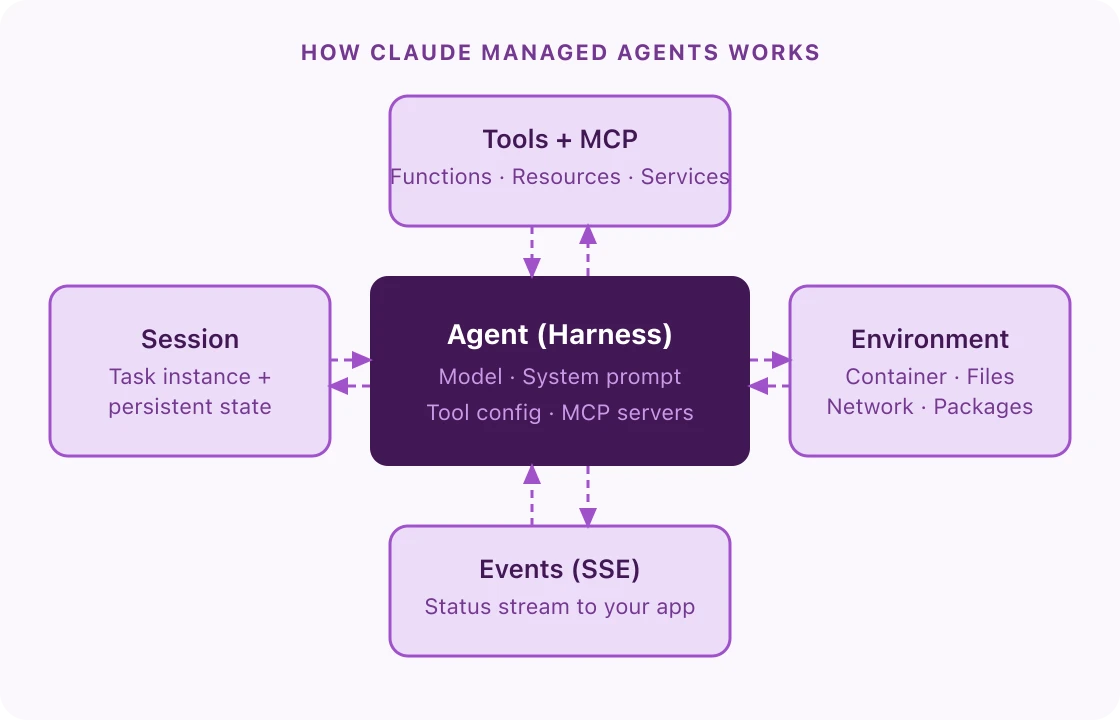
- A cloud container where Claude can run shell commands, read and write files, browse the web, and execute code
- Persistent session state across a long-running task
- Event streaming via server-sent events, so your application receives status updates as the agent works
- Built-in rate limits: 60 create requests and 600 read requests per minute
What it doesn’t give you: a user interface. Claude Managed Agents has no chat window, no built-in channel, and no way to talk to it directly. You build the interface yourself, or your product’s existing interface handles it.
This absence of a user interface is more significant than most coverage has acknowledged. Claude Managed Agents generated more than 20 YouTube tutorials in its first 48 hours, nearly all aimed at developers already writing code. If you’re not a developer and don’t have one on your team, the launch doesn’t give you anything you can use directly.
Technical Deep DiveSessions, environments, and the four core concepts
Claude Managed Agents is built around four objects. Understanding these before you build anything saves significant debugging time.
Agent: the configuration object. It holds the model (e.g., claude-sonnet-4-5-20251022), system prompt, tool definitions, any connected MCP servers, and skills. Create the agent once, then reference it by ID across sessions. For a practical look at connecting MCP servers to Claude in a production context, see how I set up ad platform MCPs for an agency workflow.
Environment: the container template. It defines which packages are pre-installed (Python, Node.js, Go, and others), what network access the container has, and any files mounted at startup. Environments are reusable across sessions.
Session: a running instance. One session represents one task. It references an agent and an environment. When a session starts, Anthropic provisions the container on their infrastructure.
Events: the message protocol. Your application sends user turns as events. The agent streams results, tool calls, and status updates back via server-sent events. The full event history is stored server-side and is fetchable at any point.
A minimal Python call to start a session:
import anthropic

client = anthropic.Anthropic()
agent = client.beta.agents.create(
    name="research-agent",
    model="claude-sonnet-4-5-20251022",
    system_prompt="You are a research assistant.",
)
session = client.beta.agents.sessions.create(agent_id=agent.id)
All calls require the beta header anthropic-beta: managed-agents-2026-04-01. The SDK sets it automatically. Direct HTTP requests need it in the headers manually.
Rate limits apply per organisation, not per user. There is no way to purchase higher limits in the current beta.
What Is OpenClaw, for Anyone New to It?
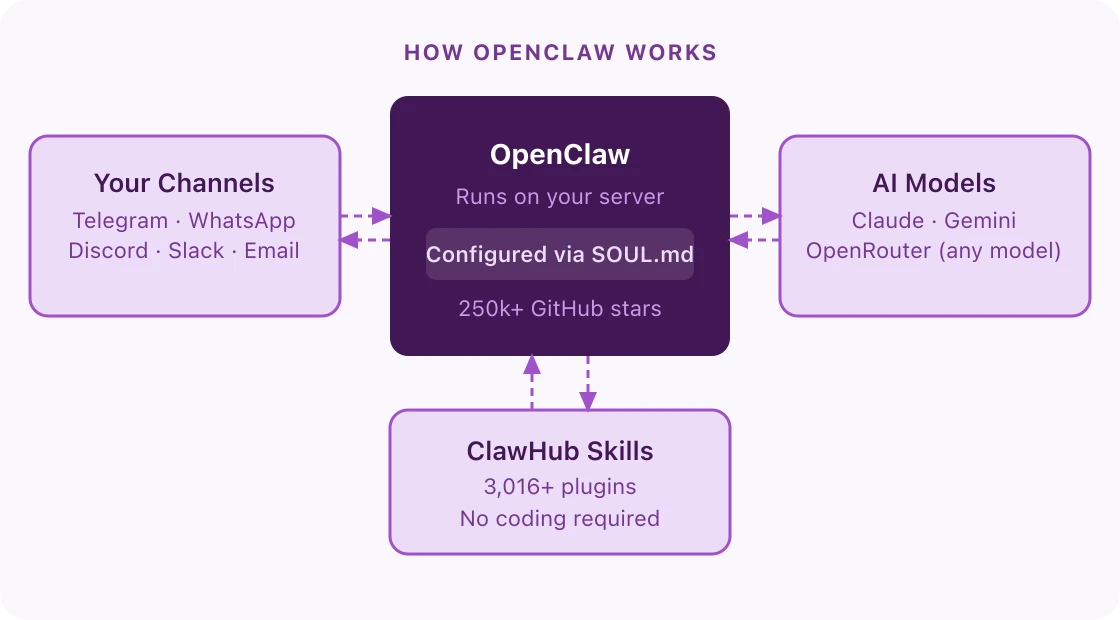
OpenClaw is an open-source agent platform that runs as a private AI assistant on a server you control (GitHub, 2026). You configure its behaviour through a markdown file called SOUL.md, with no programming required. The primary interface is a messaging app: Telegram, WhatsApp, Discord, Slack, or one of 12+ other channels that connect via plugins.
The platform reached 250,000 GitHub stars within months of launch, surpassing React to become the most-starred open-source project on GitHub (Yahoo Finance, 2026). Its creator, Peter Steinberger, later joined OpenAI. Sam Altman described him as “a genius with a lot of amazing ideas about the future of very smart agents” (TechCrunch, 2026).
The core appeal is ownership. Your conversations stay on your server. Your agent can read your email, check your calendar, and deliver a morning briefing without any of that data touching a third-party platform. OpenClaw supports multiple AI models (Claude, Gemini, and others via OpenRouter), so you’re not tied to a single provider.
For a full walkthrough of what OpenClaw does day-to-day, see how I built a private AI assistant that runs my morning briefings.
Technical Deep DiveArchitecture, SOUL.md, and the heartbeat system
OpenClaw runs as a containerised application on your VPS, managed via Docker Compose. The main process listens for incoming messages from enabled channel plugins, routes them to the configured AI model, executes tool calls, and returns the response.
SOUL.md is the primary configuration file. It defines the agent’s name and personality, which AI model to use as default and fallback, which skills to load, and any custom workflow instructions.
A minimal SOUL.md:
# Nexus

You are a private business assistant. Be concise and direct.

## Default model
claude-sonnet-4-5

## Fallback model
gemini-flash-lite

## Skills
- morning-briefing
- email-triage
- calendar-summary
The heartbeat system handles proactive tasks. You define scheduled checks in a heartbeat block. The agent wakes at the specified interval, runs the configured skills, and messages you with results, with no prompt from you. This is how daily briefings work.
ClawHub is the skill marketplace. As of April 2026, it holds 3,016+ published skills. Skills are markdown files that extend the agent’s capabilities. A Telegram command installs them in under a minute. Security note: researchers found 341 malicious skills on ClawHub (11.3% of the marketplace at the time of the study) in early 2026 (The Hacker News, 2026). Reviewing skills before installation matters.
The recommended server for a single-user setup: DigitalOcean 4GB / 2vCPU droplet running Ubuntu 24.04, at $24/month in the Singapore region.
The Actual Difference, Explained in Plain Language
Search volume for “openclaw vs claude” spiked 7,100% in February 2026 (DataForSEO, 2026), suggesting large numbers of users discovered both simultaneously and faced the same choice. The confusion is understandable. Both involve Claude as the AI model. Both run agents. That’s roughly where the overlap ends.
Here’s the clearest way to see it:
If you wanted to build a competitor to Intercom (a B2B SaaS product where AI handles customer support tickets automatically), Claude Managed Agents gives you the backend engine to do it. You’d write code that creates a session for each incoming ticket, lets Claude work through it, and returns the result to your existing interface.
If you wanted an assistant that reads your emails every morning, sends you a briefing on Telegram before 8am, and responds when you ask it to book a meeting. OpenClaw is what you install on a $24/month server and configure over a weekend.
One is developer infrastructure. The other is a finished product you configure.
I’ve been running OpenClaw in production at my agency since early March 2026. It handles daily briefings, email triage, and client summaries. Nothing about the Claude Managed Agents launch changes that setup. It’s not designed to replace it. What it does give the developer side of our business is a faster path to building Claude-powered features into client-facing tools. They sit at different layers of the same stack.
Feature Comparison: Six Dimensions That Matter
OpenClaw supports 12+ channel integrations and multi-model routing, while Claude Managed Agents supports the Claude family only. That single difference reflects the two products’ entirely different goals (Anthropic, 2026; OpenClaw GitHub, 2026). Here’s the full picture:
| Claude Managed Agents | OpenClaw | |
|---|---|---|
| Who it’s for | Developers building SaaS features | Individuals and small teams wanting an assistant |
| Interface | API only (no built-in chat) | 12+ channel plugins (Telegram, WhatsApp, Discord, Slack) |
| AI model | Claude only | Claude, Gemini, and others via OpenRouter |
| Data location | Anthropic’s cloud infrastructure | Your server |
| Setup requirement | Developer with API experience | Non-coders can configure via markdown |
| Cost model | Per-token + $0.08/session-hour compute + dev costs | Fixed server ($24/month) plus API usage |
| Multi-agent | Research preview (waitlist required) | Native support via sub-agent skills |
| Memory | Research preview (waitlist required) | Persistent memory via ClawHub skills |
Technical Deep DiveModel access, tool availability, and API surface
Model access
Claude Managed Agents supports the Claude model family only. Model selection is set per-agent when you create the agent object. There is no mid-session model switching and no fallback routing to non-Claude models.
OpenClaw supports any model accessible via OpenRouter, which includes GPT-4o, Gemini 1.5 Pro, Mistral, and others alongside Claude. Default and fallback models are set in SOUL.md. Skill files can specify model overrides for cost-sensitive tasks.
Tool availability
Claude Managed Agents built-in tools:
- Bash (shell execution in the container)
- File operations (read, write, edit, glob, grep)
- Web search and fetch
- MCP server connections
OpenClaw built-in tools vary by installed skill. Core capabilities include email (Gmail or IMAP), calendar (Google Calendar), Telegram and WhatsApp controls, web search, and web scraping. Advanced tools come via ClawHub or custom skill files.
API surface
Claude Managed Agents exposes these primary REST endpoints:
POST /v1/agents: create an agentPOST /v1/environments: create an environmentPOST /v1/agents/{id}/sessions: start a sessionPOST /v1/agents/{id}/sessions/{session_id}/events: send a user turnGET /v1/agents/{id}/sessions/{session_id}/events: stream events back
The Python and TypeScript SDKs wrap these. All endpoints require the managed-agents-2026-04-01 beta header.
OpenClaw has no external API by default. Control happens through the channel interface (Telegram commands, WhatsApp messages). An HTTP API mode is available as a community skill if programmatic access is needed.
How the Costs Actually Compare
For a non-developer running 50 messages per day with routine tasks (briefings, email triage, quick research), OpenClaw costs roughly $24/month for the server plus $5-10/month in API usage. Total: $29-34/month.
The same workload through Claude Managed Agents isn’t directly comparable because there’s no built-in channel. You’d need to build the Telegram or WhatsApp integration yourself, or hire a developer. One perspective shared publicly puts operational costs at “$2.58 to fulfill a $1,000 service” for an agency using managed sessions for client research tasks (Corey Ganim on X, 2026), though that excludes the up-front development cost to build the interface layer.
The number that matters isn’t per-message API cost. It’s the cost of the interface layer that Claude Managed Agents doesn’t include. Building a Telegram bot with session management, credential storage, and error handling typically runs two to four weeks of a developer’s time, or several thousand dollars of contractor work. OpenClaw ships with that layer already built.
Technical Deep DiveSession pricing mechanics and token attribution
Claude Managed Agents pricing has two components. First, standard Claude token rates apply exactly as they do on the Messages API. Second, there’s a compute charge of $0.08 per session-hour for the active runtime: the sandboxed container, state management, checkpointing, and tool orchestration Anthropic provides. The first 50 session-hours per day across your organisation are free. Runtime only accrues while a session is actively running, so idle time waiting for user input doesn’t accumulate charges.
What drives token costs up is session length. A session that completes 30 tool calls passes the full tool call history as context on each subsequent model call. This is where costs grow faster than simple message-per-day estimates suggest.
Built-in prompt caching reduces this significantly for sessions with stable system prompts. Cache hits are priced at a fraction of standard input tokens. For agents with long system prompts (common when MCP servers inject tool documentation), caching the system prompt can cut input token costs by 60-80%.
Compaction handles context that grows too large. Claude Managed Agents compresses earlier turns into a summary automatically. For tasks under 30 minutes, compaction is unlikely to trigger.
For OpenClaw, cost control comes from model routing. Setting a cheaper fallback (Gemini Flash Lite is currently free for low usage) for routine tasks keeps daily API spend predictable. High-complexity tasks route to Claude; routine briefings route to the free-tier model.
Which Should You Choose?
The answer follows from three questions.
Are you building a product or running an assistant?
If you’re building a product (a SaaS tool, a client-facing agent, a feature you’re shipping to users), Claude Managed Agents removes weeks of infrastructure work. Your engineering team builds the interface; Anthropic handles the agent runtime, sandboxing, and state management.
If you want an assistant for yourself or your team: something you talk to every morning and that runs your recurring workflows, OpenClaw is what you install. It’s ready on day one. You don’t need to build anything.
Do you have a developer, or are you the person setting this up?
Claude Managed Agents requires programming. Not deep expertise, but you need to be comfortable with REST APIs, server-sent events, and async patterns. There’s no configuration file a non-developer can edit to change behaviour.
OpenClaw has a configuration file (SOUL.md) that non-developers can edit. The install requires terminal access and copy-pasting commands, but no coding. For the full walkthrough, see the OpenClaw install guide. If you want more context on how far non-coders can get with AI tools generally, see how I built an AI tool without writing any code.
How much does data ownership matter?
With Claude Managed Agents, Anthropic’s API terms don’t permit training on your data by default, so ownership isn’t really in question. What you give up is physical control: session data resides on their infrastructure, subject to their retention schedules, and you can’t audit or purge it on demand. For regulated industries or client data that carries confidentiality obligations, that matters.
With OpenClaw on your own server, you control exactly where data lives, how long it’s kept, and who can access it. For use cases involving email, calendars, or client communications, that level of control is what some teams specifically need.
Already using OpenClaw? The OpenClaw security audit guide covers the three issues I found on my own production setup, and exactly how to fix them.
Frequently Asked Questions
Does Claude Managed Agents replace OpenClaw?
No. Claude Managed Agents is a developer API for building agent-powered features inside applications. OpenClaw is a ready-to-use assistant that runs on your own server. They solve different problems for different users. Most OpenClaw users don't write code at all. Claude Managed Agents requires a developer before it's useful to anyone.
Can OpenClaw use Claude Managed Agents under the hood?
Not directly. OpenClaw connects to AI models via the Messages API or OpenRouter. Claude Managed Agents uses a separate API surface with different primitives: agents, environments, sessions. An advanced developer could build an OpenClaw skill that calls Claude Managed Agents sessions, but it would require custom work and wouldn't use OpenClaw's standard model routing.
Is Claude Managed Agents more expensive than the standard Messages API?
Claude Managed Agents charges standard Claude token rates plus $0.08 per session-hour for the active compute environment. The first 50 session-hours per day per organisation are free, and idle time doesn't accrue charges. Token costs also run higher than simple API calls because long sessions accumulate tool call history as context. Built-in caching mitigates this for sessions with stable system prompts.
Which is better for a small business automating admin work?
OpenClaw. Admin automation typically means email triage, calendar management, briefings, and Telegram or WhatsApp responses. All of these work with OpenClaw's built-in channel integrations and ClawHub skills, configured through markdown. Claude Managed Agents would require building custom channel integration before any of that automation is possible. For a practical guide to what OpenClaw handles day-to-day, see how I built a private AI assistant that runs my morning briefings. For specific automation workflows — WhatsApp support, invoice processing, social scheduling — see 7 OpenClaw automations for SEA small businesses.
Does OpenClaw lock you into using Claude?
No. OpenClaw supports multiple models via OpenRouter and direct API connections. You can set Claude as the default and Gemini as a free-tier fallback, and switch models at any time by editing SOUL.md. Claude Managed Agents supports only the Claude model family.
Where This Leaves You
Claude Managed Agents is the most significant developer infrastructure Anthropic has shipped since the Messages API. For engineering teams building agent-powered products, it removes real complexity. But it’s backend plumbing, not a finished tool.
OpenClaw is the finished tool. If you want an assistant running on your own server, responding on Telegram, reading your email, and briefing you before 8am, OpenClaw is what you install. The launch of Claude Managed Agents doesn’t change that. They sit at different layers of the same stack.
If you’re evaluating OpenClaw for your own setup, the install guide walks through the full process. If you want a lighter Tier 2 alternative with a self-learning loop rather than a structured config, the Hermes Agent setup guide covers that build — same self-hosted approach, smaller server footprint. If you’d rather skip the setup entirely, read on.
I handle the server, channels, and configuration. You get a working assistant without touching a terminal.
Get in Touch