


Everything here, I've used myself. If you buy through these links, I earn a small commission — but that's not why I wrote this.
When you start a company or run a small business, alignment is free at the start. Everyone is in the same room, or the same group chat, and you just talk. No one needs a system because the system is proximity.
That stops working somewhere between seven and twelve people. You find out a project has been blocked for two weeks. You discover someone has built something that duplicates work another person was already doing. You ask for an update and get a Notion link you will never read.
This is the 10-person wall, and it is the most common cause of startup growing pains. Growing pains in business are the coordination failures that emerge when headcount growth outpaces the systems meant to hold the team together: missed updates, duplicated work, slow decisions, and blockers that nobody flags. They hit agencies, family-run businesses, software startups, retail teams, and consultancies with the same predictability. The math is simple. In a team of three, there are three two-way communication lines. In a team of ten, there are forty-five. The number of relationships grows faster than the headcount, and the breakdown follows.
Most articles tell you to “document everything” or “hire an ops person.” That advice is too early or too late depending on where you are. What founders and small business owners actually need is a system matched to team size, with stage gates that tell you when to add the next layer.
This piece prescribes four stages. Each one adds the minimum structure needed at that size. None require a tool you do not already have, until the last stage, when you finally do.
Key Takeaways
- At 10 people, your team has 45 two-way communication lines, up from 3 at three. The formula is n(n-1)/2.
- The fix is a staged system: shared sheet at 5, weekly snapshot at 10, owner model at 15, lightweight tooling at 25.
- Each stage adds just enough structure to avoid surprises without slowing the team down.
Why Does Communication Break at 10 People?
The 10-person wall is the predictable breakdown in operational alignment that companies hit between 7 and 12 employees, when the number of two-way communication lines outgrows what any single person can track. At 10 people, a team has 45 distinct communication lines, up from 3 at three people and 10 at five. By 20, there will be 190. The formula is n(n-1)/2, and the growth is non-linear. This is the structural reason startup teams and small businesses hit a wall around the 10-person mark.
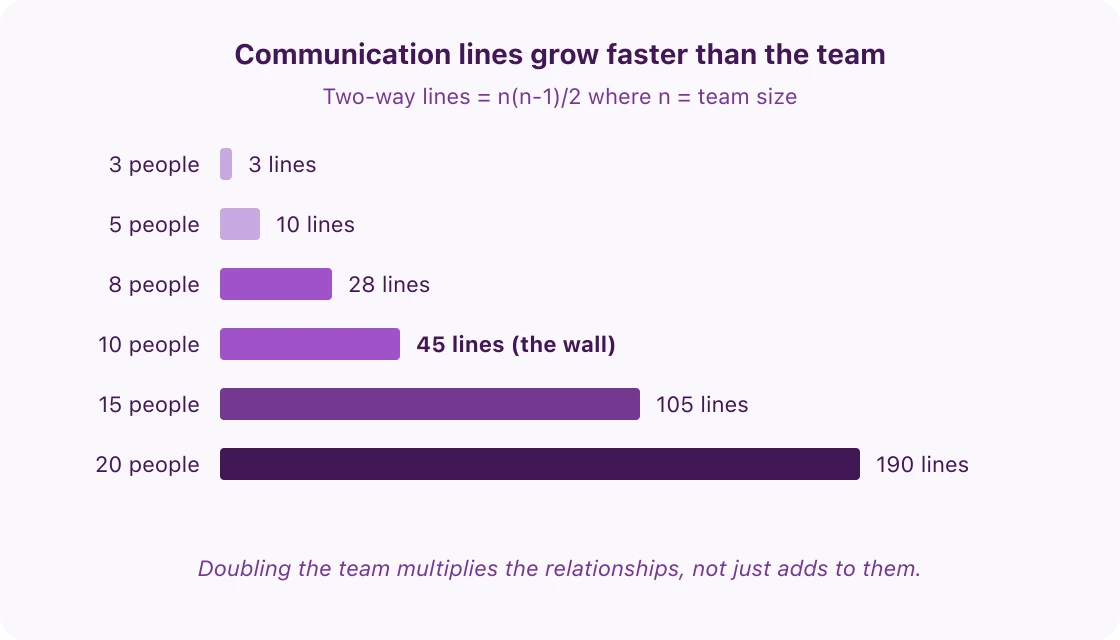
The breakdown is not about competence or trust. It is physics. With 45 possible conversations to track, no single person, including the founder, can hold the full picture in their head. Information starts living in the gaps between people. Updates get missed because everyone assumes someone else flagged the issue. Work gets duplicated because the two people doing it have not spoken in three days.
Anthropologist Robin Dunbar’s research on group size, originally published in 1992 in Behavioral and Brain Sciences, found that humans can maintain roughly 5 close working relationships, 15 close-ish ones, and 50 acquaintances (Dunbar, 1992). A 10-person team already exceeds the close-relationship limit for most of its members. By 15, it has crossed into the second tier. The team feels different at 15 than at 8 because it is operating at a different cognitive scale.
I have seen this play out in advisory work across software startups and small service businesses. One founder I worked with had 12 people and was confident the team was aligned. We sat in on a planning meeting and found two people who had been blocked on the same vendor dependency for nine days. Neither had raised it because both assumed the other would. Another small business owner I advised, running a 14-person agency, had a designer building screens for a campaign the founder had killed in a side conversation with the account lead two weeks earlier.
These are not failures of effort. They are predictable outputs of a system that has not been updated to match the team size.
What Works for a Team of 5 to 8 People?
From 5 to 8 people, there are between 10 and 28 two-way lines to track. At this size, a Google Sheet with four columns (Owner, Task, Status, Blockers) is enough operational system. The goal is not project management. It is avoiding surprises.
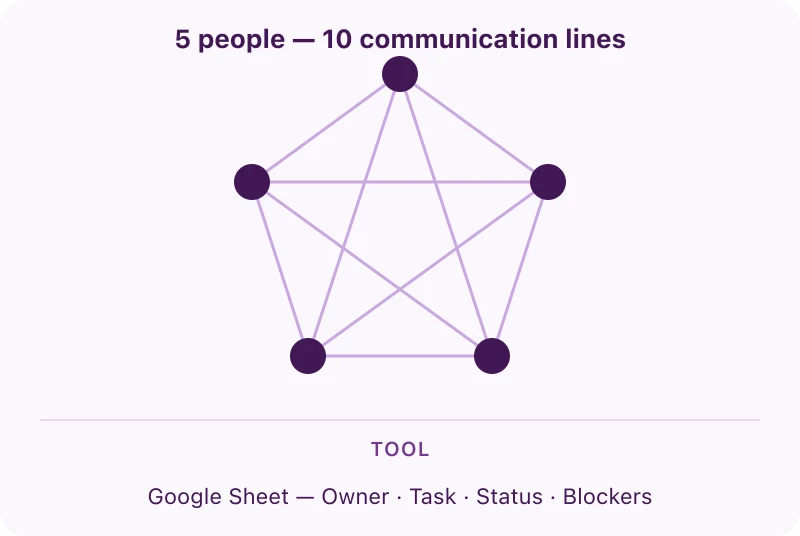
Keep it to one row per task. If updating it takes more than ten seconds, people stop doing it within a week. The discipline matters more than the format.
The sheet works because at this size, alignment is still mostly informal. People still talk to each other naturally. The sheet is a backstop while conversation is still the primary channel.
Two columns matter more than the others. The Owner column eliminates the “I thought you were doing it” failure mode. The Blockers column gives people a structured way to flag when they are stuck without having to write an email or schedule a meeting.
When this stops working: when you have to scroll to find someone’s tasks, or when the Status column is more than two days stale on most rows, or when Blockers stays empty for a week even though you know things are stuck. Those signals mean the team has outgrown the sheet. Do not patch it with more columns. Move to Stage 2.
How Do You Keep 8 to 15 People Aligned Without All-Hands Meetings?
From 8 to 15 people, the team has between 28 and 105 two-way lines. The Stage 1 sheet starts to fail because no one reads everyone else’s rows anymore. The fix is a weekly snapshot: one Slack message or one slide per function, posted on the same day each week, with three bullets covering what got done, what is in progress, and what is blocked.
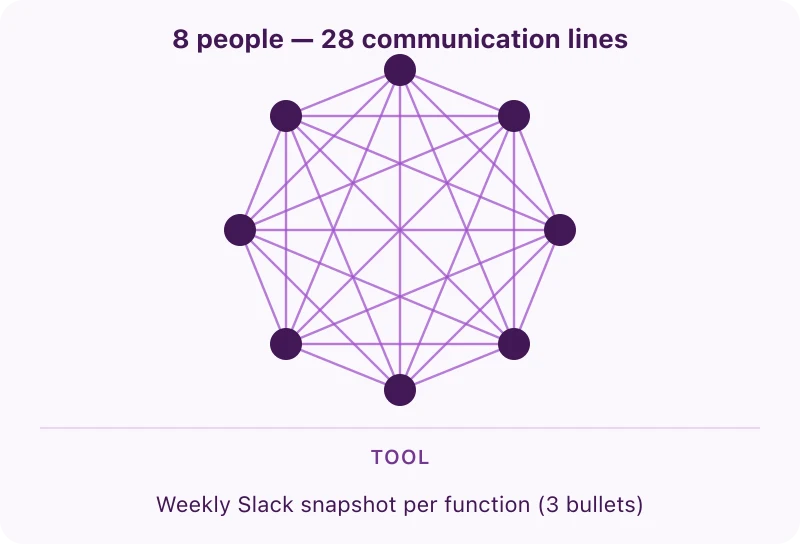
The snapshot replaces the all-hands status meeting that nobody actually wants. Done well, it takes 10 minutes per function to write and 5 minutes per reader to scan. Total cost across a 12-person team is around two hours per week, which is less than one badly run all-hands.
The snapshot has two audiences. The founder uses it to spot drift across functions before it compounds. Everyone else uses it to build shared context without having to read each other’s tools. This is the same operational discipline that makes a GTM sprint work, where weekly visibility on what is being tested and what is being learned is the entire point.
The snapshot is also the cheapest way to surface bad news early. Founders who skip this stage usually find out about problems from quitting employees rather than from the team that is still trying to fix them. The snapshot is permission to flag things going wrong before they become someone’s resignation reason.
When this stops working: the snapshot becomes too long to read in five minutes, or the Blockers section stays consistently empty even though you know things are stuck. Either signal means you are at Stage 3.
Stage 3: The Owner Model (15 to 25 People)
From 15 to 25 people, the team has between 105 and 300 two-way lines. No single person can hold that picture, and any founder who has been running the snapshot themselves since Stage 2 is already overdue to hand it off. Stage 3 introduces ownership: one named person per function or major project, responsible for keeping their section of the snapshot current and flagging blockers early.
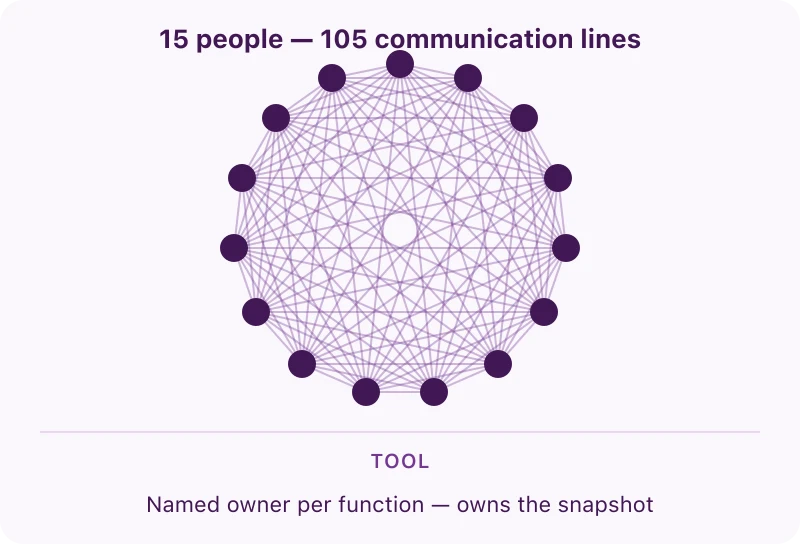
This is the delegation inflection point most founders resist. You stop asking everyone for updates and start asking one person who owns the outcome. You also stop reviewing every deliverable, which feels like losing control because it is.
The owner is not a manager. Their job is visibility into the function: a clear weekly summary plus blockers raised before they bite. If they cannot do that within the first two weeks, the issue is usually that they were given the title without the authority to actually own the work.
Only one in two employees globally say they know what is expected of them at work. When Stage 3 works, it is because the owner knows what success looks like in their function, not just what tasks they are doing. Gallup’s Q12 research found that organisations which move this ratio from 50% to 80% see 10% higher productivity and 22% lower turnover (Gallup).
I have advised companies that resisted this stage for over a year because the founder wanted to stay in every decision. The pattern repeats. The team grows to 22 or 25, output drops, the best people start leaving because they are blocked on the founder’s calendar, and the founder concludes the team is the problem. The team is not the problem. Stage 3 is overdue.
When this stops working: owners start needing their own sub-systems to track what is happening inside their function. That is Stage 4.
When Should a Startup Adopt a Project Management Tool?
Past 25 people, you have at least 300 two-way communication lines and roughly 5 to 8 functions to coordinate. Sheets and snapshots break under the volume. This is when a tool starts paying for itself. The choice of tool matters less than how it is configured.
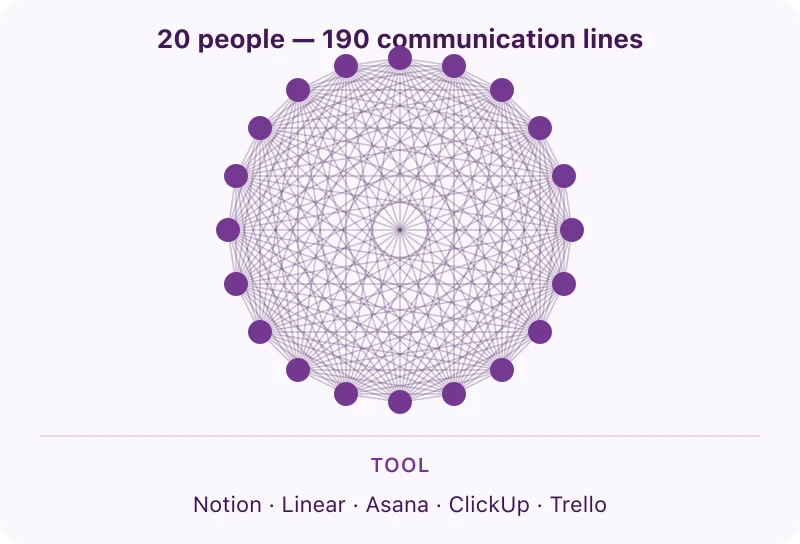
Notion, Linear, Asana, ClickUp, Trello: pick one the team will actually use. The discipline is what generates the value, not the tool.
Most founders who finally adopt a tool at this stage configure it as if they have 250 people. Two views are enough at the start: “what I am working on this week” and “what is blocked across the company.” If you cannot run the company off those two views, adding more views will not save you.
Set the tool up to make the same things visible that worked at Stage 2: who owns what, what is in progress, what is blocked, what is done. Ignore every other feature for the first three months. When the team has the discipline of actually using those four fields, then add roadmaps and dependencies and dashboards, not before.
The mistake at this stage is mistaking the tool for the system. A team that struggled to update a spreadsheet will struggle harder with Linear, because Linear has more to update. Operational clarity is a habit. Tools amplify whatever habit is in place. If you are constantly chasing updates, the tool will not fix that. The problem is in the team, not the system. Stay at Stage 3 until ownership is real.
This is also where the conversation about visibility starts to overlap with the conversation about data. Once you have ownership and a tool, you can start running the company on shared metrics rather than gut feel. That shift is covered in building a data-driven startup culture, which picks up where this article leaves off. Both are part of the Startups & Scaling series for operators navigating the 10 to 50 headcount stage.
If you are building past 50 people and want a comprehensive operating framework for that next stage, Verne Harnish’s Scaling Up is the playbook most operators use for that transition — covering strategy, execution, people, and cash as a connected system.
Which Stage Matches Your Team Right Now?
The 10-person wall is predictable, and the fix is incremental. Most startup growing pains at this size are not about the team. They are about the system failing to keep up with the math.
The four stages, side by side:
| Team size | Stage | Communication lines | What to use | When to move on |
|---|---|---|---|---|
| 5 to 8 | Stage 1: Shared Sheet | 10 to 28 | Google Sheet (Owner, Task, Status, Blockers) | Status more than 2 days stale on most rows |
| 8 to 15 | Stage 2: Weekly Snapshot | 28 to 105 | One Slack message per function, weekly | Snapshot takes more than 5 minutes to read |
| 15 to 25 | Stage 3: Owner Model | 105 to 300 | Named owner per function, owns the snapshot | Owners need their own sub-systems |
| 25+ | Stage 4: Lightweight Tooling | 300+ | Notion, Linear, Asana, ClickUp, or Trello | The tool becomes the bottleneck, not the help |
Match the system to the team you have today, and add the next stage when the current one stops working, not before.
Asana’s Anatomy of Work Index, surveying over 10,000 knowledge workers globally, found that the average worker now spends 60% of their time on “work about work” (coordination, status hunts, app switching, chasing updates) rather than the skilled work they were hired to do. The same study put time lost to duplicative work alone at 209 hours per worker per year (Asana, 2026). At 5 people, that overhead is invisible. By 15, it is the bottleneck. The 10-person wall is what that overhead looks like before anyone has put a name on it.
At 5 people, build the sheet. By 12, add the snapshot. Around 20, name owners. If you are at 25 and still patching together a fraying snapshot, you are overdue for a tool. The cost of moving to the next stage early is small. The cost of moving late is usually the part of your team that quits because the chaos has become theirs to absorb.
Operational clarity is what makes the rest of the company possible: better hiring, better delegation, decisions made closer to the work. Without it, every other improvement compounds slower than it should.
Get more operator playbooks like this. Join the newsletter for weekly notes on scaling startups, agencies, and small businesses across Southeast Asia.
Frequently Asked Questions
What is the 10-person wall?
The 10-person wall is the predictable breakdown in operational alignment that companies hit between 7 and 12 employees. It happens because the number of two-way communication lines on a team grows with the formula n(n-1)/2, which means a 10-person team has 45 lines to coordinate, up from 3 at three people. The fix is a stage-based system, not more meetings.
How many communication channels does a team of 10 have?
A team of 10 people has 45 distinct two-way communication channels, calculated using the formula n(n-1)/2. By comparison, a team of 5 has 10 channels and a team of 20 has 190. The non-linear growth is the structural reason teams hit a wall at around 10 people: each new hire adds more relationships than the previous hire did.
When should a startup or small business add operational structure?
Before you need it, which is usually at 7 to 10 people. The signs are subtle: a project blocked for two weeks that nobody flagged, two people doing duplicate work, or a founder or owner who has not spoken to a team member in five days. Start with the simplest system, a shared sheet, and add structure only when the current stage breaks.
What breaks when a startup team grows past 10 people?
Communication. At three people, you have three two-way lines. By ten, that grows to 45, and by twenty, 190. Updates get missed, work duplicates, blockers go unreported because everyone assumes someone else raised them. The fix is one weekly snapshot per function, not more meetings.
How do you maintain team alignment without slowing down?
Match the system to the team size. A 5-person team needs a shared sheet, not a project management tool. A 15-person team needs function owners reporting weekly, not an all-hands status meeting. Over-indexing on process is as costly as under-indexing. Add the minimum structure needed to avoid surprises, and nothing more.
How do you scale up a team effectively?
Match the operating system to the team size at every stage. From 5 to 8 people, a shared sheet covering owner, task, status, and blockers is enough. From 8 to 15, switch to a weekly snapshot per function. From 15 to 25, name a single owner per function to maintain the snapshot. Past 25, move to a lightweight tool such as Notion, Linear, or Asana. Each transition adds the minimum structure for the next size.
Do startups need project management tools from day one?
No. Tools become useful around 25 people, when sheets and manual processes break under their own weight. Before that, a Google Sheet and a weekly Slack message cover 90 percent of what is needed. The discipline of updating matters more than the tool. Most teams adopting a tool at 25 people configure it as if they have 250, which is the real failure mode at that stage.
I advise founders and small business owners across Southeast Asia on operational clarity: the systems and habits that keep 10-to-50-person teams from breaking under their own weight. If you are hitting the wall, let’s talk.
More on building operational foundations: Startups & Scaling | Once you have clarity on who owns what, building a data-driven startup culture covers how to run your team on shared metrics rather than gut feel.