


Startups are easy to romanticise from a distance. The founder stories, the fundraising announcements, the “we 10x’d in 12 months” posts. Up close, the reality is messier. Decisions made with incomplete information, trade-offs where every option has real downsides, and the constant tension between moving fast and building something that holds together.
I co-founded 2Stallions in 2012. We grew from a small digital marketing outfit in Singapore to a remote-first agency with 40+ people across Singapore, Malaysia, Indonesia, and India, serving clients like RedBull, Raffles Hotel, and Epson. More recently, I launched ChutneyAds, Bangladesh’s first AI-powered digital out-of-home ad network. Beyond my own companies, I have worked with 30+ startups across Southeast Asia and South Asia through angel investing, CG Ventures, and mentoring at Accelerating Asia and Plug and Play APAC.
This page is where I collect my thinking on what it takes to start, run, and scale a company. Not a step-by-step guide. The articles linked below go deeper on specific topics. This page is the operating philosophy underneath.
Growth and Scale Are Not the Same Thing
Most founders use “growth” and “scale” interchangeably. They are fundamentally different.
Growth means your revenue is increasing. You add salespeople, spend more on ads, expand into new markets. Revenue goes up, but costs often go up at the same rate. You are getting bigger, not more efficient.
Scale means your revenue is increasing faster than your costs. You have built systems and processes that let each additional dollar of revenue cost less than the last. A startup that grows from $1M to $5M by going from 10 people to 50 has grown. One that does it going from 10 to 20 has scaled.
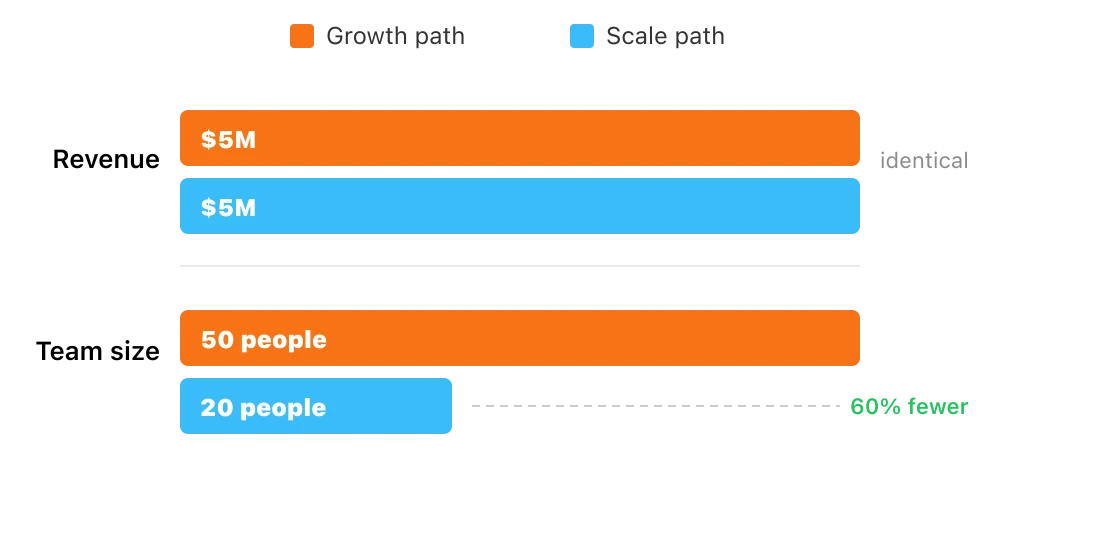
The distinction matters because most of the advice founders hear is about growth. Hire more. Spend more. Expand faster. The harder, more valuable work is figuring out how to increase output without a proportional increase in resources. At 2Stallions, the inflection points were never the big client wins. They were the moments we built systems that let us onboard clients faster, manage a multi-country team, and deliver quality without everything flowing through me.
Prove It Works Before You Pour Fuel on It
Premature scaling kills more startups than bad ideas. Startup Genome’s research found that startups scaling too early grow roughly 20 times slower than those that get the timing right (Startup Genome, 2011). I have watched this pattern play out dozens of times across the startups I advise.
Product-market fit is not “people like our product.” It is “people consistently pay, retain over time, and refer others.” If your churn is high or your NPS is mediocre, fix the product before you scale distribution. Scaling a leaky bucket just means you lose water faster.
The signals I look for: revenue that is consistent enough to roughly predict. Unit economics that work, with LTV at least 3x CAC. A repeatable acquisition process that does not depend entirely on the founder’s network. Customers who stay. If those signals are not there, the job is still to find product-market fit, not to scale.
One of the biggest lessons from ChutneyAds has been patience. We could have rushed to deploy thousands of screens immediately, but proving the model worked at 200 first mattered more than speed. With the startups I advise, I push back on the instinct to accelerate. Getting the sequence right is almost always more important than getting the speed right.
Go-to-Market Is Not a Deck
Your go-to-market strategy is the operational plan connecting your product to the people who need it. Most GTM strategies fail not because they are wrong, but because they are too vague to execute.
“SMEs in Southeast Asia” is not a target market. “Series A B2B SaaS companies in Singapore with 20-100 employees who spend $10K+ per month on digital advertising” is. The tighter the definition, the sharper the messaging, the lower the acquisition cost. I see founders skip this and jump straight to tactics. That is how you end up with expensive campaigns that generate clicks but nothing else.
If you’re sizing the wider AI-savvy small-business segment in the region, my APAC AI Adoption 2026 survey of founders and business leaders across 15 markets is a useful reference point — it covers who is using AI, what they spend, and what they get back, broken out by country and company size.
Positioning comes before channels. Why should your target customer choose you over every alternative, including doing nothing? If you cannot answer that in one sentence, you are not ready to spend on distribution.
Channel selection should follow evidence, not what competitors are doing. Start with one or two channels where you have traction or a clear hypothesis. Run focused experiments. Double down on what works. Most startups try five channels at once and do none of them well enough to learn anything. I wrote more about how I think about channel selection and marketing systems on the Marketing & Growth page.
Pricing is part of GTM, not an afterthought. I have seen startups leave enormous revenue on the table from underpricing. Others priced themselves out by anchoring to what they thought the product was worth rather than what the market would bear.
If your GTM plan does not fit on one page (target customer, positioning, primary and secondary channels, key metrics, pricing model, 90-day timeline), it is probably too complicated for anyone to follow.
Build the Boring Stuff Early
Operations is where most founders lose interest and most companies get stuck. The exciting parts of running a startup are product, customer conversations, and closing deals. The unglamorous part is building the systems that let all of that happen without the founder in the middle of every decision.
At 2Stallions, the transition from 5 people to 15 was rough. What worked at 5 (everything in the founder’s head, decisions made on the fly, processes that lived in Slack threads) broke completely at 15. Client onboarding took too long. Quality was inconsistent. New hires took months to become productive because so much knowledge was tacit.
The fix was SOPs. Not a 200-page operations manual. Simple, documented processes for the things we did repeatedly: how to onboard a new client, how to scope a project, how to run a weekly review, how to escalate a problem. Each one a page or less. The resistance from the team was predictable. “We’re a startup, not a corporation.” In practice, documentation did the opposite of slowing us down. It freed people to make decisions without asking the founder. New hires got productive in weeks instead of months.
The pattern across the companies I advise is the same. Founders resist documenting processes because it feels premature or corporate. Then they wonder why every new hire needs three months of hand-holding, why quality is inconsistent, why they cannot take a week off without everything stalling. The answer is almost always: the knowledge is in people’s heads instead of on paper.
You do not need perfect processes. You need written-down ones that the team can iterate on. Version one is always rough. That is fine. A rough SOP that exists beats a perfect one that lives only in the founder’s imagination.
What to document first
Start with whatever you do more than twice a week and whatever a new hire would need to know. For most startups at the 10-20 person stage, that means: client or customer onboarding, sales qualification criteria, weekly team meeting format, incident and escalation handling, and how you make hiring decisions. Everything else can wait.
Why Does Every Startup Need an Operating Cadence?
SOPs cover how you do things. An operating cadence covers when you review, decide, and adjust. Without it, everything feels urgent, priorities shift weekly, and teams burn out.
The rhythms I use and recommend: async daily check-ins or a 15-minute standup focused on blockers, not status updates. A weekly team meeting of 45-60 minutes reviewing progress against goals and making decisions. A monthly company-wide KPI review with a retrospective on what is and is not working. Quarterly strategic planning with three to five objectives and measurable key results.
The cadence only works if teams are making decisions based on real numbers. I am not talking about sophisticated analytics. I mean the habit of asking “what did last week’s numbers tell you?” in every meeting, and answering with data rather than instinct.
Make Decisions From Numbers, Not Instinct
Data-driven decision making at the startup level does not require a data team or expensive tooling. It requires a habit. Every team should be able to answer “how do we know this is working?” with a specific metric rather than a feeling.
At 2Stallions, the shift happened when we changed our weekly standup question from “what are you working on?” to “what did last week’s numbers tell you?” That single change mattered more than any analytics platform. It forced people to look at their numbers before the meeting. It made data part of the rhythm, not an afterthought.
The progression follows a predictable arc. At 1 to 10 people, the founder’s gut works because they see everything. At 10 to 25, decisions start happening without the founder in the room, and quality drops unless you give teams a number to own. At 25+, you need shared definitions so “conversion rate” means the same thing to everyone.
Most startups over-invest in dashboards and under-invest in the habit of actually looking at them. I wrote about this in detail: How to Build a Data-Driven Culture When You’re Still Figuring Things Out.
How Does the Founder’s Role Change?
The skills that got you from 0 to 10 will not get you from 10 to 50. This is one of the hardest transitions in building a company, and the founders I work with consistently underestimate it.
In the early days, you are the doer. Writing code, closing deals, designing landing pages, answering support tickets. Your value is in execution. As you scale, your job shifts from doing to enabling: setting direction, building the team, removing obstacles. The founders who struggle with this transition are usually the ones who were exceptional individual contributors. The very thing that made them successful early on becomes a bottleneck.
Delegation is the skill that matters most, and the one founders resist longest. Not “hand off tasks and check constantly” delegation. Ownership of an outcome, with trust that the person will figure out how. When I was scaling 2Stallions, learning to delegate outcomes rather than tasks was one of the hardest shifts I made. I kept catching myself specifying exactly how something should be done, which defeated the purpose of hiring capable people.
Communication becomes a bigger part of the job than most founders expect. At 5 people, everyone knows what is happening. At 50, information does not flow naturally. You need to over-communicate vision, strategy, and priorities. If you are not bored of repeating yourself, you probably have not said it enough.
For more on decision-making frameworks and governance as organisations scale, see: Leadership & Governance.
What Are the Most Common Scaling Mistakes?
Having worked with 30+ startups, these are the mistakes I see most often. None are mistakes of ambition. Most are mistakes of timing or sequencing.
Scaling before the product works. Founders get excited by early traction and spend aggressively on growth. If the product does not retain users, scaling just accelerates the loss.
Hiring ahead of revenue. Building a team based on projections that never materialise. The result is layoffs, destroyed morale, and lost momentum. Tie headcount to revenue milestones, not investor pitch forecasts.
Ignoring unit economics. Chasing topline growth while losing money on every customer. CB Insights found that running out of cash is the second most common reason startups fail (CB Insights, 2021). Know your CAC, LTV, and gross margins. Not roughly. Cold.
Founder bottleneck. Every decision flows through one person. Natural at 5 people, fatal at 50. Build a leadership layer, document how decisions get made, and push authority down to the people closest to the work.
No documented processes. The startup grows from 5 to 30 with everything in the founder’s head. Onboarding is chaos. Quality is inconsistent. The founder wonders why they cannot step away for a week. The answer is always the same: nothing is written down.
Over-investing in acquisition, under-investing in retention. Bain & Company found that increasing customer retention by just 5% can increase profits by 25-95% (Bain/HBR, 2014). Many of the startups I advise discover their biggest growth lever is reducing churn, not a new acquisition channel.
Confusing fundraising with progress. Raising a round is a financing event, not a milestone. The milestones that matter are product launches, revenue targets, and customer retention.
Building for the wrong market. Common in Southeast Asia, where founders build for markets they aspire to rather than the one they are in. Pick one market. Dominate it. Then expand.
Frequently Asked Questions
What does scaling a startup actually mean?
Scaling means increasing revenue without a proportional increase in costs. Unlike simple growth where revenue and expenses rise together, scaling builds systems and processes that let each additional dollar of revenue cost less than the last. Your margins improve as volume increases.
When is a startup ready to scale?
When you have confirmed product-market fit through consistent retention and repeatable sales, unit economics that work (LTV at least 3x CAC), and enough operational stability that adding customers will not break the team. Research from Startup Genome shows premature scaling is the number one cause of startup failure.
What is product-market fit and how do you know you have it?
Product-market fit means customers consistently pay, retain over time, and refer others. Quantitative signals include low churn, NPS above 40, and LTV:CAC ratio above 3:1. Sean Ellis's benchmark is that 40% or more of surveyed users would be "very disappointed" without your product. If acquisition costs are sustainable and retention is strong without heavy intervention, you likely have it.
Why do startups need SOPs?
Without documented processes, knowledge lives in people's heads. That means every new hire needs months of hand-holding, quality is inconsistent, and the founder cannot step away without things stalling. Simple SOPs for repeated tasks like client onboarding, project scoping, and weekly reviews let teams make decisions independently and new hires become productive faster.
What is data-driven decision making for startups?
At the startup level, it means every team can answer "how do we know this is working?" with a specific metric rather than intuition. Start with one number per team, reviewed weekly. You do not need a data team or complex analytics. You need the habit of checking real numbers before making calls.
How should a founder's role change as the company scales?
The founder shifts from doer to enabler. In the early days, you write code, close deals, and answer support tickets. As you scale, your job becomes setting direction, building the team, and removing obstacles. The hardest transition is delegation: giving someone ownership of an outcome and trusting them to figure out how, rather than specifying every step.
What are the biggest mistakes startups make when scaling?
The most common are scaling before product-market fit, hiring ahead of revenue, ignoring unit economics, creating a founder bottleneck where every decision flows through one person, and neglecting to document processes. Most are not mistakes of ambition but of timing and sequencing.
What should a startup's go-to-market strategy include?
A one-page plan covering target customer definition, positioning statement, primary and secondary channels, key metrics, pricing model, and a 90-day timeline. Start with a tight customer definition, nail your positioning before investing in channels, and test one or two channels before adding more. If your GTM strategy lives in a 50-page deck, nobody will follow it.
I work with founders and scaling teams on the playbooks that compound: GTM strategy, operating cadence, and growth systems. If you are past early traction and the decisions are getting harder, let’s talk. More about how I work with startups: Startup Advisory.