


TL;DR: Generative-AI traffic to U.S. retail grew 693% year-on-year during the 2025 holiday season and a further 393% in Q1 2026, with AI-influenced spend hitting ~$262B globally during the holidays (Adobe, Jan 2026). OpenAI and Google have launched competing commerce protocols, ACP and UCP, to control how AI agents buy on behalf of consumers. Early movers will have a structural advantage.
From Writing Tools to Spending Tools
For two years, the AI conversation in marketing has focused on content: who writes it, how to detect it, whether Google would penalise it. The bigger shift happened in the background, with less fanfare and more money attached.
AI started buying things.
OpenAI and Stripe launched the Agentic Commerce Protocol (ACP) in September 2025, enabling ChatGPT users to browse products and check out without leaving the chat. Three months later, Google announced the Universal Commerce Protocol (UCP) at NRF 2026, backed by Shopify, Target, Visa, and Mastercard (Walmart, initially named, has since wound down its OpenAI checkout pilot — more on that below).
I run 2Stallions across four Southeast Asian markets. Over 14 years I’ve watched channel shifts reshape how businesses find customers.
Search disrupted directories. Social disrupted search. Mobile disrupted desktop. Each time, the early movers captured disproportionate value, and everyone else spent years catching up.
This one is moving faster. Shopify’s Q1 2026 earnings showed AI-driven orders up nearly 13x year-on-year and AI-driven traffic up 8x, with new-buyer orders from AI search arriving at roughly twice the rate of traditional organic. Adobe reported generative-AI traffic to U.S. retail sites up 693% year-on-year during the 2025 holiday season and a further 393% in Q1 2026. Production numbers, not projections.
What Are ACP and UCP?
Gartner predicts AI agents will handle 90% of B2B buying by 2028, over $15 trillion in annual spend (Gartner, 2025). Two competing protocols are positioning to capture that flow.
ACP (Agentic Commerce Protocol) was co-developed by OpenAI and Stripe and released as open-source under Apache 2.0 in September 2025. It powers ChatGPT’s Instant Checkout feature for U.S. users.
Etsy sellers were the first merchants onboarded. Over one million Shopify merchants joined in January 2026, including Glossier, SKIMS, Spanx, and Vuori. By February 2026, ACP expanded beyond checkout-only integrations to add a discovery layer: Target, Sephora, Nordstrom, Lowe’s, Best Buy, The Home Depot, and Wayfair joined the discovery side (OpenAI, Feb 2026), while Stripe added URBN (Anthropologie, Free People, Urban Outfitters), Coach, Kate Spade, Revolve, and Ashley Furniture as launch partners. Instacart became the first grocery integration in December 2025.
PayPal announced support in October 2025. Salesforce followed the same month, bringing commerce customers like L’Oreal, Pandora, and Saks into the ChatGPT checkout ecosystem.
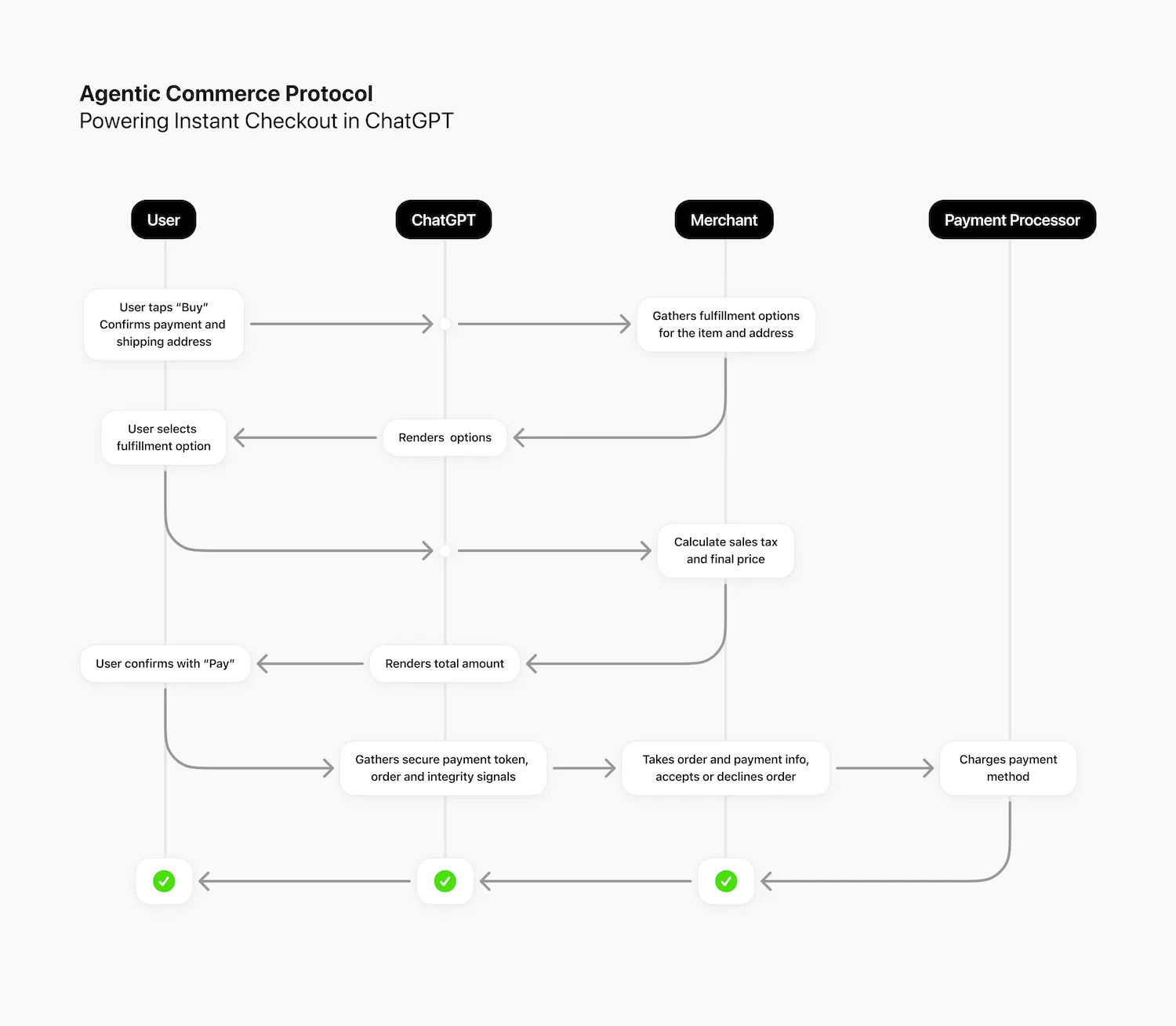 Source: OpenAI Developer Docs
UCP (Universal Commerce Protocol) is Google’s answer. Sundar Pichai announced it at NRF 2026, built in partnership with Shopify, Etsy, Wayfair, Target, and Walmart. Over 20 companies endorsed it at launch, including Visa, Mastercard, American Express, Best Buy, Macy’s, The Home Depot, Flipkart, and Zalando. UCP went live in Merchant Center the same month; in March 2026 Google opened a simplified onboarding flow for retailers of all sizes, and Stripe joined Adyen, Salesforce, and Commerce Inc as confirmed UCP platform implementers — a sign the payment stack is hedging across both protocols.
It currently powers checkout in Google’s AI Mode (within Search) and the Gemini app. Both protocols are open-source, and both want to become the default way AI agents transact with businesses.
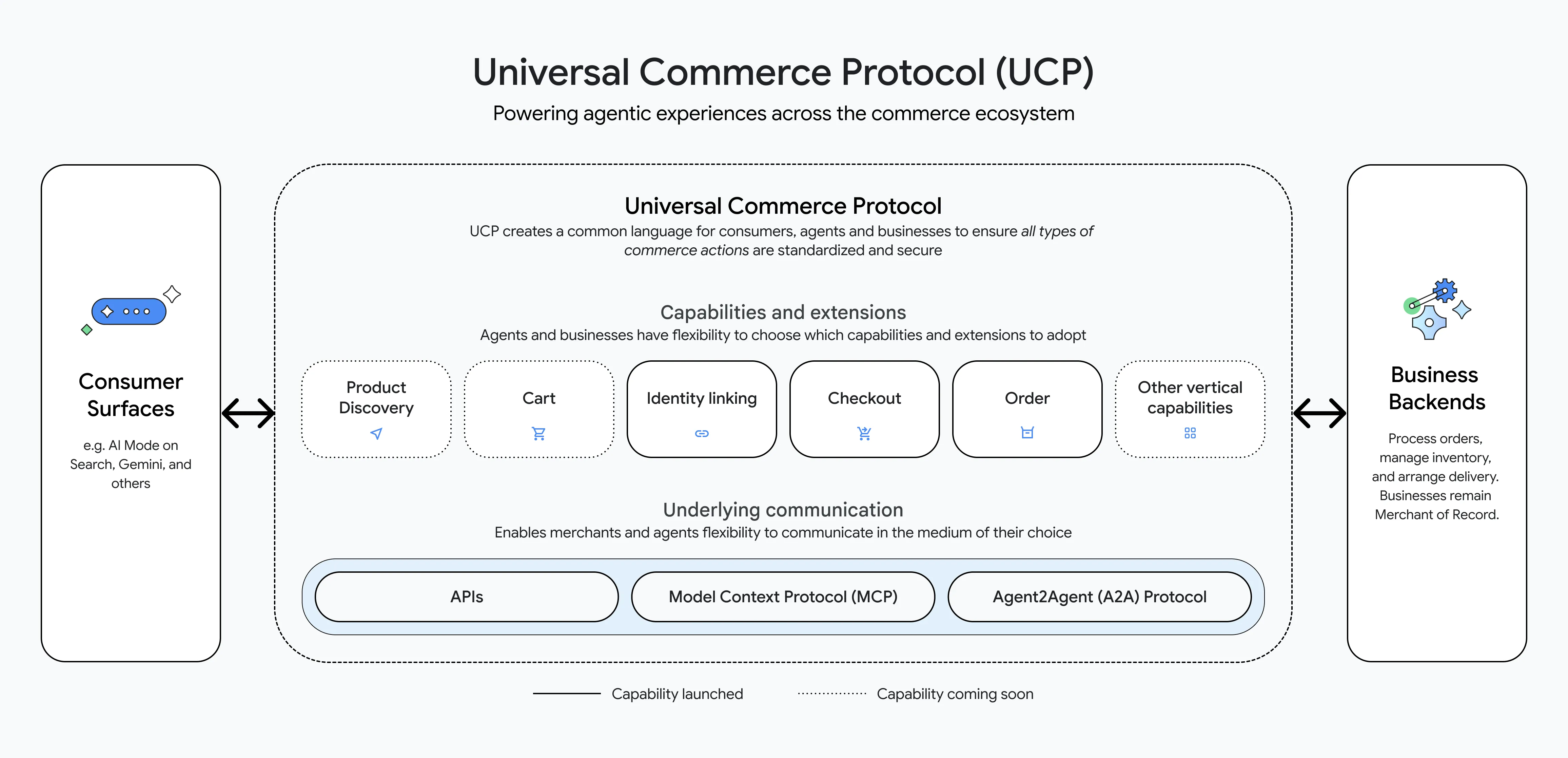 Source: Google Developers Blog
How Do the Two Protocols Compare?
The philosophical split matters more than the technical one. ACP is built around a chat-first model: you ask ChatGPT for a product, it finds one, you buy it without leaving the conversation. UCP covers the full shopping journey from discovery through checkout to post-purchase loyalty, designed to work across Google’s surfaces.
One number that changes the merchant math: OpenAI charges a 4% fee on transactions through ChatGPT’s Instant Checkout, on top of standard Stripe processing fees. Google currently charges nothing for UCP-powered checkout.
For businesses running on thin margins, that cost gap is real.
Discovery works differently too. ACP is centralised: merchants apply to OpenAI to be listed. UCP is decentralised: merchants host a /.well-known/ucp JSON manifest on their own domain, similar to how robots.txt works for search crawlers.
If you’ve watched how Google Merchant Center feeds evolved, the decentralised model should feel familiar.
| ACP (OpenAI + Stripe) | UCP (Google + Partners) | |
|---|---|---|
| Launched | September 2025 | January 2026 |
| Scope | Checkout-focused | Full shopping journey |
| Merchant fee | 4% per transaction | None (currently) |
| Discovery | Centralised (apply to OpenAI) | Decentralised (host manifest on your domain) |
| Payment | Stripe | Google Pay, Wallet, PayPal soon |
| Live on | ChatGPT | Google AI Mode, Gemini |
| Key backers | Stripe, PayPal, Salesforce, Shopify, Etsy, Instacart | Shopify, Target, Visa, Mastercard, Adyen, Stripe, Salesforce, Commerce Inc |
| Session model | Transient (ends with chat) | Persistent (across devices) |
A common misconception: both protocols are often described as “building on MCP” (Model Context Protocol, Anthropic’s standard for AI-tool connectivity). ACP has no MCP dependency. UCP supports MCP as one of several optional transport bindings alongside REST and A2A.
They operate at different layers. Conflating them leads to bad architectural decisions.
What Does AI Commerce Traffic Growth Mean for Brands?
Adobe Digital Insights tracked U.S. retail sites and found generative-AI traffic up 693% year-on-year during the 2025 holiday season — Cyber Monday alone hit 670% — and a further 393% in Q1 2026 (Adobe, Jan 2026). AI agents now influence roughly $262 billion in global online holiday spend, about 20% of the $1.29T total.
The bigger shift is on conversion. The gap that existed in early 2025 has not just closed but reversed: AI-referred visitors now convert 31% MORE often than non-AI traffic, spend 45% more time on site, and produce revenue per visit 254% higher than the prior year (Adobe, Jan 2026). Treating AI commerce as an immature channel is no longer defensible.
What makes the data actionable is the acceleration. Shopify’s Q1 2026 earnings showed AI-driven orders up nearly 13x year-on-year and AI-driven traffic up 8x, with new-buyer orders from AI search arriving at roughly twice the rate of traditional organic. Ahrefs analysed 300,000 keywords and found AI Overviews reduce clicks to the top organic result by 58% (Ahrefs, 2026).
One signal worth watching: Walmart wound down its OpenAI Instant Checkout pilot in early 2026 after accuracy and conversion issues and is instead deploying its own Sparky chatbot inside both ChatGPT and Gemini (Retail Dive, 2026). The lesson: very large retailers may prefer running their own agent rather than ceding the customer relationship to either protocol’s checkout. The payment networks are moving the other way — Mastercard’s Agent Pay completed its first live agentic transaction in September 2025, and Visa Intelligent Commerce now integrates with Anthropic, OpenAI, and Microsoft (American Banker, 2026) — so the rails are real even where merchant strategies diverge.
Consider what the compressed purchase journey means in practice. A customer who asks ChatGPT “find me running shoes under $150 with good arch support” gets recommendations and a checkout button in the same conversation. If your brand is not in the set the agent considers, there is no second chance. There is no retargeting pixel on a chat window.
If your marketing and growth strategy depends entirely on organic search clicks, you’re building on ground that is shifting. The brands positioning well here are structuring product data for AI extraction and testing how they appear in ChatGPT and Gemini shopping results. The same instinct that drove AI engine optimisation applies here, extended to commerce.
Are Consumers Ready to Let AI Buy for Them?
30% of U.S. consumers say they would let an AI agent complete a purchase on their behalf, based on a survey of 1,300 consumers (Contentsquare, 2025). That sounds low until you remember mobile commerce had similar adoption hesitancy in 2010.
IBM and NRF surveyed over 18,000 people across 23 countries and found 45% already turn to AI tools during their buying journeys. 41% use AI to research products and 33% use it to interpret reviews. Adobe’s data shows 38% of consumers have used generative AI for shopping, with 52% planning to.
There is a clear trust gradient. Consumers are comfortable using AI for research and comparison but less willing to hand over the actual transaction.
NielsenIQ found that among Americans who already use AI shopping tools, willingness to delegate purchases jumps to 70-85% across most product categories. The barrier is not resistance. It is unfamiliarity.
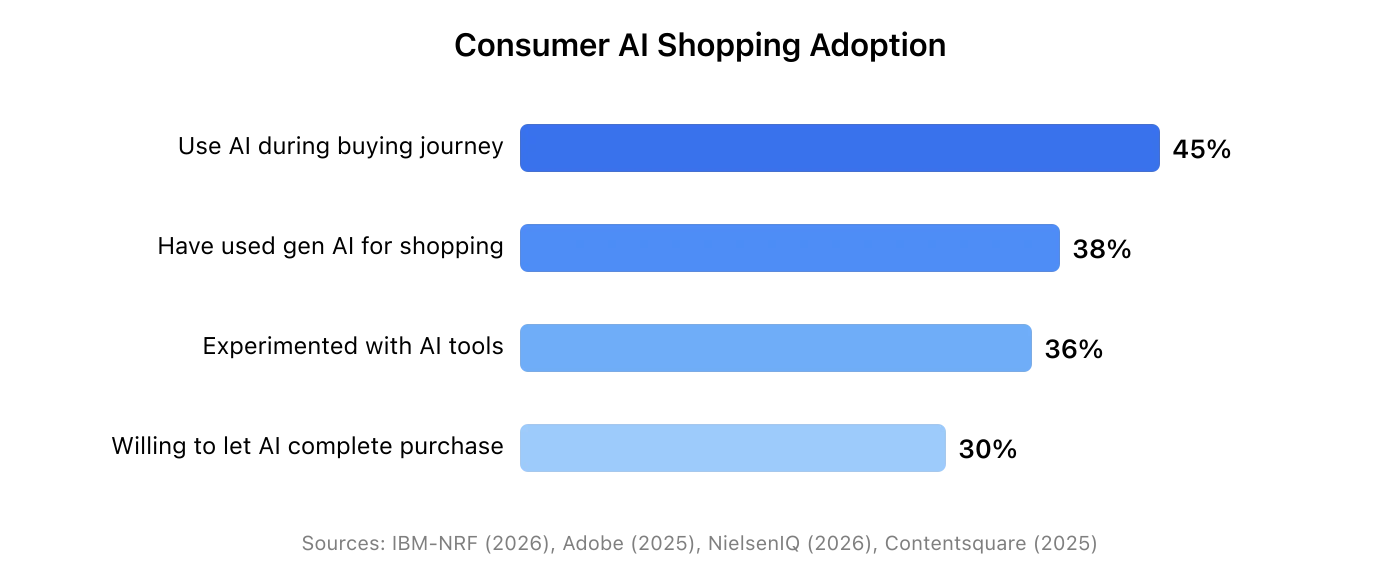
The adoption trajectory is clear. What CMOs need to focus on is making sure their brand is discoverable and ready for transactions when AI-mediated purchasing goes mainstream.
What Should Southeast Asian Businesses Prepare For?
Southeast Asia’s digital economy surpassed $300 billion in GMV in 2025, with e-commerce accounting for $185 billion (Google/Temasek/Bain, 2025). What makes the region particularly relevant for AI commerce is the demand side: consumer interest in AI across SEA is 3x the global average. The supply side matches it — my APAC AI Adoption 2026 survey of founders across 15 markets has 83% using AI regularly and 89% planning to scale further this year, so the brands buyers will encounter in AI-mediated commerce are already operating with AI inside.
75% of Southeast Asian users find AI-powered features like chatbots, image search, and product recommendations helpful for discovery. 30% have already discovered new brands through AI features (Google/Temasek/Bain, 2025). In a mobile-first region where smartphone penetration exceeds desktop usage across all major SEA markets, AI commerce will arrive through mobile interfaces, not desktop.
Google including Flipkart among UCP’s endorsers is a signal worth watching. Flipkart is one of India and Southeast Asia’s largest e-commerce platforms, and its participation gives UCP regional distribution that ACP currently lacks.
I’ve spent 14 years building businesses across this region and advising startups on growth and digital strategy. One pattern holds: mobile-first technologies get adopted here faster than Western markets expect.
When AI shopping tools reach SEA consumers through apps they already use, the adoption curve will be steep. Brands that have structured their product data for AI agent discovery will have a head start.
What Should Marketing Leaders Do Now?
Protocol wars take years to settle. HTTP and HTTPS coexisted for decades. Visa and Mastercard still compete.
Planning around a single winner between ACP and UCP is not realistic. What you can do is prepare for a world where both exist.
-
Product data. AI agents need clean, parsable product feeds with accurate pricing, real-time inventory, and structured descriptions. If your product data lives in JavaScript-rendered pages or PDFs, agents cannot read it. Start with Google Merchant Center feeds and schema markup.
-
AI visibility audit. Search for your key products in ChatGPT and Google’s AI Mode. Note whether your brand appears, which competitors show up, and what the AI says about your products. Do this monthly.
-
Fee modelling. ACP’s 4% could drop as competition heats up, or it could increase once OpenAI has merchant lock-in. UCP is free today, but Google has a history of monetising platforms after they reach scale. Build financial models that account for channel costs that don’t exist yet.
-
Pick your entry point. Shopify merchants likely already surface in both protocols through Shopify’s integrations. If you sell on your own platform, UCP’s decentralised discovery (hosting a manifest on your domain) is the lower-friction starting point. ACP requires an application to OpenAI.
If you want a starting point this week, search for your top three products in ChatGPT and Google’s AI Mode. The results will tell you more about your AI commerce readiness than any strategy deck.
Frequently Asked Questions
What is the Agentic Commerce Protocol (ACP)?
ACP is an open-source protocol co-developed by OpenAI and Stripe that lets AI agents browse products and complete purchases on behalf of users inside ChatGPT. Merchants apply to OpenAI for listing and pay a 4% fee per transaction on top of standard Stripe processing. The protocol launched in September 2025 and currently supports U.S. merchants on Etsy, Shopify, and platforms integrated via PayPal and Salesforce.
What is Google's Universal Commerce Protocol (UCP)?
UCP is Google's open-source answer to ACP, covering the full shopping journey rather than just checkout. Merchants integrate by hosting a JSON manifest file on their own domain, giving them more control over how their products surface in AI results. Google currently charges no merchant fees for UCP transactions, though that may change as the protocol scales.
How does AI commerce change brand discovery?
Traditional SEO focused on ranking in search results where humans browse and click. AI commerce removes the browsing step entirely: an AI agent evaluates your product data, compares it against competitors, and either recommends you or skips you in a single interaction. Brands that lack clean, structured product feeds will be invisible to these agents regardless of their search rankings.
Should businesses support ACP, UCP, or both?
Plan for both but start with one. Shopify merchants get automatic access to both through Shopify's integrations. If you run your own platform, UCP is the lower-friction entry point because it uses a decentralised manifest file you host yourself, while ACP requires an application to OpenAI. Monitor fee structures and merchant terms as both protocols evolve.
Are consumers willing to let AI make purchases for them?
Willingness varies sharply by familiarity. Among consumers who have never used AI shopping tools, adoption interest sits around 30%. Among those who already use them, willingness to delegate actual purchases jumps to 70-85% depending on product category, with electronics, appliances, and furniture seeing the highest openness (NielsenIQ, 2026).
What does AI commerce mean for Southeast Asian businesses?
Southeast Asia's mobile-first consumer base and above-average AI interest make the region likely to adopt AI shopping faster than Western markets. Google's decision to include Flipkart as a UCP endorser points to near-term regional rollout. Businesses selling in SEA should prioritise clean product data feeds and test how their products appear in Google's AI Mode and ChatGPT before competitors do.
I cover how AI is reshaping business models and marketing channels. More on this topic: AI for Business.
If your marketing team is evaluating AI commerce readiness, let’s talk.